Innotrans 2026

Calabria, Sardinia and Sicily are home to the world’s first narrow-gauge hydrogen-powered trains

The 21 trainsets manufactured by the Swiss group Stadler are destined for three operators: the Sardinian Regional Transport Authority (10 trains), the Calabrian Railways (9) and the Ferrovia Circumetnea (two) in Sicily

3' min read

Translated by AI
Versione italiana

3' min read

Translated by AI
Versione italiana

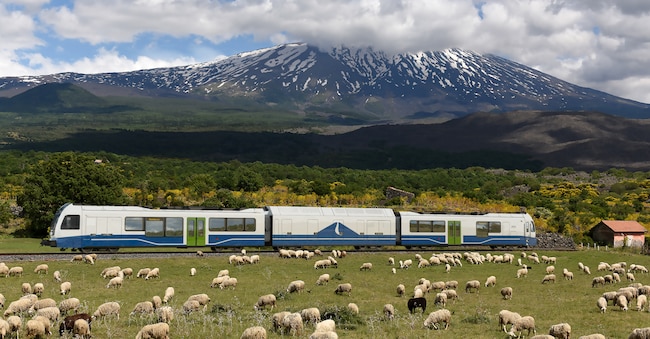
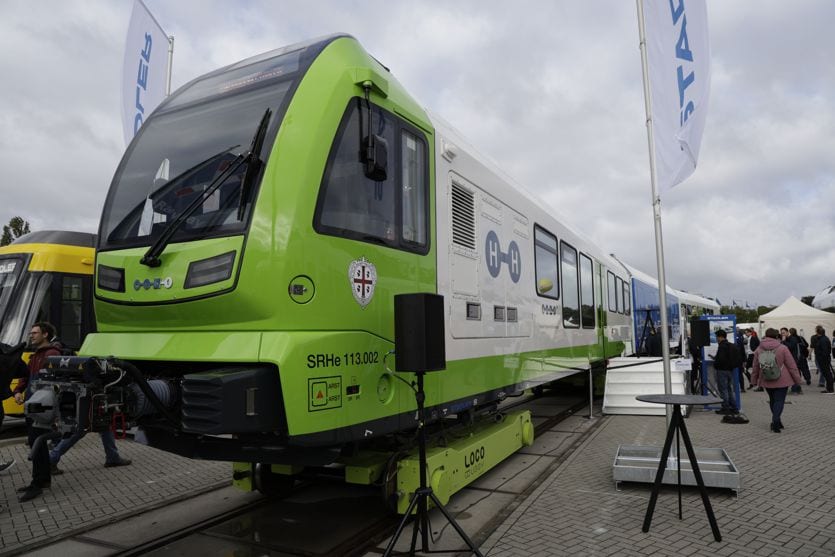
It is the world’s first narrow-gauge hydrogen train and will run on Italian tracks in three regions of southern Italy: Calabria, Sardinia and Sicily. These are lines currently served by old, polluting diesel trains. The Swiss manufacturer Stadler unveiled them at the Innotrans trade fair in Berlin, the world’s most important railway industry exhibition.

Manufactured at Stadler’s headquarters in Bussnang, in eastern Switzerland, the new trains will soon enable zero-emission rail operations. Stadler is currently building a series of 21 new trains for the Sardinian Regional Transport Company (Arst), the Calabrian Railways (FdC) and the Circumetnea Railway (Fce) in Sicily. The first train has been built for ARST in Sardinia, under a framework contract covering the design and development of a total of ten vehicles. Nine trains are also under production for FdC and two for FCE. In future, the trains will be deployed on regional and local services.
Loading...


Over 2,100 tonnes less CO₂

The distinctive feature of the new trains is their environmentally sustainable propulsion system, based on fuel cells and hydrogen tanks installed in the central carriage, which operates in conjunction with the traction batteries. These batteries are recharged using the energy generated by the hydrogen. Thanks to this technology, the trains can run efficiently, environmentally friendly and without interruption on non-electrified lines. For example, compared with the use of diesel vehicles, ten hydrogen-powered trains will save up to 2,100 tonnes of CO₂ per year.

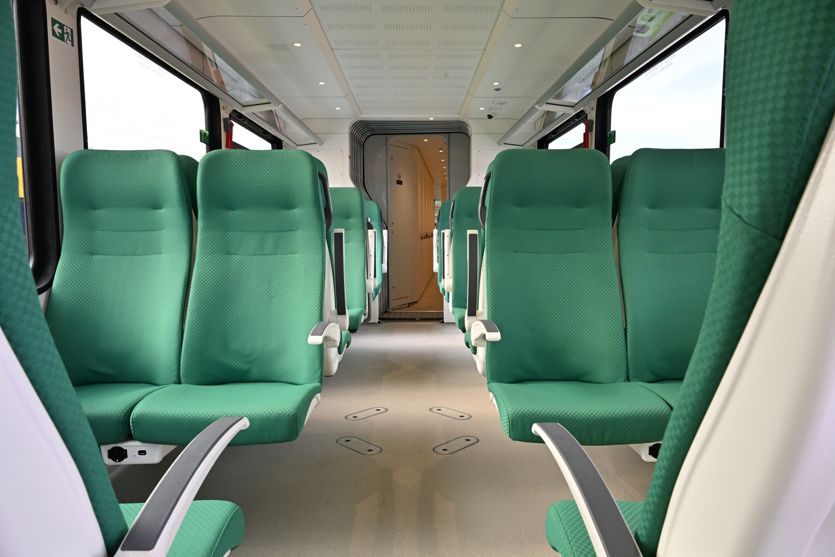
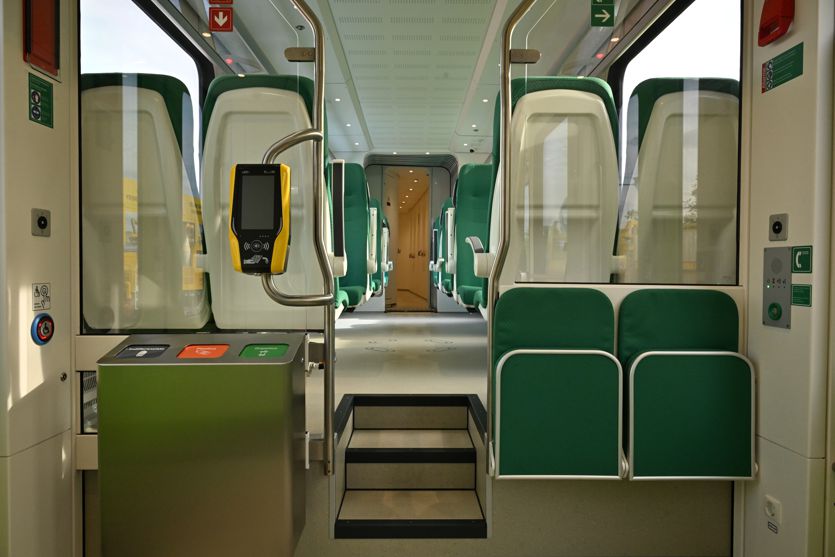
Compared with diesel trains, hydrogen-powered trains are considerably quieter, offering a further tangible benefit for local residents and passengers. Passengers will also be able to enjoy bright interiors and large panoramic windows. The low-floor access allows for easy boarding, even for people with reduced mobility.
 

Hydrogen produced using solar energy

The trains will be fuelled with green hydrogen generated by a network of power stations powered entirely by solar energy. Arst, FdC and Fce are strongly committed to the development of their respective power stations, which are currently under construction.

“These vehicles, developed in collaboration with Stadler, are a key element of the decarbonisation strategy for the narrow-gauge network. We are proud to introduce the world’s first narrow-gauge hydrogen train onto our lines,” explains Carlo Poledrini, Managing Director of Arst. “For our company, this project represents the first step in Arst’s evolution from a transport operator to an energy company.”

Tailored to each region

Each train is specifically designed to meet the needs of different routes and operators: from the coastal stretches of Sardinia to the mountain tunnels of Calabria, right through to the steep gradients that characterise the Etna Nature Park in Sicily.

“Thanks to close collaboration with the Ministry of Transport and the rail operators Arst, FdC and Fce, Stadler has developed a modular solution capable of adapting to the diverse requirements of Italy’s narrow-gauge rail networks. All the trains are based on the same technological platform and combine a compact profile, lightweight mechanical structures and an innovative hydrogen propulsion system,” says Maurizio Oberti, Stadler’s Director of Sales & Marketing for the Italia market.

Loading...

Aristide Vercillo Martino, sole director of FdC, emphasises: “The partnership between Stadler and Ferrovie della Calabria has been continuing successfully for around twenty years. It began with the first vehicle developed specifically for FdC for Italia’s narrow-gauge railways. This long-standing partnership has laid the foundations for the development of a new generation of trains.”

Compared with diesel trains, hydrogen-powered trains are considerably quieter, offering a further tangible benefit for local residents and passengers. Passengers will also enjoy bright interiors and large panoramic windows. The low-floor access allows for easy boarding, even for people with reduced mobility.

“Thanks to the introduction of the new hydrogen-powered trains, we can improve passenger comfort whilst, at the same time, making a tangible contribution to more sustainable transport,” says Salvatore Fiore, Managing Director of FCE.

Copyright reserved ©
Loading...

Brand connect

Loading...

Newsletter

Notizie e approfondimenti sugli avvenimenti politici, economici e finanziari.

Iscriviti