USA

Farmers in California are in crisis: ‘Costs are too high; we can’t keep this up for long’

by Roberta MiragliaCorrespondent in Sacramento (California)Correspondent in Sacramento (California)

Aggiungi Il Sole 24 Ore
ai preferiti su Google
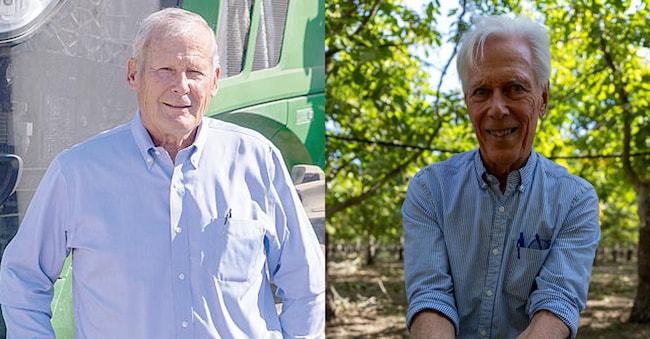
Don Cameron, direttore di Terranova Ranch a Helm; Craig McNamara, proprietario di Sierra Orchards, Winters (credit Nick Roach/Ussa)

5' min read

Translated by AI
Versione italiana

5' min read

Translated by AI
Versione italiana

Four more years to break even. “A local farmer has just told me that his break-even point has shifted from 7 to 11 years,” says Danielle Veenstra, a small-scale almond grower. An almond orchard already takes a long time to turn a profit, but the surge in inflation risks putting even the farmers’ unshakeable perseverance to the test. Under the porch facing the rows of almond trees in Escalon, in California’s vast, flat Central Valley, Veenstra proudly shows off the small business she has set up next to the family farm where she grew up: six hectares in the region that produces 80 per cent of the world’s almonds. As a member of the Almond Board of California, this young descendant of Dutch immigrants echoes the concerns of her colleagues. ‘Fuel prices have reached unprecedented levels,’ she says, but farmers, she sighs, ‘have always found a way to adapt’.

Family farmers in the USSA

Loading...

After all, his priority is sustainability, as it is for the vast majority of family farmers who are members of the USSA (US Sustainability Alliance), which brings together 28 agri-food organisations with an eye on Europe and its sustainability models. Two-thirds of US agricultural exports to the EU and the UK – $13.6 billion – are generated by USSA farmers, with California at the heart of it all. Karen Ross, the State Secretary of Agriculture, highlights California’s leading position in US agricultural production by value: ‘$64 billion by 2025, with 95 per cent of Californian farms being family-run. Sixty per cent are smaller than 40 hectares’. Across the vast expanses of the US, the average farm size is 187 hectares. The Californian economy, the fourth largest in the world, is also an agricultural giant, with the immense Central Valley at its heart – 700 kilometres of countryside stretching as far as the eye can see, punctuated by scattered farming settlements.

Fuel consumption doubled

Further north of the almond groves of Escalon, in Yuba County, Michael Rue started out fifty years ago with pastures and livestock. Over time, he converted the land into rice paddies. Today, rice accounts for 85 per cent of his business in a state that cultivates 200,000 hectares of it annually, almost all of it here in the Sacramento Valley, the northern section of the Central Valley. California ranks second amongst US rice-producing states and has a monopoly on Japonica rice – the medium- and short-grain variety perfect for sushi – which is destined for export. On his ranch overlooking an artificial blue lake, Rue voices his concern about soaring operating costs due to the war in Iran. ‘A load of diesel used to cost $24,000; by August it had risen to $40,000, and I recently paid $52,000 for it.’ He exports around 50 per cent of his production; the Middle East is a key market, with Jordan serving as his gateway. The conflict has driven freight rates up from $800 to $4,000, due to insurance costs. “The impact of these events,” he says, “is becoming significant. Geopolitical turmoil is putting pressure on all producers. Goods are at risk of not reaching the shelves.” And when market share is lost as a result of temporary upheavals, it is not easy to recover.

Water and climate change

Further south, at Terranova Ranch – a 3,260-hectare estate in Helm, in the San Joaquin Valley, the southern part of the Central Valley – Don Cameron has seen 45 years of harvests come and go. To irrigate the estate’s 25 different crops, the manager of this agri-food empire has tackled the water challenge with colossal, pioneering projects, becoming a celebrity in the American agricultural world, drawing on both capital from the company – owned by a Swiss trust – and state public funds. Terranova Ranch relies on groundwater in an area of the valley at serious risk of water scarcity. Cameron has spent decades building artificial canals and pumping stations to capture rainwater that can ‘recharge’ the aquifer; he is tackling the increasingly scorching temperatures that are transforming the crop cycle: ‘We plant tomatoes as early as the end of February to reduce exposure to the extreme heat of the summers.’ But the challenge of such sudden inflation was not on the horizon. ‘Diesel prices are killing us. They’ve risen by around 87 per cent; fertiliser prices by 23 per cent, whilst crop prices had been negotiated before the surge. A tanker load of diesel that used to cost 20–25 thousand dollars now costs us 50 thousand or more. We can’t carry on like this for much longer.’ An equally challenging obstacle is the labour force. ‘We had an open-borders policy,’ Cameron summarises. ‘Now, due to a shortage of workers, many farms will struggle to sow their crops.’

Tariffs lead to a loss of market share

Craig McNamara runs Sierra Orchards, a family business based in Winters in the northern Central Valley. The son of the long-serving Secretary of Defence Robert is a force of nature. The successes achieved through increasingly sustainable farming practices are being undermined by the difficulties created by the government’s decisions. “It wasn’t enough,” he says, “that we were facing recurring trade wars – with their negative impact on walnut and almond exports due to retaliatory tariffs imposed by India, one of our main export markets, in response to the steel and aluminium tariffs imposed by the first Trump administration. The second presidential term is hitting us hard, every single day, and the instability is mounting.” On the estate’s 180 hectares, diversification has become vital, so alongside the walnuts, almonds are now growing, as well as rotational crops. ‘We’ve lost market share, first and foremost in India and then in the Middle East. As farmers, we have a tradition of resilience, yet now I’m losing it.’ Above all, however, global warming looms large. ‘When we talk about climate change, we’re talking about water. Without water, we won’t have to worry about immigration, regulations or harvests any more. It’s game over.’

Wine exports plummet, but the domestic market holds steady

Loading...

Beyond the Vaca Mountains, across the plains of the Central Valley, and even in the renowned Napa Valley – the treasure trove of Californian wines – the renewed tariffs have taken their toll. At the St. Supéry estate, founded in 1982 by French winegrowers and acquired by Chanel in 2015, the prized Sauvignon Blanc and Cabernet Sauvignon are destined primarily for the domestic market, as is all Californian wine, of which only 10–15 per cent of production is exported. By 2025, US wine exports (95 per cent of which come from California) had plummeted by 34.5 per cent. The largest share of the decline came from Canada, which fell from 36 per cent to 12 per cent of total overseas sales. Whilst Donald Trump was threatening to annex the United States’ northern neighbours, Canadian consumers stopped drinking Californian wines.

Copyright reserved ©
Loading...

Brand connect

Loading...

Newsletter

Notizie e approfondimenti sugli avvenimenti politici, economici e finanziari.

Iscriviti