
In defence of a free and virtuous society
'A rich blend of social science and ancient wisdom, Super habits. The Universal System for a Free and Happy Society (Rubbettino, 2026) by Andrew Abela shows how strengthening our virtues leads to well-being'.

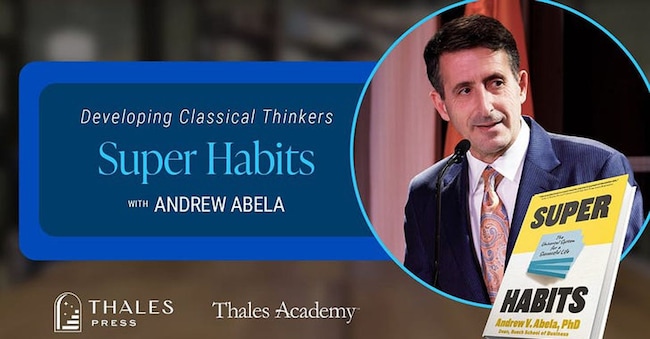
'A rich blend of social science and ancient wisdom, Super habits. The Universal System for a Free and Happy Society (Rubbettino, 2026) by Andrew Abela shows how strengthening our virtues leads to well-being'. These are the words with which Prof. Arthur C. Brooks of Harvard University introduces the new book by Andrew V. Abela, dean and founder of the Busch School of Business at the Catholic University of America in Washington D.C.
Starting from Brooks' words, we intend to highlight some aspects of Abela's book that introduce us to a very interesting cultural debate, which involves the entire civil sphere, meaning by civil the complex system that includes the political, economic and ethical-cultural dimensions.
Abela's reflections represent a valuable contribution to the development of that current of political and economic thought that embraces the principles of the Christian tradition and the modern social doctrine of the Church, in the knowledge that they are valuable nourishment for the health of our liberal democracies and market economies, which today are under siege from increasingly illiberal forms.
Super habits fits into that current of thought that considers moral ecology not secondary to the ecology of the biosphere. An important reference is Michael Novak, the American theologian and political scientist, according to whom liberal democracies can prosper if they hold in high regard the virtues that made them possible.
Following the lesson of Alexis de Tocqueville, the religious dimension represents the first art of the democratic experiment: 'the first of their political institutions'. Well, while the French political scientist analysed the US democratic experiment, comparing it with the French one, Novak adopted the Tocquevillian paradigm, making it universal in space and time. Liberal democracies are born from the idea that human beings are equal, free and responsible, which is why they are called to the difficult art of self-government.

