Unbreathable air

Record pollution in Delhi, 18 times over Milan: pale sunshine and closed schools

The reasons for the collapse in air quality are well known: traffic, coal-fired power plants and, this season, the burning of rice straw

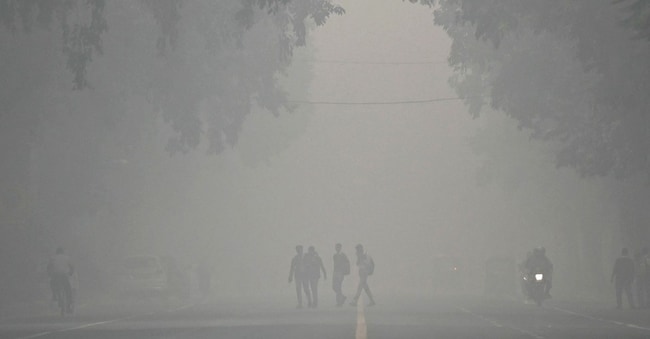
Pedoni avvolti nello smog di Delhi lunedì mattina

4' min read

4' min read

From our correspondent

NEW DELHI - It is not uncommon for visibility on airport runways to be less than optimal this time of year. But this morning the toxic haze that has been shrouding Delhi for days was so thick that it penetrated right into the terminals of Indira Gandhi International.

Loading...

Blame it on the highest concentration of pollutants ever recorded in 2024: at 12.30 p.m. local time, the Air quality index compiled by the Swiss company IQAir read 1,862 points. A frightening figure if we think that exceeding 150 points is considered 'harmful', going above 200 'very harmful', and breaking through 300 'dangerous' to health. This is how this morning New Delhi became - by detachment - the most polluted city on the planet. Seven times more than the second in the ranking - the other big South Asian sufferer, Lahore, in Pakistan - and 18 times more than Milan.

A situation that repeats itself, for the worse, every year, when in November the eyes and throat start to burn, the sun becomes a pale disc and a layer of dangerous fine dust settles everywhere: from the leaves of the trees to the lungs of the 33 million inhabitants of this megalopolis.

This morning in Nehru Nagar, a stone's throw from one of the capital's most exclusive neighbourhoods, more than 1,000 micrograms of pm 2.5, the fine particulate matter that penetrates deep into the lungs and from there into the blood, causing respiratory and circulatory diseases, were suspended in every cubic metre of air. The World Health Organisation (WHO) recommends not exceeding 15 micrograms per cubic metre, 67 times less.

The measures

.

Like every year, after months of ignoring the causes of the problem, politicians are belatedly running for cover. Today, a protocol has been activated, which comes into force with increasing force depending on pollution levels. According to the directives, most schools have been closed, construction sites have been stopped and many of the old trucks that clog the arteries connecting Delhi to the surrounding regions every night have been idle. The elderly and those suffering from respiratory diseases have been advised against venturing out.

Common sense moves, but insufficient and belated, which seem designed above all to give the impression that the problem is being addressed. With the aggravating factor of affecting the most vulnerable strata of the population - the labourers of the homeless paid by the day at the construction sites; the children locked up at home to theoretically do distance learning - without appreciably improving the situation.

India, scuole chiuse e invito a non uscire di casa per inquinamento

Photogallery27 foto

The causes

.

The reasons behind the seasonal collapse of Delhi's air quality are well known. Every autumn, in three states with a strong agricultural vocation bordering the capital - Punjab, Haryana and Uttar Pradesh - the remains of the freshly harvested crops are set on fire.

It is mostly rice, preferred to other crops more suited to the climate and soil of northern India, because it is bought at a guaranteed price by the state. The problem is that in many of the grain-growing areas, water consumption has not been sustainable for years, which is why local governments impose sowing calendars that serve to reduce water consumption, but end up compressing the time, pushing the burning of straw.

A perverse game of incentives, both local and national, that create addiction and remedy one problem, generating another in a chain that never seems to end. In this context, with almost no precipitation, the seasonal drop in temperatures imprisons the fumes and prevents them from dispersing at high altitudes. The wind does the rest, scattering them all over the Indo-Gangetic plain, including Delhi.

Loading...

According to Safar, a government agency, agricultural fires are currently contributing a good 40 per cent of the city's pollution. On Sunday alone, satellites of the Consortium for Research on Agroecosystem Monitoring and Modeling from Space (Creams) detected 1,334 of them in six states of the country.

A political rebus

.

Camp fires are a double curse for Delhi: environmental and political. Environmental, because it is estimated that an average of 80 people die every day in the Indian capital due to air pollution. Political, because by involving administrations other than the city's - such as the local administrations of neighbouring states, as well as the central government - this crisis creates a situation that facilitates the shifting of responsibilities between those who incentivise agricultural fires, those who do not limit car use, and those who do not promote less polluting energy policies than the current ones.

In fact, the problem of unbreathable air is only partly a seasonal one, because peaks such as the one we are experiencing nowadays are added to a picture that is never favourable in itself. The only exception is the monsoon season, when the rains break down the dust generated by vehicular traffic, the many construction sites scattered around the city, dusty, unmaintained roads and the 11 coal-fired power plants that power - and suffocate - the Indian capital.

Copyright reserved ©
Loading...

Brand connect

Loading...

Newsletter

Notizie e approfondimenti sugli avvenimenti politici, economici e finanziari.

Iscriviti