
In Europe, children study up to 14 subjects and 30 hours per week
Between increasingly dense curricula, many subjects and extended timetables, compulsory schooling in several European countries risks turning into a high-pressure system, with effects on learning, student welfare and inequalities between families
by Silvia Martelli (Il Sole 24 Ore), Giota Tessi (Efsyn, Greece) and Ana Somavilla (El Confidencial, Spain)
 Aggiungi Il Sole 24 Ore
ai preferiti su Google
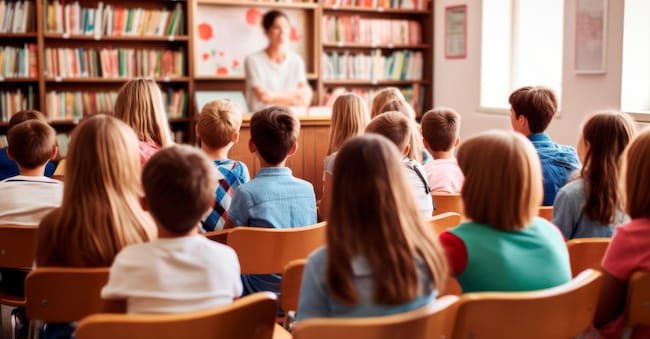
In Europe, primary and secondary schools are increasingly being called upon to fulfil a multiplicity of objectives: to transmit basic knowledge, to develop digital skills, to reinforce foreign languages, to educate on citizenship, sustainability, health and even entrepreneurship. A continuous expansion of functions that, in many countries, has resulted in an increase in the number of subjects and teaching hours already in the lower age groups. The result is a system that, according to parents and experts, runs the risk of turning the school into an educationally intensive one, with high workloads, fragmented curricula and constant pressure on students and families.
A comparison of European education systems shows significant differences, but also a common trend: increasingly dense curricula and a weekly load that is growing rapidly. In Greece, for example, the primary school curriculum includes up to 13-14 compulsory subjects. Besides language, mathematics and science, pupils study history, geography, social and political education, religion, computer science, music, art, physical education and participate in so-called 'skills workshops', introduced in recent years. English is compulsory from the first year of school, while a second foreign language is added in the last two years of primary school. The school timetable reflects this complexity. In the first years we start with around 24 hours per week, which becomes 26 hours in the intermediate classes and increases to 30 hours per week in the last two years of primary school. Lessons last 45 minutes and start early in the morning; this is supplemented by full-time afternoon programmes, which extend the time spent at school into the late afternoon. A structure designed to enrich the educational offer, but which raises questions about the sustainability of the rhythms for six- and seven-year-old children.
The picture is different, but not opposite, in Spain. Here, the organisation of education is highly decentralised and the national curriculum is adapted by the autonomous communities. In primary school, students follow on average between 8 and 10 subjects, with a weekly commitment of between 25 and 30 hours, while in lower secondary school it rises to 30-32 hours. Again, English starts at the age of six, while a second language may be added in later years. The model appears more flexible, but the public debate questions the effects of a high timetable load and how much it really affects educational outcomes.
Italy is in an intermediate position. In primary school there are ten subjects, plus religion (the only optional subject), with English as the compulsory foreign language. The second language becomes compulsory only in secondary school. The school calendar covers approximately 33 weeks a year and the weekly timetable varies according to the autonomy of the individual schools, oscillating between normal-time and full-time models. Here too, however, the multiplication of 'cross-curricular education' and additional projects contributes to a perception of overload.
The central issue is not just the number of hours or subjects, but the resulting educational model. In many European systems, every new social priority - from digital education to environmental sustainability - is incorporated without a comprehensive review of existing curricula. The risk is that of a fragmentation of learning, with school days dense with content but little room for in-depth study, play and consolidation of basic skills.


