Fine balances in the EU Commission

The battle for the places that count in Brussels: Germany-Italy 4:1

The division of command posts in the cabinets once again rewards Germany. Also penalised is France, which has only one seat. Fitto's team

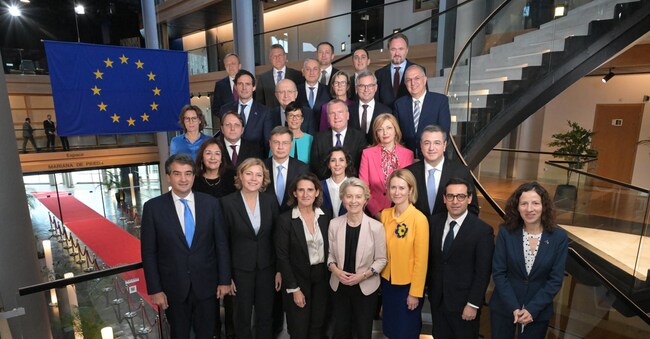
La Commissione Von der Leyen 2

3' min read

3' min read

A member state's ability to influence European Commission decisions depends not only on the weight and personality of the commissioner sent to Brussels, but also on the key positions occupied in the 27 cabinets, from the presidency on down. Ursula von der Leyen has set precise guidelines for the composition of the cabinets, which must be a maximum of nine people of five different nationalities, no more than three of the same nationality as the commissioner, and maintaining gender balance. In this game, the positions that count are those of the heads of cabinet and their deputies. When they are really good, they are much more than an alter ego of the commissioners themselves, capable of guiding them through the complexities of the EU institutional machine, negotiating the different dossiers behind the scenes, steering decisions and fighting when necessary to support the commissioner's policies.

Germany beats Italy and France...

That long introduction having been made, let us come to the point. The 2024-2029 commission teams are almost complete, the result of laborious and complex negotiations between the embassies (the permanent representatives), the party structures, the commissioners-designate themselves, various sponsors and, of course, the stakeholders. Germany, (once again) emerged victorious from this game. Germans, in fact, are four heads of cabinet out of 27, including Bjorn Siebert confirmed at the head of Ursula's team.

Loading...


France and Italy have one each, that of 'their' commissioner, respectively Stéphane Sejourné at Industry and Raffaele Fitto at Cohesion, who are also vice-presidents. It went better for the Netherlands, which got two: that of Dutch Commissioner Wopke Hoekstra (Climate and Clean Growth) and that of Luxembourger Christophe Hansen (Agriculture and Food).


compared to the last parliamentary term, the weight was halved for Italy, which lost one position: in addition to Gentiloni, Stefano Grassi, head of cabinet of the former energy commissioner, the Estonian Kadri Simson, who managed (successfully) the energy crisis from 2022 onwards, was also Italian.

Not all portfolios carry the same weight. The race is on to secure neuralgic positions in the European institutional architecture, in order to ensure that the Member State has an adequate capacity to influence the dossiers that matter.

Who chose to rely on the Germans

.

In addition to von der Leyen of course, the German heads of cabinet were also the Slovakian Maroš Šefčovič (Trade and Economic Security) who chose Bernd Biervert; the Latvian Valdis Dombrovskis who took over from Paolo Gentiloni at Economic Affairs (portfolio renamed Economy and Productivity) and confirmed as team leader Michael Hager; and Ekaterina Zaharieva, Bulgarian Head of Startups and Innovation who chose Andreas Schwarz.

The situation for Italy does not improve if we also look at the 'deputies': only two positions, Francesca Arena with Cypriot Costas Kadis (Fisheries and Oceans) and Pierpaolo Settembri with Greek Tzitzicostas (Sustainable Transport and Tourism), two portfolios that fall under the remit of Vice-President Fitto.
The French deputy heads of cabinet are six, including the presidency's number two, Alexandre Adam, European sherpa of Emmanuel Macron, who arrived in September and is considered the price paid by von der Leyen for the ouster of Thierry Breton. The Italian Valeria Miceli was also confirmed in the presidency cabinet. The French deputies become seven counting also the Franco-German Estelle Göger who will work with Sejourné. Germany has 'made do' with four positions (Industry, Climate, Rights and competences, and Justice and the rule of law).

Fitto's choices

.

Raffaele Fitto's choice for the head of the team fell on Vincenzo Matano, his former trusted parliamentary assistant in Brussels and deputy secretary of the Conservatives and Reformists group (Ecr) to which Fdi belongs: consolidated experience in Parliament but none at the Berlaymont palace, the Commission headquarters. A very demanding challenge given that Fitto is not just a commissioner but one of the six executive vice-presidents. To fill this gap, at least at the beginning, will have to deal with the senior expert Gabriele Giudice, who has been working in the Commission for more than thirty years, deputy director of DG Ecfin where since 2020 he was in charge of the Spanish and Croatian NRPs and before that head of unit for Greece in the years of Grexit and the bailout. The third Italian in Fitto's team is Marco Canaparo currently head of the Department for European Policies and who will be the diplomatic advisor. For the other members of the team selections are underway, including the number two who will almost certainly be a woman, probably an expert in cohesion policy, certainly not Italian.

The road, therefore, appears to be uphill, and the definition of 'great strategic victory' with which the Italian government has defined Raffaele Fitto's executive vice-presidency from here on still remains to be proven.

Ue, Meloni: incarico Fitto conferma ritrovata centralità Italia
Copyright reserved ©
Loading...

Brand connect

Loading...

Newsletter

Notizie e approfondimenti sugli avvenimenti politici, economici e finanziari.

Iscriviti