
A major project by the Zelestra Group in Ferrara: 500 MW of capacity

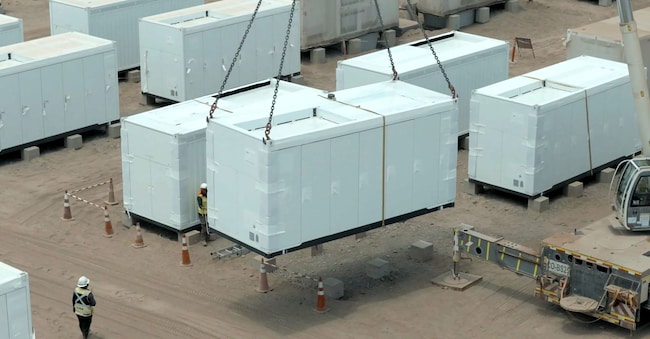
Three large battery units, 300 megawatts of power and four hours of runtime to provide the Italian grid with the flexibility needed to integrate a growing share of renewable energy. Zelestra’s large-scale project is taking shape in the province of Ferrara; it is the largest Bess system authorised to date in Italia and will be realised thanks in part to the agreement signed with EnBW, Germany’s largest integrated utility. The agreement covers a storage capacity of approximately 1.2 gigawatt-hours and will complete a process that began last year, when the go-ahead was given for the first two 200-megawatt batteries. Work in the Ferrara area is expected to begin in 2027, whilst the project is scheduled to come on stream by 2028, tentatively in October. No precise figures have been released regarding the value of the investment, “but the order of magnitude is in the hundreds of millions of euros,” explains Eliano Russo, managing director of Zelestra Italia.
The industrial and financial backbone of the operation is a long-term physical tolling agreement. In practice: Zelestra will build and retain ownership of the battery, whilst EnBW will manage its capacity, deciding when to charge and discharge it and on which markets to sell the energy. In return, Zelestra will receive a fixed payment: a structure that reduces revenue volatility and makes the project easier for banks to finance. “The battery is a smarter asset than a plant that merely produces energy: the point is not just to charge and discharge it, but to understand when to do so and for what service,” explains Russo. EnBW will be able to utilise the facility in the energy and grid services markets, integrating it into a broader portfolio. “For us, the contract allows us to manage volatility and create the conditions to make the project bankable, by combining our equity investment with debt.” In terms of scale, the agreement sets a new record: based on publicly available information, it is the largest physical tolling contract signed to date in continental Europe. It also completes the process begun last year, when Zelestra had contracted out the first two units of the plant, in that case through a financial tolling agreement with the Swiss company BKW. The remaining three units are now covered by the agreement with EnBW.
The choice of Emilia-Romagna is linked to strong industrial demand for electricity and the growing need for flexible capacity. The battery will be standalone, meaning it will not be connected to a specific solar or wind farm: it will draw energy directly from the grid and feed it back in when the system needs it most, contributing to the stability and integration of intermittent sources. “The Italian grid needs flexible capacity, and it needs it on a large scale,” Russo emphasises once again. “If we want to gradually replace thermal power generation with solar and wind power, we must complement renewables with tools capable of modulating their output.” The project will also be eligible to participate in the next capacity market auction: if awarded as new capacity, it would secure a fifteen-year contract.
For Zelestra, which entered the Italia market in 2021 through the acquisition of a local developer, the plant also symbolises rapid growth. Its national portfolio currently stands at around 1.5 gigawatts of solar and battery capacity, and the aim is to double this by the end of the year, reaching 2.8–3 gigawatts. “We will still be a relatively small operator compared to the big names operating in the country,” concludes Russo, “but we are growing very rapidly.”

