Trento Festival of Economics

In geopolitical chaos, flexibility becomes an investment strategy

Global markets. From isolated episodes, shocks have become a structural factor directly impacting inflation, supply chains and public policies

by R.Fi.
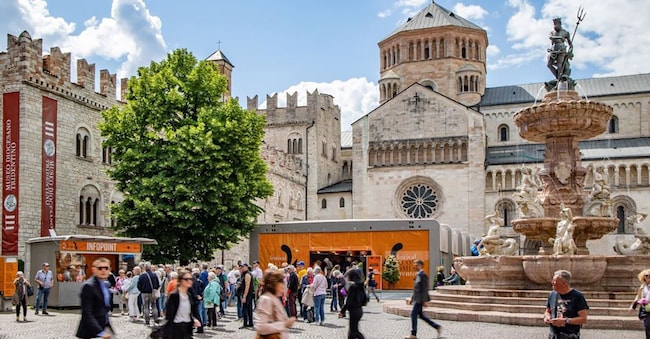
L’appuntamento. Trento e le sue piazze vivono con i colori del Festival

3' min read

Translated by AI
Versione italiana

3' min read

Translated by AI
Versione italiana

From the new global monetary balances to the transformation of the European banking system, via energy, financial markets and technological innovation.

Against a backdrop of an international economy once again affected by geopolitical tensions in the Middle East, global equity markets went through phases of high volatility, with widespread corrections on the main stock markets and a rotation of investors towards more defensive assets.

Loading...

At the same time, oil prices trended upwards, buoyed by concerns about the possible impact of tensions on the supply and security of energy supplies, while gold consolidated its role as a safe haven asset, benefiting from increased risk aversion and hedging by institutional traders.

Against this backdrop, the Trento Festival of Economics, scheduled from 20 to 24 May, devotes ample space to the key issues of economic policy and finance with a series of panels bringing together economists, bankers, policymakers and protagonists from the business world.

For a long time, financial markets showed a certain difficulty in consistently pricing geopolitical risk. Each new escalation was interpreted as an isolated episode, destined to recede once the phase of tension had passed. Today, this interpretative scheme appears less and less adequate to describe reality. Geopolitical risk is no longer an episodic variable of the business cycle, but a structural feature of a more fragmented and multipolar global system.

The progressive loss of effectiveness of multilateral institutions and the erosion of stability conditions in recent decades have transformed geopolitics into an economic factor in its own right, with direct impacts on trade, supply chains industrial policy, energy security, public spending and inflationary dynamics. In this context, investment decisions can no longer ignore an integrated reading of geopolitical risk.

The recent phase of geopolitical volatility is often compared to the shock of 2022, following the Russian invasion of Ukraine. But the level of bond yields is significantly higher than in 2022, providing a cushion of income that can better absorb market shocks. This improves the risk/return profile of fixed income, which returns to play a more effective role in building diversification.

Inflation remains one of the main risk variables related to geopolitical tensions, particularly in the energy and commodity markets. Rising real yields may indeed lead to price pressure on longer maturities, even in the presence of rising inflationary expectations.

Commodities have recently shown behaviour consistent with economic theory: higher volatility associated with changes in inflationary expectations and price rises in times of stress. In this segment, volatility is not only a risk factor, but also a source of redefining risk premiums.

In a context where geopolitics acts as a structural economic variable, portfolio construction must evolve towards more adaptive and dynamic models. While diversification may be temporarily ineffective during phases of extreme stress, it retains a central role in risk management over longer horizons. Flexible multi-sector strategies - in particular, dynamic bond funds and income-oriented portfolios - fit into this new architecture, making it possible to manage the dispersion of returns, deal with inflationary uncertainty and seize relative value opportunities. Ultimately, the new paradigm does not reward rigidity, but adaptability. In a world dominated by geopolitical instability, flexibility is no longer just a feature of investment strategies: it becomes the strategy itself.

WEDNESDAY 20 MAY

The euro, the dollar and Mr Trump

Protagonists: Donato Masciandaro

What changes for companies, banks and savers with capital market reform

Protagonists: Andrea Corona; Paolo Di Benedetto; Federico Freni; Luigi Orsi; Lando Sileoni; Maurizio Tamagnini; Gianfranco Ursino

THURSDAY 21 MAY

The Curse of Oil

Protagonists: Alberto Clò; Sergio Nava; Arrigo Sadun; Janiv Shah

Impires and Coins

Protagonists: Angelo Federico Arcelli; Fabrizio Burlando; Domenico Fanizza; Pasquale Lucio Scandizzo; Paola Subacchi; Maristella Vicini

Friday 22 MAY

How artificial intelligence and quantum technologies destabilise stock markets

Protagonists: Paolo Gualtieri; Marcello Minenna; Filippo Annunziata; Vittorio Carlini; Fabrizio Lillo

Asia's thirst for energy

Protagonists: Davide Tabarelli; Matteo Di Castelnuovo; Alessandro Lanza; Pietro Saccò

The automotive industry in Europe: Caporetto or revival

Protagonists: Giovanni Primo Quagliano; Nicola Armaroli; Antonella Bruno; Filomena Greco; Antonio Sileo

Stock market investments: algorithms retire traditional analysis

Protagonists: Rita D'Ecclesia; Giovanni Tamburi; Vittorio Carlini; Vittorio De Pedys; Enrico Malverti

SATURDAY 23 MAY

Why banks are a strength of Europe

Protagonists: Antonio Patuelli; Laura Serafini

Banks, economy of territories and artificial intelligence

Protagonists: Stefano Barrese; Maria Latella

Stakeholder capitalism and the role of youth

Protagonists: Edward Freeman; Anna Gervasoni; Silvana Signori; Fabrizio Testa

SOMDAY 24 MAY

The role of finance and the social economy in economic growth

Protagonists: Laura Biancalani; Maria Carla De Cesari; Giorgio Micheli; Nicola Riccardi; Gabriele Sepio; Paolo Venturi

Copyright reserved ©
Loading...

Brand connect

Loading...

Newsletter

Notizie e approfondimenti sugli avvenimenti politici, economici e finanziari.

Iscriviti