
Gardens between chaos and order in Giarre
The fifth edition of the Radicepura Garden Festival kicks off in Sicily

4' min read
4' min read
Chaos and order are the botanical mantras of the fifth edition of the Radicepura Garden Festival inaugurated in Giarre and destined to blossom with luxuriant cultural initiatives until next 7 December in the park between Etna and the sea, including a writing course organised by the Holden School entitled The roots of a story, concerts of funk, afrobeat, jazz and flamenco guitar, as well as cinema with Garden in Movies.
Landscape architects
The parenthesis between the two words contains the conjunction 'and', which is up to the eye of those who sneak into the intricacies of the leaves and stems, as well as to the flair-genius of the landscape architects selected, to accentuate or corner. "This apparently chaotic mosaic that is the garden," says Antonio Perazzi, land designer and director of Radicepura Garden Festival, "brings out all the eclecticism of nature. The plants evoke memories, sensations and impulses that take shape over time at a variable speed.
In this edition that also looks to the Far East, to the Indian universe nuances and interactions between cultures dialogue in a mature and enthusiastic manner with our Mediterranean environment'. Mario Faro, the inspiring soul of this Biennial that involved thirty volunteers from all over the world, including Siberia, is also satisfied and enthusiastic about the high quality achieved: "Our call for action sent thousands of projects to the selectors' examination, which put the jury to the test in identifying the most deserving designers," he said. "We believe we have chosen well.
The botanical highlight of this edition, as well as a garden designer with great empathy for the local landscape, is undoubtedly the master Sarah Eberle, a multiple Chelsea Flower Show medallist, who gave colourful and material proof of all this affection by creating A Postcard From Sicily, i.e., a garden in which the craftsman's touch emerges: terracotta amphorae contain the marine sculpture-creatures, while around them gigantic ceramic lemons emphasise the joy of this citrus island. Eberle's creation with a strong aesthetic impact physically and also empirically accompanies another precious gift received by Radicepura, namely the garden designed by Paolo Pejrone, which has grown into an adult compared to two years ago when it was presented: all its plant essences, including aquatic ones, within the mural perimeter that surrounds them and in the basins that contain them, give life and strength to a fairy-tale composition, light and docile, capable of caressing the senses, in particular the touch induced to graze the two-coloured reeds. One rests, therefore, at the edge of the pools themselves and closes one's eyes to let oneself be transported to a Mediterranean that is both near and far.
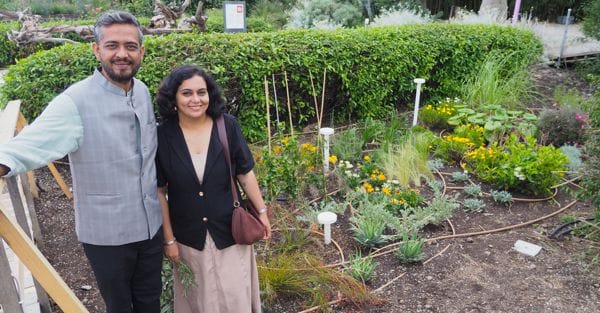
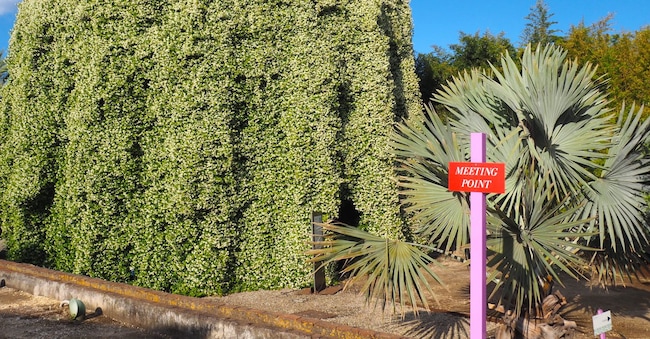
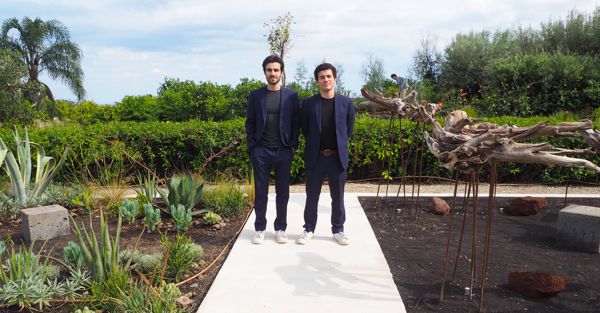
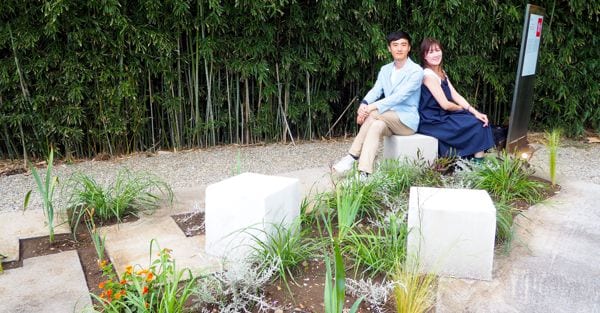
As every time, Michel Péna's Tour d'Y Voir, now dripping with jasmine blossoms, sets the tone for the journey into the future: in fact, it starts here, alongside Home Ground, which spins the vocabulary of its author Antonio Perazzi like a rosary, to discover the new installations of the 2025 edition. And certainly Quasimodo's Miracle conceived by the twins Carlo Federico and Franco Enrico Serra transforms the words of the poem Specchio del Nobel into two tangible botanical expressions of the friend-enemies death and life in the form, the first, of trunks and roots elevated to sculpture, while in the second composition, opposite yet separate, plants restore chaos and hope. The public will love Patio by the siblings Marta and Fernando Gamarro, originally from Andalusia but transplanted to Great Britain, bringing with them a baggage of memories and stylistic traits that here has taken shape through a module composed of a multiplicity of terracotta vases often tattooed with strips of colour and containing plant essences, flowers. These clay containers lend themselves to becoming seats, varying their dimensions, inviting a welcome and expanding a feeling of gypsy cheerfulness that never hurts. This youthfulness of botanical vision also emerges from the interstices of the white backdrop designed by Monica Torrisi and Giada Straci, who in their Mira satisfy the curiosity and also the surprise of human beings in the presence of nature: we look through the windows, thus recognising the otherness and mystery, however never repelling, transmitted to us by the flora. Even in the presence of The Garden of Earth, admiring the juxtaposition of the eight raw earth columns, one grasps the harmony and strength of opposing natural elements that Vincent Dumay makes dialogue and coexist in an only apparent fixity. In contrast, in The Garden of the Mazari Palm designed by Nicholas Roth, who currently serves as Visual Resources Librarian for Islamic Art and Architecture at Harvard University's Fine Arts Library, wild disorder seems to prevail over order. Intricate Dance of Harmonic Contrast by the Hong Kong-born duo Cracks of Nature composed of Koni Chan and Rose Tan immediately puts everything back into question again, leaving one uncertain and never quite sure what prevails between order and chaos. After all, this is the certainty and uncertainty of a garden.

