
In Ikaría, the island of long life and 'Panigíria' where Dionysus still lives
Between Samos and Mykonos, it has magnificent people's festivals, fairytale beaches, archaeological sites (Drákano), excellent wines (Karimalis) and pleasant slow rhythms

If Ikaría were a book, it would be John Fante's Full of life. There is as much life as possible - and a thousand faces - on this island lost in the shimmering Aegean. It has Cycladic features, with its dazzling whites, the lush green of the Sporades and the rugged rock of much of the Dodecanese. Here, between Samos and Mykonos, of all that there is - and there is a lot - nothing is missing. This is also recalled by Gabriella, originally from Bolzano and transplanted to Greece some thirty years ago, in Ráches, a village in the hills, in front of the Women's Cooperative: 'I came to Ikaría on holiday in 1992, I was fascinated by the villages and beaches, the warmth of the people and the greenery, I went back and decided to stay. In 2009, with a dozen other women, we founded the cooperative. Which is a café-bakery and also a workshop where we process about two tonnes of fruit and vegetables every year to make jams and pickles'. The tables are crowded, there is a morning buzz for Greek coffee and delicious pastries. Gabriella and the other women have created jobs in a context that is not easy from an employment point of view and they ensure that fruit and vegetables from individual farmers are not lost. On Ikaría, an island of 9,000 residents, everything is small, on a human scale, and for that reason big, and breathes life.
That was once Dolochi
The island, which used to be called Dolichi first and Makris later to emphasise its long, narrow shape, was named after Icarus, who crashed here after brushing against the sun with his wax wings. Today, this land has none of the hybris of ancient myth, but lives in a happy and engaging slowness, in a time worth a thousand years, so much so that it is among the five Blue Zones of the world. Together with Okinawa (Japan), Sardinia, Nicoya (Costa Rica) and Loma Linda (California), it is one of the areas where people live the longest. What is the secret? Georgios Karimalis studied it in the field. In his winery, on a hillside in Pigí, under an arbour laden with grapes and overlooking the blue, his words are posed, his long gaze with his pronounced eyebrows giving him a philosophical air. It is a lesson in life, which he takes to universities around the world during the winter months: 'It is not a pre-packaged recipe, there are naturally grown raw materials, good food, daily exercise, a glass of wine and the ability to always think ahead'. As Georgios himself does with his wife Eléni: their winery, where they produce 25,000 bottles of wine that go as far as the USA and Australia, also makes room for tastings of wines made from ancient vines such as Fokianó and cooking lessons. Eléni has a cheerful smile and her sufikó, a kind of pepperoni that releases the Greek sun, is worth a visit to the Karimalis estate alone. Nearby, you cannot miss a visit to the monastery of Theoktístis, a small church and many cells carved into the living rock.
Down to the Sea
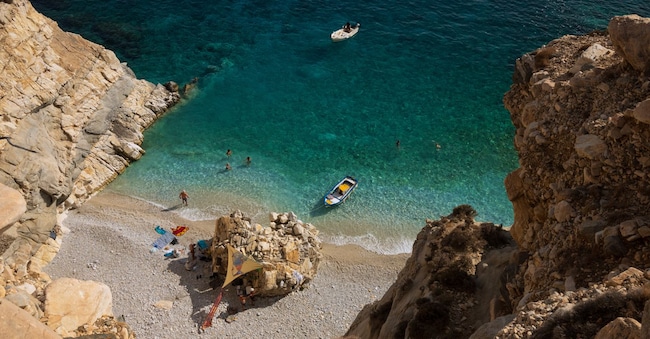
From Pigí, you descend towards the sea in a maze of small villages, in an explosion of oleander and bougainvillea (dear Mr Mayor, why not use European funds to improve the island's road system?) to arrive at the village of Armenistís. The beach of Mesachti offers crystal-clear waters, like that of Nas, which becomes scenic at sunset. Even the ancients had noticed this, having erected here the temple, the foundations of which are still visible, to Artemis Tauropolos, dating from the 4th century BC. Archaeology is one of the many faces of Ikaría: in Kámpos, the ancient Oinóe (from the Greek word for wine), the remains of the Odeion and aqueduct can still be seen.
At Évdilos, one of the larger villages, you can take a detour from the north coast to the south, stopping off at the Maldivian Seychelles beach, set in white rock and with fairy-tale waters, which that nice little boy Tommaso and his mum and dad love so much, and then continue on to Ágios Kírykos, the main town, choosing to sleep high up, perhaps at the magnificent and quiet Drákano Studios with views of Samos, Fourni and the endless sea. The streets are narrow, the seaside taverns offer revithokeftédes, chickpea meatballs, or conkathoúra, soft goat's cheese, there is an archaeological museum that is a jewel, born of the knowledge of Themistoklis Katsaros: 'There is little of everything on the island, so we have always made our brains work,' explains Aggeliki Niapa, born on the island and a lifelong resident of Athens, like all islanders, 'there is above all good living. If you ask an Ikariota what time it is, he will ask you if you have to take medicine. But now it is time for our tourism to make a quantum leap. We must abandon our isolationism (Ikaría is a communist stronghold, formerly a prison for political deportees in the 20th century, ndr) and give new opportunities, especially to young people, so that they can work and stay on the island'.
The archaeological site of Drákano
There is no shortage of possibilities, such as the thermal waters in the spectacular corner that is Thermá, the beaches of Fáros and Ieró or visits to the archaeological site of Drákano, also mentioned by Strabo, with its Hellenistic-era fortress.


