Feature

In Irpinia, businesses are on the rise, driven by history, exports and the Special Economic Zone (ZES)

From digital technology to pharmaceuticals, from agri-food to eyewear – a full range of industrial sectors, including many multinationals

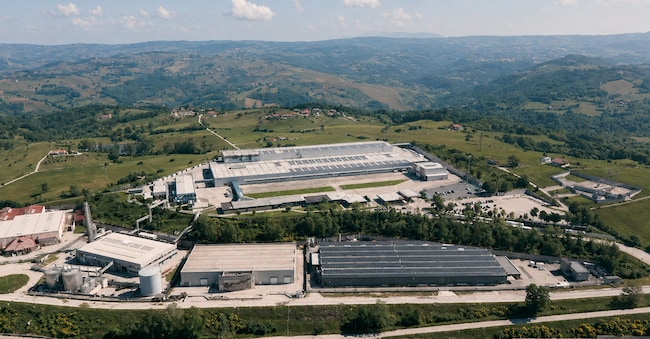
Area industriale di Sant’Angelo dei Lombardi (Av), paese simbolo della distruzione del terremoto del 1980

7' min read

Translated by AI
Versione italiana

Key points

  • Behind the growth
  • The Luiss Report
  • High employment, many companies led by women
  • Strength through adversity
  • The impact of high-speed rail and the legacies of the past
  • Multinational companies and local businesses
  • The veterans
  • Full industrial estates
  • Training
  • Growing despite the challenges

7' min read

Translated by AI
Versione italiana

Once you take any of the seven motorway exits in the province of Avellino, you pass through woods, hills and villages with ‘a chimney for every bell tower’, as the post-earthquake mantra goes. And here, in the watchword of the 1980s, still lies the form and substance of Irpinia’s – growing – industry. These are the fruits of a dynamism sparked by the arrival of multinationals at the time; supported by a range of incentives and driven – most recently – by the Special Economic Zone. ‘These have given a boost to a region that was already industrial,’ analysts note, alongside the generational shift.

Behind the growth

But what unites the success stories of businesses across a wide range of sectors and of very different sizes – from agri-food to eyewear, from IT to pharmaceuticals – is, above all, a strong connection to the local area, with its raw materials and its potential. This enables, amongst other things, quite a few companies to become energy self-sufficient. Solid roots, for bold ventures out into the world. So much so that the province ranks amongst those with the fastest-growing businesses, according to a Luiss report

Loading...

The Luiss report

The Luiss Italy Industrial Policy Report highlights companies with ‘latent potential’: those that are growing, despite the difficulties. On the map of regions with high-growth firms – where Milan, the North-East and the major industrial clusters remain at the top – the provinces of Teramo and Avellino rank among the leaders. “They took us by surprise,” admits Donato Di Carlo, assistant professor of economic policy at the London School of Economics and director of the Luiss Hub for New Industrial Policy. “We looked at high-growth companies in terms of turnover over the last 3–5 years and also delved into the micro-level. By shifting our perspective,” he explains, “another Italy emerges alongside the better-known one – one that is dynamic in a different way.” This confirms – he explains – the need for a transformative industrial policy, tailored to the diverse needs of different companies: ‘With such a diverse territory, blanket incentives only benefit the North and increase inequalities’.

High employment, many companies led by women

Almost all of them talk about investing in people; about direct links with universities, in-house academies and vocational training, starting with the ITS; and also widespread welfare provision, in an area with an employment rate of over 70 per cent among 35–49-year-olds, according to Unioncamere. There is also a significant number of female-led companies (29 per cent of the 36,000 registered as at 31 March). Just as robust as the vineyards that have made the wine from these hills famous are the companies’ abilities to turn challenges into strengths.

Industria Felix: nel post-Covid in Campania utili per 74,5% imprese

From the earthquake to transport links: drawing strength from adversity

“I’m convinced that it was the lack of infrastructure and connectivity that fostered the digital revolution,” he reflects – for example – Antonio Cianciulli of Acca Software, a leading player in Open BIM (Building Information Modelling), a technology for public procurement in the construction sector involving the creation of digital twins. “‘Our potential will increase further with the forthcoming Hirpinia station on the High-Speed/High-Capacity Naples–Bari line and the construction of a logistics hub for freight transport in the Ufita Valley’, estimate entrepreneurs, trade unionists and local officials.

The impact of high-speed rail and the legacies of the past

The hope – which is by no means unspoken – is that the new infrastructure will bring benefits: the high-speed rail line alone is estimated to have a total economic impact of 4.4 billion and create 62,000 jobs, according to a study by RFI and Svimez – a boost similar to that brought about in the 1960s by the diversion of the A16 Naples–Canosa motorway route around these hairpin bends. That was the legacy of the Irpinian minister Fiorentino Sullo; Then came the era of Ciriaco De Mita and Nusco as the ‘capital’ – a term used ironically to refer to one of the nine existing industrial areas (in addition to the four ASI industrial development zones and many more PIPs, according to the local councils themselves). At that time, under Law 219/81, major business figures from the North arrived in this province, which had been devastated by the 1980 earthquake – 3,000 deaths, destroyed villages, delayed relief efforts and a massive blow to local businesses. Now these are the veterans of an economic fabric “which, with the new generations, is definitively breaking away from that more rural past,” summarises Marco De Matteis, CEO of the agri-food group of the same name, “in favour of a new economy more open to international markets. “But with a strong commitment to the local area.” A dynamism that outweighs the persistent challenges, which at times even affect essential services such as the water supply and sewerage systems.

Aerospazio, Pmi e ricerca, così la Campania compete nel mondo

Multinational and local companies

Thus, in the same industrial area of Morra De Sanctis – a town of 1,400 inhabitants – the aerospace hub is growing, with Ema/Rolls Royce and a leading local pharmaceutical company such as Altergon, one of the world’s leading manufacturers of medicated plasters and hyaluronic acid (turnover of 56 million in 2002, 90 million in 2025). Acca Software SpA has doubled its turnover, rising from 16.7 million to 33.9 million euros in six years thanks to its insights into Open BIM technology – ‘which we brought to Italia’, they claim – and investment in skilled staff in Bagnoli Irpino, 4 km from Montella, where it all began in an engineering consultancy at the height of the reconstruction effort. Or take the De Matteis group, which has seen its revenue more than double with the Armando pasta project (from 100 to 240 million in 20 years) and the pride of having a fully integrated production cycle, from the mill to the pasta factory, at its two plants in Flumeri: here, where Iveco used to manufacture coaches, other businesses processing flour or meat have now sprung up around De Matteis. And amongst these industrial units, industry has joined forces with agriculture, and the regeneration of the local area has taken precedence over the struggling automotive sector. ‘We have a direct relationship with farmers – 800 producers from Tuscany southwards, but above all here in Irpinia and Puglia – and we have developed a set of cultivation guidelines, born,’ explains the CEO, ‘from the philosophy of our forebears: the very same philosophy that led us to become a benefit corporation.’

About ten kilometres into the heart of the Apennines, next to the Grottaminarda motorway junction, lies the Frigento industrial estate, where a former eyewear start-up with just two employees, Essequadro, which grew out of a family tradition of opticians, has become a business with a turnover of 9.5 million, up 23 per cent on 2024 and already up 26 per cent in the first half of 2026, thanks to “new markets such as Russia and the consolidation of existing ones, for our own brands and the eyewear manufactured for major designer labels. “Essential for us,” says CEO Stefano Scauzillo - “is our in-depth knowledge of the sector, the exceptionally high calibre of staff we can rely on, and our strong sense of belonging to the local area,” he explains, announcing the forthcoming application to the Special Economic Zone (ZES) and the imminent expansion of the factories. “But always one step at a time.” In keeping with the local philosophy.

The veterans

Examples and stories of entrepreneurs – such as Carlo Matarazzo of the long-established Cosmopol; Emilio De Vizia, with his industrial plant installation business; or Mive, founded by Antonio Verderosa, in the energy sector; or Feudi di San Gregorio, led by Antonio Capaldo, which has become one of the best-known wineries in Southern Italy – all of whom have grown their businesses – as has also been the case in the Solofra tanning district – and generated related economic activity. Alongside big names such as Vicenzi in Nusco, Zuegg in Mango sul Calore and Ferrero with its vegan Nutella in Sant’Angelo dei Lombardi, a symbol of the devastation of 1980. Or, among the multinationals, Stellantis (1,500 employees); Denso Thermal System (750); CoFren (part of the Wabtec Group, manufacturing train brakes, 200 employees); the Bruno Group, which manufactures agricultural machinery, and Sediver, a producer of glass insulators.

Full industrial estates

“We are seeing steady growth, which has consolidated since the pandemic, with increases in revenue and new jobs,” summarises Angelo Petitto, president of the Irpinia Industrialists’ Association, who is proud to represent a region where “there are almost no vacant plots left in the industrial estates”, he says. That is not to say there are no difficulties in sectors such as the automotive industry, where, across various companies, “around 600 jobs” have been lost, according to the provincial secretary of CGIL FIOM, Carmine Morsa, who speaks of industrial relations based on a “constructive approach, not least given the small-to-medium size of many businesses”. For these companies in particular, “the ZES has been helpful with social security contribution relief and, even more so, with the streamlining of red tape”, analyses Petitto, who identifies one of the drivers of growth in the generational shift that has strengthened the region’s international profile. For a long time, it was not difficult to find workers here. Now, however, this is set to become a priority in light of the 17,000 young people who have left over the last ten years, according to the CGIA in Mestre.

Loading...

Training

As a result, specialist staff in particular – such as those required by Acca Software or Altergon – are recruited directly by the companies. “We collaborate constantly with universities and research organisations,” say representatives from Acca Software. “We have specific protocols, which have encouraged some employees to return from other roles; that’s why we place great emphasis on staff wellbeing,” admits Domenico Bruno, Altergon’s head of human resources. People and the local area: once again, an inseparable pairing: “We bought half a hill to build a solar park in a little-known protected area.” Like this area, which is also growing in the pharmaceutical and biomedical sectors, centred around the Biogem research centre in Ariano Irpino, founded by former minister Ortensio Zecchino.

Growing despite the challenges

The widespread regret is that ‘growth could be greater’, if, for example, Altergon had not been forced to shut down for a month and a half last year due to problems with the water mains; or if various road-widening projects had been completed. Not to mention the sewerage system in the Cervinara industrial estate. ‘Based on the ZES model, it would be important to establish inland free trade zones for these inland areas, relative to the ports of Naples and Salerno: the absence of tariffs,’ explains the president of Confindustria Avellino, ‘would attract investors and generate positive feedback loops.’ This would enable continued growth by focusing on people and the local area.

Copyright reserved ©
Loading...

Brand connect

Loading...

Newsletter

Notizie e approfondimenti sugli avvenimenti politici, economici e finanziari.

Iscriviti