
ChatGPT is now showing adverts in Italia. This is how OpenAI is trying to diversify its revenue streams
From 24 August, ChatGPT Ads will be available in 31 European countries. Sam Altman is focusing on advertising to monetise free users and reduce reliance on subscriptions.

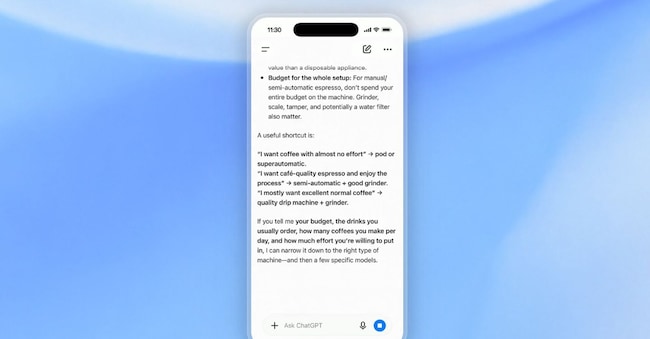
OpenAI is opening the door to advertising in Europe. And it is doing so at the most delicate moment in its financial history: whilst ChatGPT is growing, the costs of running it are rising even faster. From 24 August, ChatGPT Ads will be available in 31 European countries, including Italia, following six months of testing in the United States. The mechanism described by OpenAI is fairly straightforward. Adverts will be clearly labelled as such and separated from the chatbot’s responses. According to the company, advertisers will not be able to influence what ChatGPT says. For brands, however, a small advertising platform is emerging that now bears less and less resemblance to an experiment: OpenAI started with CPM (cost per thousand impressions), added CPC (cost per click), and now also offers oCPC, which optimises campaigns based on the probability of conversion. There is also geographical targeting, custom audiences, an OpenAI Pixel and an API to measure sales generated by campaigns. Self-service via Ads Manager is expected to be available within the quarter.
The real innovation, however, is not technological. It is economic.
OpenAI is attempting to transform ChatGPT from a massive digital product into a massive commercial enterprise. According to the Financial Times, in the initial US trials, OpenAI was charging advertisers above-market rates – around $60 per thousand impressions – with initial commitments in the region of $200,000. The pilot project is said to have already exceeded $100 million in annualised revenue in less than six weeks.
But to understand why Sam Altman has changed his mind, one need only look at the income statement. For years, OpenAI’s CEO treated advertising with great scepticism, going so far as to describe it as a sort of last resort. In 2024, he explained that the combination of advertising and artificial intelligence struck him as particularly problematic. Then came the figures. In 2025, OpenAI spent $34 billion, of which $19 billion went on research and development, against revenues of around $13 billion. Excluding significant non-monetary items, operating losses would have been around $8 billion. And TechCrunch reported in July that OpenAI expects to invest up to $750 billion in infrastructure by 2030.
This is the paradox of generative artificial intelligence. The more successful the product is, the more GPUs need to be purchased, data centres built and energy costs incurred to meet user demand. The Plus, Pro and enterprise subscriptions therefore remain essential, but they are not enough to monetise the hundreds of millions of people who use ChatGPT for free. In this regard, advertising is intended by OpenAI to account for less than half of total revenue. It is, however, a second important revenue stream: it allows the company to generate income even from users who will never pull out their credit cards.
In short, Altman is trying to solve a problem as old as the Internet itself: millions of users are great – until someone asks who’s footing the bill.


