
In Italia, urban regeneration faces the challenge of gaining public support
From housing as infrastructure to investment risk mitigation, from the management of public spaces to the continuity of policy decisions. In Milan, Uli Italy compares European models with national challenges

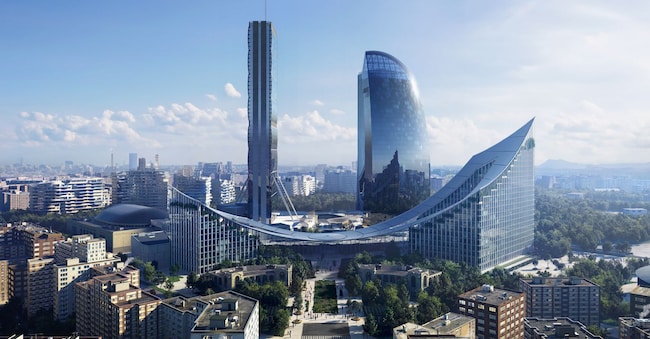
‘Building consensus amongst citizens is crucial for any urban regeneration project.’ Guido Alberto Inzaghi, founding partner of Studio Inzaghi, raises an issue that currently affects the Italian property market directly, but which is common to many European cities. Against a backdrop of economic hardship and geopolitical tensions, there is growing opposition to developers and investors, who are perceived as being more interested in profit than in providing affordable housing. How, then, can this divide be bridged? And how can building consensus be reconciled with the need to guarantee clear timelines for investors?
The discussion organised by Uli Italy on 23 November in Milan, hosted by the Riccardo Catella Foundation, centred on these questions. It was entitled Urban Change – From Consensus to Implementation: European and Italian Experiences. The discussion focused on a selection of European case studies – Copenhagen, Hamburg, Madrid and Birmingham – with a view to identifying tools and working methods that could also be useful in the Italian context. The backdrop to the debate was provided by the legal proceedings surrounding Milan’s urban planning and a climate of growing opposition to property development projects, starting with the recent demonstrations in Rome ‘against property investment funds’. In Milan, in particular, the issue of consensus is intertwined with that of planning permission and the use of implementation plans: ‘Private parties need certainty regarding timelines,’ observes Inzaghi, ‘a certainty that is lost even when the possibility of challenging a planning permission extends beyond the start of construction.’
Reducing risk before the product reaches the market
For Antonino Turicchi, managing director of CDP Real Asset SGR, one possible solution lies in the ability to work at the early stages of property transactions. Particularly when urban regeneration involves public assets, action must be taken on what he describes as the ‘first mile’ of the investment. ‘My advice is to reduce the project risk.’ He is referring to the phase in which a relationship with the local council is established, heritage protection constraints are addressed and environmental issues are managed. Turicchi draws an analogy with the experience of Italian privatisations and the work required to make such transactions market-ready. From having a solid financial partner to using special procedures – as in the case of the Olympic Village in Milan – right through to the possibility of appointing special commissioners to overcome specific authorisation hurdles, there are various tools to draw upon. However, according to Turicchi, there remains a problem with the competitiveness of the Italian system: the complexity of the Public Contracts Code, compliance requirements under anti-money laundering legislation and the length of legal proceedings can influence the decisions of foreign investors. In this context, the chief executive emphasises, ‘it is important to have a solid documentary basis’ in order to deal with any potential disputes that may arise during the development of projects.
From Denmark: the home as infrastructure and the value of shared responsibility. How much of Northern Europe’s experience can actually be applied to the countries of Southern Europe? This is the question posed by Olaf Schmidt, president of Uli Italy and a partner at Dla Piper, who urges us to consider the cultural and political differences underpinning the various development models.
Particularly significant is the case of Copenhagen, as described by Jakob Norman-Hansen, Director of Global Networks & Partnerships at Bloxhub. The transformation of the Danish capital began against a backdrop of a deep financial crisis and an agreement between a Social Democratic mayor and a conservative national government. This political convergence made it possible to develop a shared long-term vision. The city and the state pooled their land resources through a public body operating according to market principles, using the value of the land to finance urban regeneration and investments in transport. ‘It is not just about new buildings or new homes, but about how they are built,’ explains Norman-Hansen, linking the city’s competitiveness to sustainability and the quality of public spaces.

Brand connect


Newsletter RealEstate+
La newsletter premium dedicata al mondo del mercato immobiliare con inchieste esclusive, notizie, analisi ed approfondimenti
Abbonati