
In Izumo and the capital in ancient shrines where life is celebrated
This is where the earliest historical-mythological reconstructions of the birth of Japan are set, dating back to the 6th and 7th centuries AD

Key points
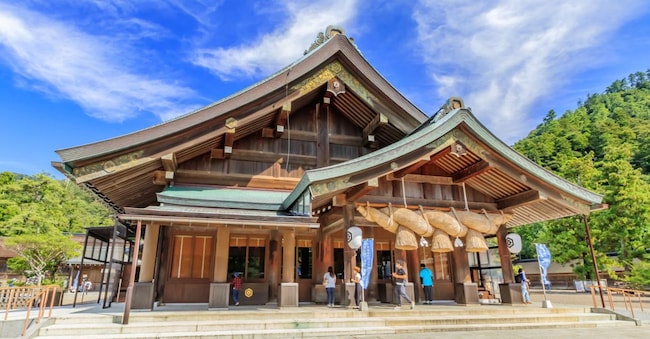
Two shrines, some 700 kilometres apart, one overlooking the Sea of Japan, facing South Korea, the other in the heart of Tokyo, a short distance from the Pacific Ocean. Izumo Taisha, Shimane prefecture, stands on an ancient sacred site and together with the shrine of Ise, Mie prefecture (on the Pacific), is the consolidated reference point of Japan's Shinto religious culture. After Ise, a staple of the imperial family, Izumo has for centuries (the foundation dates back to the year 500) been of great importance to the Japanese, who manifest their devotion with trips, visits and donations, particularly during the autumn period.
Country of the Gods
Izumo Taisha's deity of reference is Okuninushi no Mikoto, to whom mythology attributes a key role in the creation of Japan and the protection of friendship, love and marriage. The whole area is generally referred to as the 'Land of the Gods' to recall the role it played in Japan's early days, before the religious and cultural centre of gravity shifted to Kyoto, Nara, Kamakura and Tokyo. The earliest historical-mythological reconstructions of the birth of Japan, dating back to the 6th and 7th centuries AD, are set in Izumo. Tradition has it that in this site, simple but with an intense relationship with nature, the thousands of deities of the Shinto tradition have always gathered, also because another important sanctuary - Hinomisaki jinjia - dedicated to Amaterasu Omikami, the goddess of the sun, is also located here. To celebrate the reunion of the gods, an event called Kamiari is generally held in autumn (the lunar calendar is usually followed), inspiring love, friendship and marital fidelity. The emblem of Izumo Taisha, which has a very simple, essential architecture (without syncretism with Buddhism) is the Shimenawa sacred rope: at Izumo it is gigantic (it is 14 metres long and weighs more than a tonne), perhaps the largest in Japan, and delimits the sacred area of the shrine.
Izumo Taisha Tokyo
Many families historically devoted to Izumo Taisha, for the key passages of life (love, friendship, marriage, family) and also for its end, which for the Japanese presents important ritual passages to be referred to the shrine of choice, which we could define, in a broad sense, as a gateway to the afterlife. Over the centuries, as mentioned, the centre of gravity has shifted towards Tokyo: in the heart of the megalopolis of some 30 million inhabitants, in a quiet, almost anonymous street, in the district of Roppongi (Minato-ku) stands the Izumo Taisha Tokyo, a direct offshoot of the historic shrine in the prefecture of Shimane. The construction is modern, but the peculiarity is that the shrine, unlike the traditional ones, is not immersed in nature, but built high up among the houses of the Japanese bourgeoisie. In this way, the many devotees of Izumo Taisha can continue to maintain a direct relationship with their shrine of choice. And the cult staff are directly part of the religious organisational structure that has consolidated around Izumo Taisha over the centuries, without interruption. Love, friendship and the end of life even in the heart of Tokyo, a stone's throw from the nightlife for which the Roppongi and Shibuja districts are famous. A special place for families devoted to Izumo can also be found in the nearby large public cemetery of Aoyama. A gateway to the afterlife, in the centre of Tokyo, under the auspices of Okuninushi no Mikoto. Families devoted to Izumo commemorate their testimony of faith with a reproduction of the shrine's symbol, the character that in Chinese and Japanese symbolises something great and which stands out on the graves alongside prayers, mottos and invocations carved into the brown stones next to the names of family members.


