
In Japan, seeking silence and great beauty
Cartoonist Igort travels in the footsteps of Bashō and Hokusai to immortalise ryokan and spas, ghosts and solitudes and find the absence that is essence
by Maria Luisa Colledani
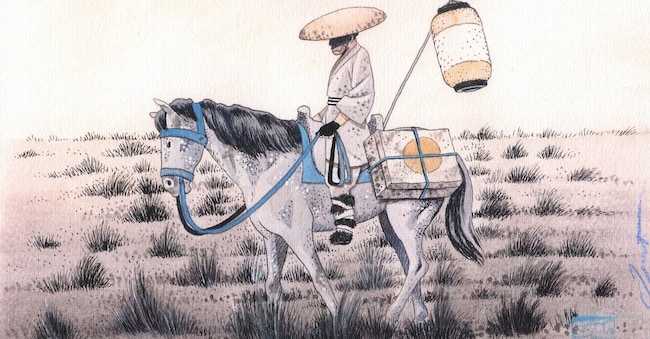
In these confused and deafening times, blessed more than ever is silence. Which breathes deeply in the pages of A cavallo con i poeti, which Igort (Igor Tuveri) dedicates to Japan, starting with Matsuo Bashō's haiku "Silence / penetrates the rock / the song of the cicadas". The writer and illustrator, who arrived in the East when he was very young, attracted by manga and the Kōdansha publishing house, pays homage to his second homeland with a journey that is word, drawing and contemplation in the footsteps of the path that Bashō took in 1689, in the north of the country, and then, southwards, following another master, the "old madman for painting" Hokusai, to contemplate the thousand and one faces of the sacred Mount Fuji and, in its appearance and disappearance, to find wonder and peace.
Igort sets out on a journey into a nature that is a living, autonomous presence and also welcomes Zen practice. It is an itinerary into absence in the company of a photographer friend: "if you want to understand something you don't know, you have to make emptiness, let yourself be, allow yourself to experience". Absence becomes essence, so dilated times leave room to re-learn to walk, breathe, see, think. In short, to exist. The North is majestic, with forests and imposing mountains crossed by pilgrims, there are small ghost towns, the solitudes of the provinces, bamboo forests, the hill of cranes, the three sacred mountains, and then inns, ryokan, the Abe baths. In short, remote Japan, so at odds with modernity, in which to lose oneself in order to find oneself again. The pages fluctuate between lofty thoughts and drawings that have the reverberation of watercolours: "I was intrigued by the arbitrariness of the water being deposited as it pleased on papers of different thicknesses and types. Watercolour drawing was a dance, made up of invitations, cues and a kind of somewhat anarchic freedom that deposited colour according to different levels of absorbency'.
So, after 1,500 kilometres to Hokkaido, Igort headed south, chasing Fuji and Hokusai, possessed by that fever that fuels, through inks and brushes, the fire of discovery and the profound sense of being. The artist of the Great Wave was an eccentric, he often drew in the street, with tightrope acrobatics (a broom instead of a brush and a giant-sized sheet of paper), to amaze and interest clients and publishers. He was a wayfarer who found in Fuji his happy obsession, to the point of portraying it more than a hundred times. Every different angle is life and wonder since 'beauty is asymmetrical because nature is. And nature is beautiful because it is imperfect, fragile like life, which is impermanent, incomplete'. And it seeks crumbs to yearn for the whole.
Igort, A cavallo con i poeti, Einaudi, pp. 152, € 19.50

