
In Kastellorizo to savour the blue and the sense of Europe
The island, the last outpost of the West, offers crystal-clear waters, long walks and trips to the Blue Grotto alongside turtles
5' min read
5' min read
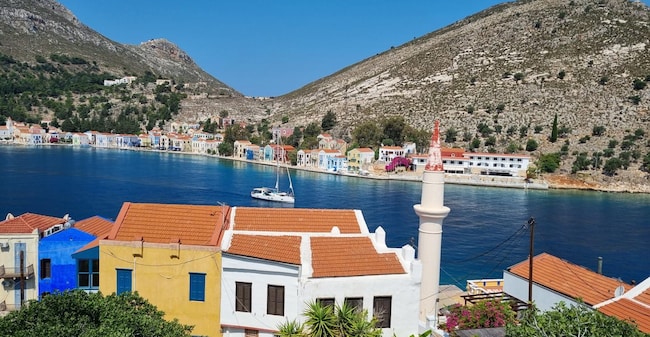
Whether it is the first island in Greece or the last, nobody knows. It depends on your point of view. Whichever is yours, Kastellorizo, three kilometres from the Turkish coast and 500 from the Greek mainland, is a heart-stopping harbour full of dazzling light. After a three-hour ferry ride from Rhodes (or a 40-minute flight, but Greece is sea and on the sea must be experienced), the small harbour is like an embrace.
A rainbow of colourful houses
.The island is all here, in this first postcard: a rainbow of dozens of colourful houses by the sea, the hills of Mounta and Vigla behind, the former mosque with its minaret turned into a museum, the castle erected by the Knights of St. John in the 14th century and which gave the island a new name: Castel Rosso, from which Kastellorizo derives. It used to be Megísti, i.e. 'the largest' (of the archipelago around it), although it only measures a dozen square kilometres. Small and big at the same time, certainly a strategic and disputed place since its beginnings, today a special watch of Turkish President Erdogan. A Greek navy frigate with its engines always running and the hundreds of military personnel present - albeit discreetly - are a sign of friction under the surface. "History has passed here and it is up to us to follow it up and preserve our island," begins Eleni Karavelatzi, 26, Greekness in her face and an endless desire for modern tourism. In 2019, after studying business administration in Thessaloniki, she returned home and founded Visit Kastellorizo, an agency that offers experiences, walks, boat trips at a slow and sustainable pace: 'Only in this way will we save Kastellorizo and give it a future, offering it to ourselves as well,' she explains.
Loading...
History and its Greek and Turkish past
.The future is certain, because the past here is an important one: outpost of the Dorians, dominion of Rhodes in Hellenistic times, then Romans, Byzantines and Crusaders. An Ottoman possession from 1552, Venetian from 1659 to 1768, then back under the Turks, the island was occupied by the French from 1915 to 1921 and, finally, by the Italians. Those same Italians immortalised by the film Mediterraneo, Oscar 1992: 'We were being sent on a mission to Megísti, a remote island in the Aegean, the smallest, the farthest away, strategic importance: zero'. We all remember Sergeant Nicola Lorusso's sentence, and in Kastellorizo every corner still speaks of the film: Vassilissa's blue house, the small port of Mandráki where the Italian soldiers arrive, the white cross at the cemetery, the Ta Platánia tavern in the little wedding square to the notes of a poignant sirtaki: "We are all in that film, it's still a dream for us," says Maria Kokala, the tavern's masterful cook with her delicious salandourmasi, stuffed onions like you've never eaten before. And she shows the sign 'Mediterraneo, for information please contact Chico', Maria's grandfather, who spoke Italian and acted in the film like so many of the island's elders: they had to give the impression of a land devoid of young people, all at the front.
Author Film Scenario
.As then, Kastellorizo embodies the spirit of the film: 'In times like these, escape is the only way to stay alive and keep dreaming'. Here, one dreams with a dip in the crystal-clear waters of Sfaghiá or the Blue Grotto, with a visit to the Lycian tomb dating back to the 4th century B.C., with a boat trip to the island of Ro, where Despina Achladioti, the heroine who hoisted the Hellenic flag every morning from 1929 to 1982, lived, or with a stroll through the village streets. It had 15,000 inhabitants in 1910, was so wealthy that it had a daily newspaper 'I foní to Kastellorizo' ('The Voice of Kastellorizo', the sign of which can be glimpsed on a house in the harbour), reduced to 1,500 in the 1940s, after looting, bombings and the explosion of an arsenal that destroyed half the houses. Today there are about 300 inhabitants and they live off tourism, subsidies from the Greek government, which knows how strategic this strip on the ridge of Europe is, and remittances from the thousands of 'Kassi' who live in Australia. In the narrow streets, there are many renovated houses, such as 'The pink house', in which the Greek designer Savvas Laz, who makes the reuse of plastic materials the compass of his creativity, has worked; the churches (seven are dedicated to St George, whom the Turks consider to be less indigestible among Catholic saints because he is the protector of knights and soldiers); the primary and secondary schools, commissioned in the early 1900s by the patron Loukas Santrapé, who affirmed equality between men and women; the bronze hands used as pickets on every door (take a good look at them: if there is a ring on the ring finger, it means that the house had been a wedding gift).
View from the monastery of Agios Georgios tou Vounou
.History also climbs the hill: 400 steps - best at sunset - lead up to the monastery of Agios Georgios tou Vounou (another Saint George, here 'of the mountain'), an immense plateau, invisible from the sea. Wild goats by the hundreds, dozens of abandoned military outposts and, sunk in a red earth like that of Roland Garros, many wine presses: 'My great-grandmother's family,' recalls Eleni, 'lived here, in the area of Avlónia, until the 1930s, a life of toil but of great values, and up here we must go back to making wine. As was the case when the Paleokastro hill began to be inhabited. First, in the 6th-5th centuries B.C., as a control outpost on the trade routes, then, from the 4th century, on a more permanent basis. Today, Paleokastro is a spaceship in the blue: 60 metres of cyclopean walls clutch the remains of the ancient city, four towers, three small churches from later times, some immense cisterns with pipes that conveyed rainwater. At sunset, it is a rosy-fingered dream, in the morning, a bath of light that pokes into the eyes and enters, overbearingly, into the soul.When evening falls, then, the bay becomes a world apart, Turkey disappears from view and so does a sense of precariousness on this uncertain European fault line. Caretta Caretta turtles splash ashore, a few bouzouki make the atmosphere tastier, like the feta-stuffed squid at Alexandra's or the katoumari, sweet pancakes made from puff pastry, at Komianos. He is typing the cost of dinner on the pos, 20 euro, a 2 million escapes him. 'With so much money, there would be no need for the tavern', I tell him, and he says: 'Euro more, euro less, for happiness this sky of stars is enough for me'. Those that also fascinated Pink Floyd guitarist David Gilmour. In his album On an island, he dedicates an instrumental track to Kastellorizo: 'Remember that night, ...we're half way to the stars'.
Copyright reserved ©


Brand connect
Loading...
