
In Lucca Puccini according to Muti
The evening celebrating the 100th anniversary of the composer's death without "cheesiness and frivolity
2' min read
2' min read
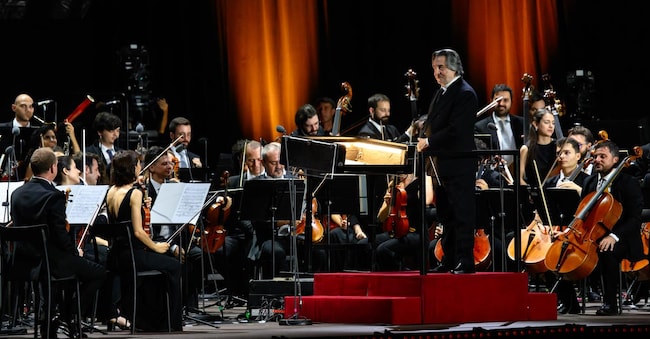
A mammoth stage, caged between spotlights and giant screens, looms over the large lawn behind Lucca's historic walls. Underneath, rows and rows of neatly arranged seats, to one side unwelcoming prefabricated grandstands. There is talk of an audience of 6,000 people. But it was not the concert of a rock star, but rather the evening celebrating the 100th anniversary of Giacomo Puccini's death: an initiative created by the Ministry of Culture, the Puccini Celebrations Promoting Committee, the City of Lucca, Teatro del Giglio, LuccaSummerFestival and others.
And paying homage, in Puccini's hometown, was Riccardo Muti, on the podium of 'his' Orchestra Giovanile Luigi Cherubini. He founded it exactly 20 years ago; this is also the anniversary to celebrate. The celebratory kermis meets all the requirements of the case: authority (Minister Sangiuliano), celebrities (Dustin Hoffman and Peter Greenaway, in Lucca to shoot a film); and there is even live coverage on RAI television, worldwide. Even the concert programme responds to the national-pop character given to the event, and layouts an inevitable gallery of arias-romances-duets. Only this time the choices are tastefully made, if only because we are spared the usual Vincerò, unfailingly berciato.
'Puccini according to Muti', reads the playbill. And what is Muti's Puccini like? Smooth in sound, built in full correspondence with the talented 123 musicians of the Cherubini, which for the occasion sits alongside the instrumentalists of today and those of yesterday. Relaxed in tempi, yet driven by a mobile tension of phrasing. Muti had said it, and he did it: Puccini needs to be cleansed of glibness and frivolity. And so, at the evening's opening, the youthful Preludio Sinfonico sounds soft, sumptuous in its cantabile, and has the broad eloquence of an important symphonic poem. Then comes the parade of arias-romances-duets, and here the results of the singing performances are uneven: Eleonora Buratto is more convincing as Madama Butterfly than as Tosca and Liù, Luciano Ganci shows off a fine timbre as Cavaradossi, Mariangela Sicilia is a sweet-toned and round-toned Mimì, and she also passionately duets with Dmitry Korchak's schematic Rodolfo; Lidia Fridman is a slightly too Teutonic Suor Angelica, while Francesco Meli gives accents of lyrical delicacy to Dick Johnson. But, in each of these pages, Muti always offers a direction that completes and enhances the dramatic meaning of the song: 'Tu che di gel sei cinta' finds a tragic and inexorable force in the orchestra's final phrases.
The famous Intermezzo from Manon Lescaut, rendered as suspended and diaphanous, without yearning, finally leads to the entire Fourth Act of the opera. Thus isolated, it reveals, as if concentrated, all its dramatic force. Fridman (Manon) and Meli (Des Grieux) carve out the words of their despair without being stentorian; and Muti guides their musical journey, now lighting it up with tension, now highlighting, with chamber-like delicacy, the desolation of certain instrumental solutions. All brought towards a conclusion that resounds epic and tragically grandiose, almost Wagnerian. Alone, this Act IV of Manon was worth the entire evening.

