


La figlia del clan racconta la ’ndrangheta a caccia della libertà
di Raffaella Calandra

4' min read
4' min read
The green of the Mediterranean scrub and the blue of the Tyrrhenian Sea, two elements that constantly accompany those who land in the enchantment of Maratea, remain in our eyes even days later, together with the one who watches over everything and everyone from the highest point on the island: the Christ wanted by the Biella entrepreneur Stefano Rivetti, who fell in love with the place and wanted the imposing 21-metre-high statue (Chiara Beghelli writes about it in Il grande telaio, Luiss 2024). It is not hard to believe, in view of the dazzling beauty of nature and the welcoming attitude of the Marathusians, that Francesco Saverio Nitti, in 1921, chose this strip of land to retire to study and devote himself to writing the trilogy on the European crisis (L'Europa senza pace , The Decadence of Europe, The Tragedy of Europe, republished by Edizioni di Storia e Letteratura), while the fascist threat was looming.
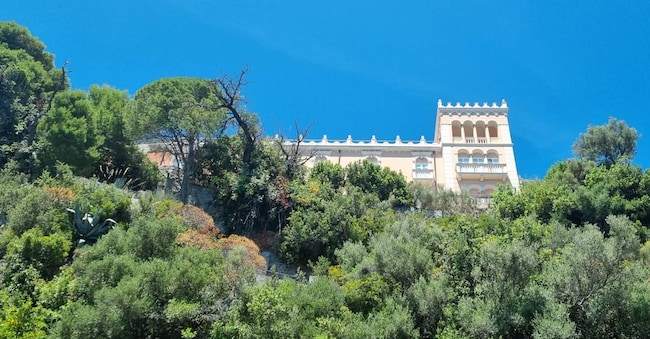
Villa Nitti, in Acquafredda di Maratea, was the Lucanian statesman's refuge, the beloved place next to the Melfi where he was born in 1868 (where the foundation named after him is now active) and grew up before flying off to Naples, studying law, becoming a professor of Finance Science and then arriving at the presidency of the Council of Ministers (in 1919, at a very difficult historical juncture), without ever forgetting his origins. Walking along the avenue leading to the villa or looking at the building from below, with the blue expanse of the sea behind you and the shrubs covering the façade, means imagining the context in which one of the greatest intellectuals and politicians of the 20th century moved (Giuliano Amato offered us a portrait of him in the last issue of the Domenica supplement). but also his everyday life in the peace of that place, among books, papers, documents and a staircase leading to the sea. Going into exile in Paris, after the devastation of the house in Rome by the black shirts, was a forced choice, but the nostalgia for this place (to which the descendants have always remained attached) probably remained strong in France. The villa is now the property of the Basilicata Region, donated by Filomena (the youngest of the children: before her were Vincenzo, Maria Luigia, Giuseppe and Federico) in the early 1970s, after the tragedy that had marked it. Her son Gianpaolo, a young historian and political hopeful, had died at the age of 37 in 1970 in a car accident on the Lucanian hairpin bends the day after being elected as an independent in the Communist Party lists in the first regional council of Basilicata. A grief too great to deal with, a place too loved to dispose of prosaically. Filomena's idea, entrusting it to the institution, was to perpetuate Nitti's lesson - of peace, freedom, modernity - leaving a living trace and testimony. Today the villa is closed, restoration work is in progress, and in recent years it has been the venue for important conferences and meetings. It would be nice if it could be opened and visited, and a suitable layout could be studied: it would thus become a further treasure offered to those who come to Maratea.
The journey from the only Lucanian locality on the Tyrrhenian Sea, squeezed between Calabria and Campania - after a stroll through the alleys of the village and a stop in the eighteenth-century Palazzo De Lieto - to San Costantino Albanese takes an hour or so. Right from its name, the small town in the Pollino park reveals its particular identity: here (and in the neighbouring municipality of San Paolo) the Albanian exile community, fleeing from Albania that had fallen into the hands of the Turks, had found refuge in the 16th century. It was, to be precise, 1534 when the house of San Costantino (Shen Kostandini, as the welcome sign reads) was founded, and still today the 800 or so inhabitants speak the Arbëreshe language - which is studied at school on a par with Italian -, they celebrate the Greek Byzantine rite in the beautiful Mother Church, in the square, and safeguard traditions, starting with the Arbëresh costume worn by the women. Climbing up to the Acquafredda refuge, with the intense yellow of the broom that accompanies us along the road up to an altitude of 1,000 metres, you can taste typical local culinary delicacies, from capocollo (cured pork neck) to 'pasticcio' with egg to the now unfailing 'peperoni cruschi' (peppers), to different types of fresh pasta, followed by a triumph of barbecued meat and finally home-made desserts served with liqueurs made from herbs and wild Pollino fruits. It is worth appreciating all this after walking along one of the paths in the forest and regenerating in the silence. Carlo Levi probably could not do this because of the snow when he came here in December 1974, during his last journey to Basilicata. The painter, writer and politician from Turin spent several days in the region, stopped in Aliano - reconciling himself with the town that had felt offended by the narration of Christ stopped at Eboli - and just before he stopped for a night in San Costantino Albanese, invited by the art publisher Ciccio Esposito (a native of the place) who had made seven lithographs of Christ. The intellectual, urged to leave a sign of his presence, took an unlit charcoal from the fireplace and drew three boys in Arbëresh costumes on the wall of the house where they were gathered for dinner, then coloured the drawing with chalks recovered from someone there at the time. It was Carlo Levi's last artistic effort, extemporaneous, on a wall in that Basilicata where he had suffered as a young man but with which he had soon fallen in love. Less than a month later, on 4 January 1975, he died and was buried in Aliano.

