
Medical school exams: only 10-15% pass the first appeal, Physics the most selective test
In order to continue your studies, you must have passed all three required exams Chemistry, Biology and Physics, which appeared particularly difficult

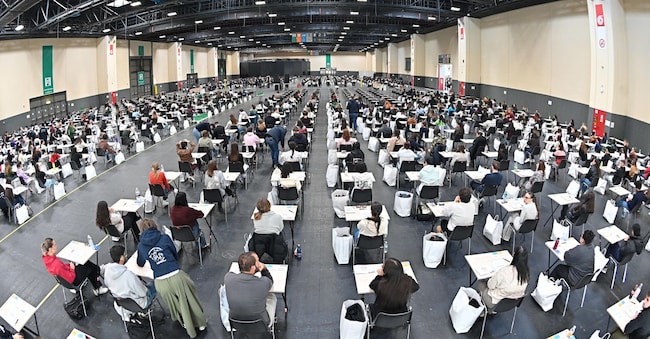
Avalanche of failures in the first exam of the filter semester for admission to the Faculty of Medicine. The numbers are not yet official, but initial estimates put the percentage of failures at between 10 and 15% in all three subjects, Chemistry, Biology and Physics, with the latter being particularly difficult. The real risk - and this would be the first time - is that, if things do not go better at the 10 December roll-call, the number of students admitted to Medicine would ultimately be lower than the places available. However, analysing the data more closely, not everything seems to have gone wrong: in fact, by cross-referencing the numbers from different universities, it appears that 22-23% of the candidates in the 20 November tests scored at least 18 in two out of three exams. In other words, around one in five students managed to pass two exams.
Physics, a critical subject
In most cases it was Biology and Chemistry, while the most critical exam was Physics, on which many will concentrate their preparation in view of the second roll call. Considering the 50,000 or so participants, we are talking about 11,000 students who passed at least two exams. The next appeal is scheduled for 10 December and registration is open until 6 December. The results of the second appeal will be published by 23 December. The aspiring white coats - around 53 thousand - have taken three exams - Chemistry and Biochemistry, Physics and Biology - in order to be able to aspire to continue their studies in Medicine by officially enrolling.
The evidence
Each 45-minute examination consisted of 31 multiple-choice or completion questions. At least 18 out of 30 marks must be obtained to pass each test. From 2023-2024, the number of places for enrolment increased from a total of 17,228 to the current 19,757 (24,000 if the availability of non-state universities is also taken into account). The outcome of the tests, however, triggered opposition. "It was an announced disaster.
The Paradox
It was supposed to be the abolition of the numerus clausus to facilitate the training of young doctors, but instead it promises to be a real debacle. If the data were to be confirmed, even in the December roll-call, we would have the paradox of not filling the places advertised. In other words, the solution adopted by the government would seem to be going in a direction diametrically opposed to the one desired,' points out Alessio D'Amato, head of Welfare at Azione. Along the same lines are Davide Faraone, vice-president of Italia Viva ("Improvisation wins," he said) and Alfredo D'Attore of the PD: "two and a half months of mainly online lessons may perhaps be fine for preparing for the often bogus exams of private telematic universities, certainly not as the first semester of Medicine and as preparation for such an important selective test". Harsh words also from the Flc CGIL, which announces that it will be in the streets with the students on 11 December. The Union of University Students has presented a collective warning to keep any positive results obtained at the first appeal: now they have 48 hours to accept the result obtained or reject it
Brand connect


Newsletter Scuola+
La newsletter premium dedicata al mondo della scuola con approfondimenti normativi, analisi e guide operative
Abbonati