
In adoration of Boccaccino
The exhibition tells the story of the artist who, from his stays in Milan, Ferrara and Venice, absorbed Leonardo's suggestions, lagoon spatialities and Nordic traits
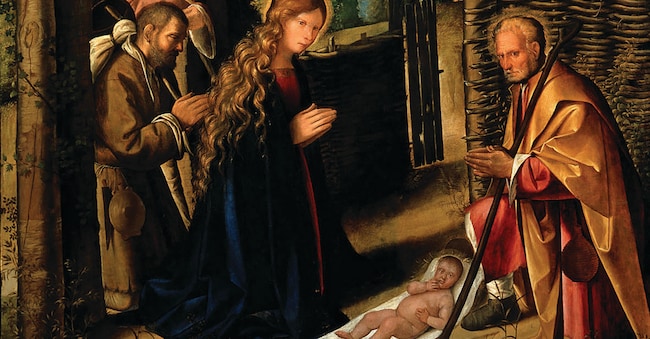
The shepherds gaze at the Baby Jesus, while Mary and Joseph look on, intimidated, and ask us to stop. In front of Boccaccio Boccaccino's Adoration of the Shepherds (c. 1499-1500), one cannot help but pause to marvel at the mystery of Christ becoming man and the artistic layering of the panel, a harmonious summa of Leonardoesque suggestions, Venetian spatiality and Nordic traits. This is Boccaccino, many worlds in a single work that opens the monographic exhibition currently underway at the Diocesan Museum of Cremona to celebrate the 500th anniversary of the death of the long-forgotten artist, and to coincide with the acquisition (and restoration) of the fragment of the altarpiece, once in the church of San Pietro al Po, in Cremona, the fourth work by Boccaccino in the diocesan institution's collection.
The Adoration of the Shepherds, from the Capodimonte Museum in Naples, is a manifesto of the intentions of this protagonist of the Renaissance in northern Italy and best portrays his identity: he was a performer who moved between Ferrara, Genoa, Milan, Venice, Rome and Cremona. He travelled, painted and compared himself with his contemporaries to rework his own artistic vision, so much so that Giorgio Vasari described him as a 'rare' and 'excellent painter', and to influence artists of later generations, including Gianfrancesco Bembo, Altobello Melone, Giulio Campi and his son Camillo. The itinerary proposed by curators Francesco Ceretti and Filippo Piazza interweaves chronology and themes: Boccaccino, son of the magister Antonio, originally from Cremona, embroiderer, 'acupictore' at the Este court from 1464 to 1503, was most probably born in Ferrara between 1462 and 1466. He breathed the cultured air of the ducal city, studied the late Ercole de' Roberti, admired the precious works of his father and, in 1493, perhaps taking advantage of an Este canal, he appeared in Genoa to sign a contract with the Augustinians for a polyptych for the hermitage convent of Santa Maria della Consolazione, which has since been lost: the "Magister Bochacinus Bochatiis de Cremona" was to "depingere bene et suficiter ac bonis coloribus et suo auro petium de mediu cum suis intaliis Majestatis", i.e. a Majesty, with agreed "ducatos quinquaginta".
Art coexists with crime: in April 1497, Antonio Costabili, the Duke of Ferrara's ambassador in Milan, wrote to his lord that he had freed the painter from prison, where he was being held for injuring an illuminator. And so Boccaccino arrived in Ferrara to replace Ercole de' Roberti at court. But his stay in the Este family was also short-lived: the artist, accused of having killed his wife who had betrayed him, was again on the run to Venice, where he discovered the spaces of Giovanni Bellini, the draperies of Vivarini and the light of Giorgione. In this temperament, Boccaccino independently reinterprets, develops and enriches two strands conceived and perfected by Bellini, that of the Madonna in adoration of the child and that of the Half-figure Sacra Conversazione. Mary's faces, in the Correr panel and the one in the Padua Civic Art Gallery, are perfect, but with gazes that are almost lost, pensive, in an unknown elsewhere. As well as in the Madonnas of the two works from private collections, hitherto never exhibited, and reminiscent of the first Venetian work, the Pala di San Zulian.
The Zingarella (c. 1504-1505) has a completely different look, magnetic and magnificent in its small format (24 x 19 centimetres), also enhanced by the intimate space dedicated to it: the sources identify it as a 'woman dressed Turkish-style' but Francesco Ceretti also proposes an identification with Mary Magdalene. What remains is an exceptional miniature sensibility and a total harmony of colours and strokes. The same, albeit in larger formats, can be found in St. John the Evangelist and St. Matthew, where the optical exactness of the fabrics is astonishing, where the flaming red is almost Giorgione, where the echo of Dürer's Rosary Feast is more vivid than ever and the shadow of the fingers on St. Matthew's left hand speaks of the artist's skill.
The exhibition spaces, so intimate and restrained, enhance the light, almost atmospheric gilding of the nimbuses painted by Boccaccino and the continuous cross-references that can be glimpsed. Such as in the Annunciazione Bonaccossi Ludovisi (permanent deposit by the Fondazione Arvedi Buschini), painted around 1507, when the artist had returned to Cremona and put the geometries and drapery of Perugino, present in the city with the Pala Roncadelli (1494, go and see it in the church of Sant'Agostino), alongside his lagoon memories.


