In Namibia’s unspoilt wilderness, amongst cheetahs and sea gems
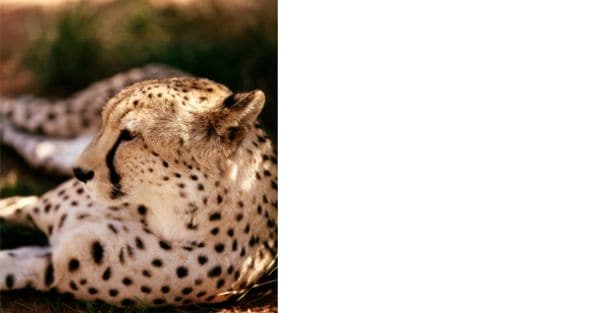
Refocusing our gaze on what truly matters. The power of light, the horizon etched between sky and bush, wild animals saved from poaching, and few signs of human presence.

It is a constant, almost physical presence that demands discipline: here, nothing can be superfluous, because everything is laid bare. It is a country that works by subtraction, reducing everything to the essentials and forcing one to slow down. The lines are clean, the horizons absolute. It is not an accommodating aesthetic, but an almost severe language that demands attention.
WHERE TREES TURN TO STONE
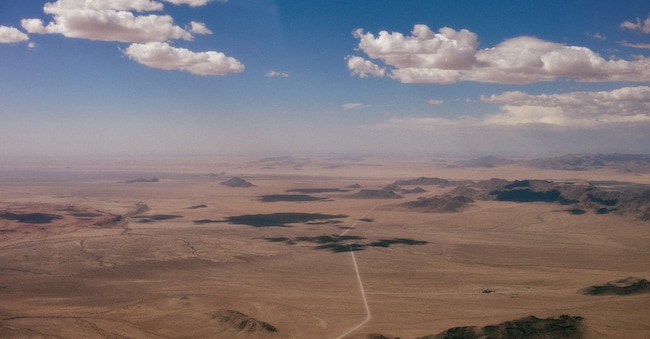
We realise this as we make our way to our first appointment. Travelling here means entering a world where even the journey itself is part of the experience. Distances are never neutral: they are traversed slowly, often from above, and serve to recalibrate one’s perspective. As in the flight that takes us towards the dune at Sossusvlei, in the Namib-Naukluft National Park, which, with its 50,000 square kilometres, is one of the largest conservation areas in the world, an endless stretch of shifting dunes ranging from ochre to red, which give way to the Atlantic Ocean. Nothing is by chance: the word Namib means ‘vast’ in the local language. From Windhoek Airport, the same one where we landed on arrival, we fly for about an hour over a stretch of red earth with a velvety appearance, barely marked by the white of the roads and tracks and interrupted here and there by piles of dark rocks, which seem close enough to touch, so near are they to the aircraft’s fuselage; scattered bushes, even rarer trees. The absence of human traces brings to mind the country’s population density, one of the lowest in the world: two million people spread across an area of 825,000 square kilometres, roughly three times the size of Italia. From up there, the desert seems motionless, but the moment you land, everything becomes unstable, yielding, alive. Like the sudden curving slopes rising up to 300 metres of the immense ochre sand dunes of Sossusvlei, one of the most astonishing sights in the world, even for those accustomed to deserts. After the flight, you reach it after an hour’s drive by jeep, with the light cutting the landscape in two – the red of the earth, the blue of the sky – before beginning the silent ascent of the dune known as 45, named after the air temperature upon arrival, though tempered by a dry wind that brings relief. At the top, the silence is surreal: a forest of black petrified trees emerges from an ancient, dried-up salt marsh, with a jagged base and cracks glistening in the sun. All around, an ocean of red sand dunes stretching as far as the eye can see conveys, at least in part, the scale of the Namib Desert, the oldest in the world, with an estimated age of 55.88 million years. No one speaks: faced with this sight of red and blue lines in the sky intersecting with the black of the tree trunks turned to stone, there is truly nothing more to say.
A LAND OF CREATIVE INSPIRATION
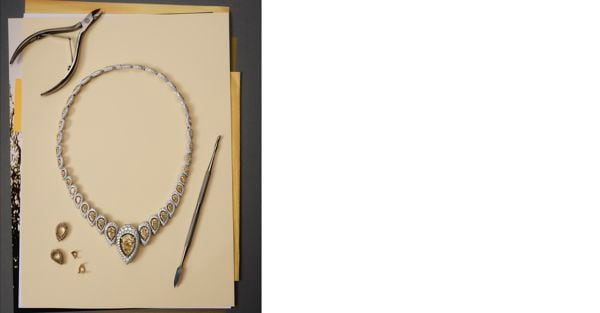
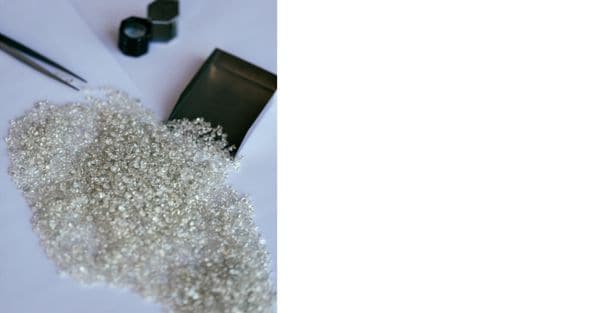
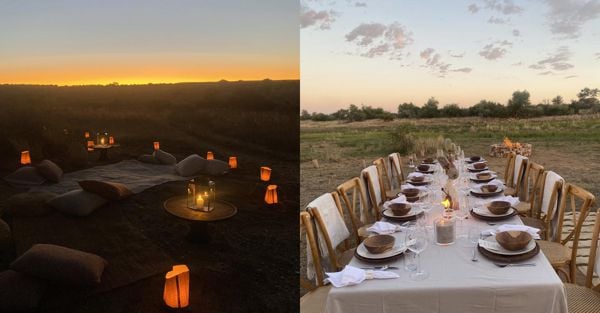
It is against this stark backdrop that Namibia’s connection with the Parisian high-end jewellery house Messika takes shape, inviting us on a journey of discovery to celebrate two decades spent following the trail of another form of pure light: that of diamonds. “Namibia has a very pure, minimalist aesthetic. It is nature to the nth degree, a primal, inspiring force,” sums up Valérie Messika, co-owner alongside her brothers Ilan and Ben. Founded in Paris in 2005 by Valérie, the creative director, alongside her father André Messika—a legendary diamond dealer whose technical and commercial expertise lives on—the house is now one of the most recognisable names in contemporary jewellery. Over ninety boutiques worldwide, a headquarters in Paris, a perfectly organised family-run structure. And a clear identity: minimalist settings, stones taking centre stage, a concept of luxury that prioritises movement and precision over ornamentation, as in the now iconic Move collection. Possessing a natural elegance, as cosmopolitan as the whole family and genuinely passionate about these landscapes, Valérie too is radiant, constantly in motion. ‘Namibia enters my collections not in a figurative form, but as an atmosphere of light, pure essence. I have gathered colours, shades and animal forms, which I do not, however, draw precisely, but rather evoke. I work by subtraction, as if I wanted to distil this land.” As we chat, the tranquil luxury of the Zannier Omaanda Lodge is an oasis of calm. Clean-lined architecture, raw materials, low-slung structures that seem to emerge from the earth, and an obsessive attention to detail, evident in the raw materials, in the punctual yet friendly service, and in the spacious rooms with windows wide open onto the bush, where light pours in and the vintage bathtub evokes the atmosphere of Out of Africa. And it’s easy to see animals passing by just a stone’s throw from the glass.