
Important Collections Find Market Consensus at Christie's in Paris
Positive results for the sales of part of the Crémieux and Renault collections. Good reception also for Contemporary art, second stop for Salvo

5' min read
5' min read
Christie's France, after its April sales of Impressionist and Modern art in Paris that realised €25.7m, organised during the first week of June three sales of 20th and 21st century art that totalled €25m, compared with a pre-sale estimate of between €16.5m and €23m. A respectable result, but it should be noted that 117 of the 201 works belonged to two important private collections: the Crémieux and Renault collections. However, the latter provoked indignation on the part of the legacies of the various artists who, on 28 May, published a letter in the French daily Le Monde declaring themselves "categorically opposed to the dispersal of a significant part of this collection" claiming that the conditions under which the artists had initially agreed to contribute to the collection had been violated and therefore the company had "completely betrayed its commitment to the artists". A controversy that makes one reflect on the collaborations between artists and then their heirs and collectors.
But here is a summary of the most significant results of the three events.
The Cremieux Collection
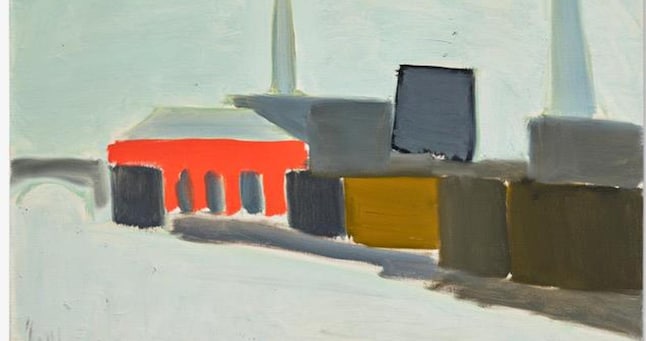
The Collection Crémieux, passion privée sale dispersed 84 lots totalling €4.6m (pre-sale estimate €3.8m - €5.4m). Formed by Rosine Bernheim-Crémieux and Claude Crémieux, their Collection brings together the great names of the French scene such as Matisse, Dubuffet, de Staël and Degottex, as well as international artists such as Rauschenberg, Wesselmann and Lam. Focusing on the post-war period and rooted in the Avant-garde, it also included works from the family legacy firmly rooted in earlier avant-garde artistic currents, as exemplified by Pierre-Auguste Renoir's Impressionist landscapes 'Paysage du midi' (lot 55, oil on canvas 13.6 x 15 cm), which was adjudicated for €94.500, from a pre-sale estimate of €35-55,000, and Auguste Herbin's oil on canvas from 1928-29, 'Composition', pre-sale estimate €150-250,000, which fetched €252,000. Among the other works that attracted interest, lot 12, the catalogue cover, the oil on canvas 'Quai de Grenelle', 1954 by Nicolas de Staël sold for over €1m from an estimate of €600-800k. The two works by Tom Wesselmann in particular lot 2, "Study for Bedroom Painting #3" sold for €233,100 (estimate €80-120,000), while Pablo Picasso's ceramics did not lose appeal, "Figure de proue" from 1952, an edition of 300, sold for €10,080 (estimate €6-8000). Of the three lots offered by the artist Wifredo Lam, only 'Oiseau papaye, Buen ritiro ou Les idoles crépusculaires', 1944 fetched €277,200, within the pre-auction estimate.
The Renault Collection
.All 33 lots in Christie's controversial 'Renault Collection, Leading the way' auction were sold on 6 June and the total proceeds of €10.6m (estimated at between €4.6m and €6.5m) will go towards the creation of the Fonds Renault pour l'art et la culture, an endowment fund dedicated to preserving the works of its art collection and supporting contemporary artistic creations with the aim of creating a unique collection of street art that reflects the company's image worldwide, with a special link to France. It will consist of acquisitions, special commissions and initiatives to spread the artistic culture of Street Art. From 15 June, the first work commissioned from a street artist - produced in the Douai factory, Ampere ElectriCity - will be unveiled in Paris, together with restored works from the historical collection.
The birth of the Renault Collection dates back to 1967 when Claude Renard, an executive with a deep passion for art and culture with close ties toAndré Malraux and various artists, played a crucial role for the collection of the automobile manufacturer, but at the same time also for his private collection, which today in part is held at the Foundation Beyeler: 33 works, i.e. the main nucleus including works byJean Dubuffet, Sam Francis and Sigmar Polke; but also Basquiat and Baldessari, collected over the years by Claude Renard and his wife Micheline. The French car manufacturer had developed a sponsorship model for the collection that was pioneering for Europe and fostered a direct dialogue with the artists. This partnership, which ranged from financial support to privileged access to workshops, led to collaborations and allowed talents to create new and often monumental works by exhibiting them in industrial buildings. Over the years, Renault has built an art collection that reflects its involvement in society, carefully witnessing and actively engaging with the art of its time. This collection now spans a wide range of disciplines and comprises 550 pieces (including 200 photographs, mostly byRobert Doisneau) by leading French and international artists.
The auction featured among the lots the iconic diamond that adorned the Renault logo until 1992, created by Victor Vasarely, an artist who occupies a special position in the company's history. All three of the artist's paintings: 'Tonk' (pre-sale estimate €100,000-150,000), 'Re.Na' (estimate €60,000-80,000) and 'CTA 102' (estimate €50,000-70,000) fetched prices above their maximum estimates at €277,200, €214,200 and €163,800 respectively.
Other highlights of the auction included three works from J. Ian Dubuffet's 'L'Hourloupe' series: 'Lice tapisse' which fetched €1,371,000 (estimate €1,000,000 - €1,500,000), 'Le Moment critique (site avec deux personnages)' which fetched more than €1m (€600,000 - €800,000) and 'Fiston la Filoche' which sold for €995,400 (€400,000 - €600,000).
Among the other notable lots was the kinetic sculpture 'EOS XII' by Swiss artist Jean Tinguely which fetched €403,200 from an estimate of €50-70,000. A work by Sam Francis, "Untitled", 1980 (estimate €200-300,000 fetched €529,200 and "1-800 (Savage)" of 1984 by Robert Rauschenberg sold for €831,600 (estimate €180-250,000) works that illustrate the symbolic role played by the discovery of Contemporary American art in the genesis of the collection.

