
In Poland, the sovereignists are now calling for the ambassadors to resign
Following the row over the Constitutional Court judges, the nationalist president Karol Nawroski has opened a new front against the Tusk government

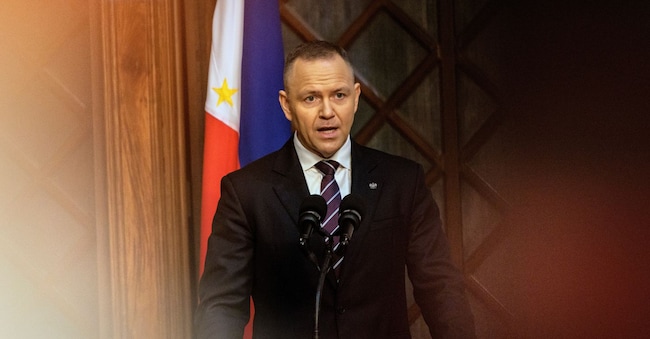
In Poland, the crisis that erupted at the weekend over the appointment of new judges to the Constitutional Court, which has led to an open clash between the sovereignist President Karol Nawrocki on the one hand, and the pro-European right-wing government led by Donald Tusk on the other. Yesterday, Foreign Minister Radoslaw Sikorski accused Nawrocki not only of blocking the appointment and swearing-in of the judges chosen by the Warsaw Parliament, but also of personally pressuring Polish ambassadors to resign from their posts. Such a demand goes beyond the powers reserved for the President of the Republic under the Constitution: ‘I thought it was the President’s staff who had urged the ambassadors to resign and abandon their posts,’ said Sikorski, ‘but it turns out the President did so personally. But forcing Polish ambassadors to resign is simply not the President’s role.” The row over the Constitutional Court has already triggered the sudden resignations of the ambassadors to China and Romania, both of whom were appointed by former President Andrzej Duda, who belongs to the same sovereignist party as Nawrocki, the PiS, which was in power in Poland between 2015 and 2023.
In Warsaw, the institutional crisis began during the night between Friday and Saturday following efforts by Tusk’s government to remove judges appointed under the previous sovereignist administration led by PiS, whose appointments had also been contested by Brussels: the European Union itself had gone so far as to freeze funds earmarked for Poland, arguing that the reforms to the judicial system had undermined the democratic mechanisms of checks and balances.
The standoff between sovereigntists and the pro-European right therefore continues. To date, Judge Anna Korwin-Piotrowska, appointed by the Warsaw Parliament and effectively the Court’s president-designate, has issued her first directives whilst standing outside the Court’s premises, which are still manned by police officers. And there is no shortage of fake news either. The Polish police themselves have had to deny rumours circulating on social media that officers from other countries were also on duty outside the Court’s headquarters. According to the Polish Foreign Minister, this report can be directly traced back to propaganda from Moscow: ‘We are facing,’ he wrote on X, ‘an unprecedented scale of online cooperation between Russian accounts, propagandists and the global far right. This should make us all reflect on who wants to stir up unrest in Poland and who stands to gain from it.’
The way in which this whole affair unfolds will have a significant impact on next year’s parliamentary elections, and could potentially push Poland closer to Russia and further away from the traditional European political camp. For now, however, the Tusk government’s more pro-European and anti-Moscow stance prevails: yesterday, the Polish police (KGP) set up an anti-terrorism task force in the north-east of the country, on the border with Russia, following intelligence warnings about potential Russian incursions and acts of sabotage. The joint security operation, involving the Polish police, army, border guard and special forces, is currently underway in the provinces of Warminsko-Mazurskie and Podlaskie, which border the Russian exclave of Kaliningrad. According to reports by the Polish broadcaster RMF, the government in Warsaw reportedly received warnings last week from the Military Intelligence Service (SWW) and allied intelligence agencies, indicating that armed groups might attempt to breach the state border from the Russian side in the coming days.


