
In Pompeii, the dawn of Christianity
The park's director, Gabriel Zuchtriegel, explains in a documented and visionary book why, precisely in Campania, the word of Christ took root

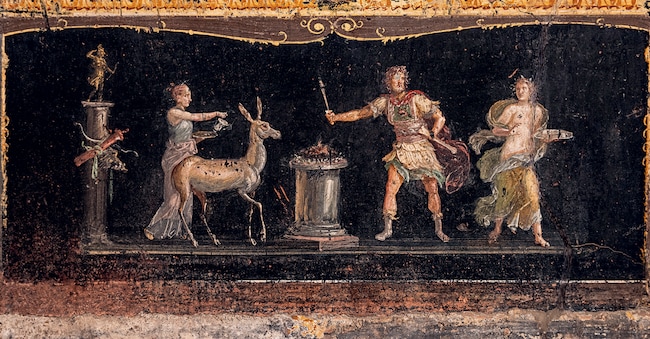
In the Campania felix of the 1st century A.D., rich in fruit and sumptuous villas, Pompeii seems to bow its head, suffering from melancholy and insecurity. And thirsting for novelty, for light, which transforms and gives hope: it is the dawn of Christianity. Little signs that come from the most recent archaeological excavations, threads of a plot to be patiently reassembled for something that is more than suggestive and that Gabriel Zuchtriegel demonstrates with lucidity and passion in his Quando gli dèi lasciarono il mondo. The Last Summer of Pompeii. The director of the Archaeological Park of Pompeii proposes a reconstruction from the excavations of recent years, he puts science and conscience into it: 'Something was broken. It seemed as if the ancient divinities were no longer up to the times: they appeared as relics, the sham of a bygone era'. In that decline of the times, Christianity took root, which, from a Roman perspective, seemed insane, disturbing and profoundly antisocial: 'this is not a systematic work,' explains the author, 'but rather a kind of archaeological reportage based on the most recent excavations, which have reached unprecedented dimensions in the last seventy years.
In 63 AD an earthquake struck the city, then, in 79 AD, the eruption of Vesuvius consigned it to the future under metres of ash and lapilli. It is a felix land, a crossroads port of goods, languages and origins, one hears Latin, Greek, Aramaic, the language of the Levant spoken by Jesus and his disciples. Nearly a third of the population lives in slavery, as the 'property' of others, and in them, deprived of dignitas, 'a revolutionary teaching, overturning all the values of the prevailing order' could be heard 'not very much, there and then, but enough to spread slowly through the arteries of the empire, in its port cities, in the residential quarters and along the back streets, in the shadow of apparently much more important events'. And it is precisely these scraps of life brought back by excavation, by observation, that are the key through which Zuchtriegel, with scintillating writing and visionary and convincing arguments, builds a picture that touches the heart. It is a very human and spiritual archaeology, his.
In the alley of the Lupanare that branches off from Via dell'Abbondanza there is a 'lupanare', the brothel, and the sex workers were all, or almost all, slaves. In those five rooms, sex scenes and obscene graffiti carved on the walls. They were suffocated lives. Opposite, a large villa, perhaps now a hotel, and someone wrote a few words in charcoal on a wall: the graffiti, discovered in 1862 in the atrium, faded immediately but the drawings remain. The text is unequivocal and speaks of Christians, viewed with distrust because they were almost approaching cannibalism, the bread being the body of Christ and the wine his blood. One hundred years after the discovery, based on the transcriptions, scholar Margherita Guarducci proved that the first of the two lines reads: Bovius audi(t) Christianos, i.e. 'Bovius - masculine proper name - listens to/follows Christians'.
Pompeii is a city of majestic temples and villas where the display of frescoes is a narration of myths and divinities, but, writes the director, 'Pompeii does not only show us the beauty of the ancient world, but also its cracks and shadows. And it is precisely there that a new form of spirituality will find fertile ground, take root and blossom. Without shadows, there is no crisis; without crisis, there is neither history nor development: this applies not only to our individual journey, but also to great history'. In Via dell'Abbondanza, the German archaeologist August Mau found the inscription SODOMA GOMORRA in 1885, demonstrating a free relationship with love and sexuality, and how well people lived before Christian morality. In the 'city of Venus', pornography is a common language, represented everywhere, so the affirmation of Christianity is also accompanied by a certain emancipation of women. Threads to tie in knots come from the House of the Thiasos, insula 10, regio IX: in the 'Corinthian room', a 'megalography', a large, extremely rare painting whose subject is the thiasos, the procession of the god Dionysus with a woman in the centre, a simple inhabitant, who is about to be initiated into the Dionysian dances, following the example of Semele and Ariadne. It is the journey between myth and human, as perhaps also in the frescoes of the Villa of the Mysteries. And how can one fail to find other pieces of the puzzle in the House of the Bakery, in Via Nola, excavated in 2023: a fresco that looks like a pizza, but above all the grates on the windows to prevent the slaves who toiled at the millstones from escaping. Also in Civita Giuliana, a kilometre from Pompeii, the servile quarter of a villa with miserable slaves who sometimes acted as the master's informers (the silentiarii) if anyone rebelled. Those men without tomorrow are fertile ground for the kingdom of God, which is first and foremost inner liberation.
The clues in this fascinating book coalesce and whisper to us that Pompeii is us, at the mercy of fears, hopes and memory. We are Osiris, who escorts the sun through the night; we are Ceres, who gives birth to plants from seeds; we are Dionysus, who dies and is reborn, and Zuchtriegel reminds us that for St Augustine it is God who takes us beyond the unknown, that God, 'who never made anything in time', because 'he made time itself' (Confessiones, XI, 14). Pompeii is 'a bend of a river in the current of life' and truth is only in the encounter. With the other, art and time to which we cling confidently because, as the Gospel of Thomas admonishes, "Jesus says: be passers-by".


