
In Sardinia for the rites of Holy Week
These are important signs of the Spanish culture that dominated the island for four centuries

3' min read
Key points
3' min read
The grieving Madonna who, with swords in her heart, searches for Jesus. And then the sound of drums and the 'matracche', the characteristic wooden instruments that, when spun, serve as a background to the procession in which the passion of Christ is relived. From Iglesias to Santulussurgiu, passing through Desulo and Castelsardo. Faith and devotion, but also tourism. Because the events preceding Easter, in Sardinia, animate towns and villages, streets and historic centres. The grieving Madonna who, with swords in her heart, searches for Jesus. And then the sound of drums and the 'matracche', the characteristic wooden instruments that, when spun, serve as a background to the procession in which the passion of Christ is relived.
From Iglesias to Santulussurgiu where tradition is most alive
From Iglesias to Santulussurgiu, via Desulo and Castelsardo. Faith and devotion, but also tourism. Because the events preceding Easter, in Sardinia, animate towns and villages, streets and historic centres. They are one of the most important signs that Spanish culture has left on our island after four centuries of domination.
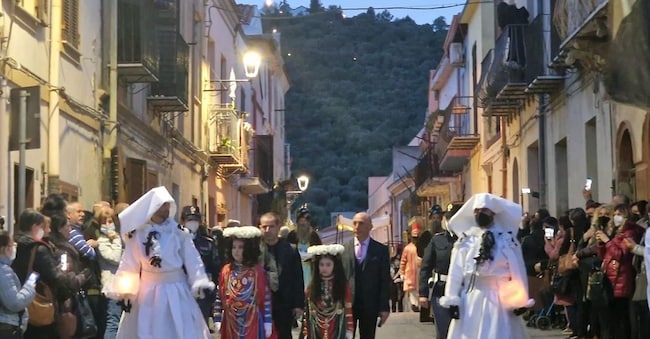
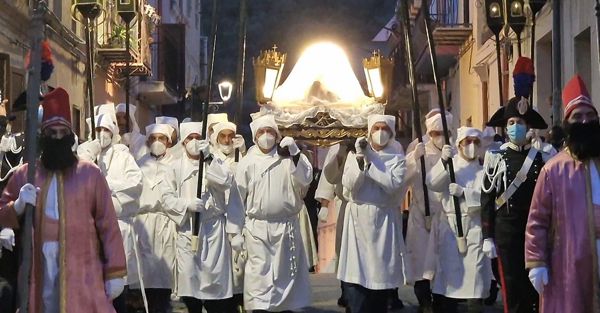
Iglesias is one of the centres where the participation and interest in Holy Week is greatest, so much so that the rituals are a sign of the influences of the Spanish tradition, transforming the oldest part of the town. The current layout of the traditional rites of Holy Week dates back to the last decades of the 17th century, but certainly penitential processions during Lent and Holy Week must have been the rule already, the presence of the Disciplinants in the town being documented in previous centuries. In shop windows the characters of the processions stand out, in the balconies of houses 'su Nenniri', the seeds of wheat or legumes sprouted in the dark, are displayed. In the streets the processions with the Germani (the brethren of the Archconfraternity of the Santo Monte) wearing starched white robes adorned with black bows, the Baballottis (the ancient Disciplinants represented by children and adults) who carry the simulacra on their shoulders on Tuesday for the procession of the Mysteries. There are two stages in the evocative procession: in the church of St Francis and in the cathedral dedicated to St Clare, there is space for two sermons, which usually invite reflection, also on topical issues. Holy Wednesday is the day of the mass and blessing with the 'Lignum Crucis': olive twigs and flowers that represented the olive garden the previous day are distributed to the faithful immediately after the celebration. Thursday is the day of the procession of Our Lady of Sorrows with the simulacrum of Our Lady desperately searching for her son before his arrest. On Friday morning, the Del Monte procession with children in their white baballottis characterises the upper part of the town; in the evening, just after sunset, the procession of the 'Descenso', the funeral of Jesus in Baroque style. It is the most eagerly awaited and popular moment: the streetlights dim and the streets are lit by torches placed on the walls. Many characters take part in the procession: starting with St John and Mary Magdalene, dressed in oriental clothes and enriched by precious jewellery lent by the faithful as a sign of devotion for some grace received. Then there are 'Is Varonis', the nobles, 'Joseph of Arimathea and Nicodemus', Is Vexillas, 'Sa Lettera' with the dead Jesus. Accompanying the procession are also the musical band, the sounds of the 'matracche' and the deaf drums that best represent the drama of the day.
Rituals in Desulo and Castelsardo
.In Desulo, the rites preceding Holy Week begin with the evocative Palm Sunday procession where the colours of the traditional costumes worn by the people in the procession dominate. In Castelsardo, it begins on the Saturday before Palm Sunday with the procession carrying a crucifix from the cathedral to the church of Santa Maria, accompanied by the choirs of the confraternity. Arriving at the church, the Christ is laid on the ground while the Stabba is performed, followed by the crowd in silence before resuming the service. The most important day is Lunissanti, (Holy Monday) which, contrary to most Easter rites in Sardinia, is the day of the mysteries. The brethren gather at 7am to put on their uniforms and then parade from the cathedral to the village of Tergu.
In Santulussurgiu, the four confraternities (Rosary, Holy Cross, Carmine and Our Lady of Sorrows) animate all the events surrounding Holy Week, starting with Palm Sunday, continuing with Holy Tuesday and then processions on Thursday and Friday, until the meeting between the Virgin Mary and the Risen Christ on Sunday.

