Companies

In Scicli, Mangrovia grows vegetables without soil, and ‘only as much as is needed’

Lorenzo Cannella talks about the hydroponic vegetable garden in the Ragusa area, where production – monitored using advanced sensor technology – is ‘tailored’ to the needs of restaurants

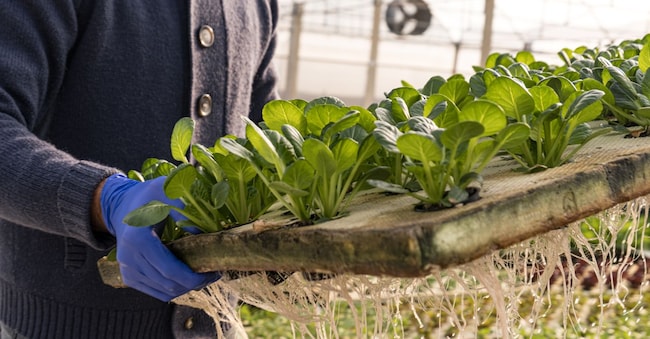
 Foto di Mangrovia

4' min read

Translated by AI
Versione italiana

4' min read

Translated by AI
Versione italiana

Sensors that analyse the air and water and monitor in real time that everything is functioning correctly, whilst also collecting data that will be useful in the future. These are the sensors installed at Mangrovia’s facilities, which grow vegetables in Scicli (in the province of Ragusa). But not in soil: the facility experiments with hydroponic cultivation, tailored to customers’ needs, with the aim of achieving higher yields whilst using fewer resources. Lorenzo Cannella, the project’s founder, spoke to *Il Sole 24 Ore* about this.

How did Mangrovia come about?

Loading...

We wanted to introduce a different approach to farming, both in terms of technique and business model, which is tailored to a niche market, with a smaller-scale operation and carefully selected varieties. We have our own market and grow what we need, producing only what is necessary and nothing more.

What experiments have you carried out so far?

We have worked with both hydroponics and aquaponics (which combines aquaculture and hydroponics in a symbiotic environment), using a closed-loop system, with the aim of producing a healthy product and minimising our environmental impact by reusing as much water as possible. For pest control, we use plant protection products authorised for organic farming, which leave zero residues and have a waiting period of virtually zero, resulting in a very low environmental impact.

Hydroponics is a soilless cultivation technique in which the plant is irrigated with a nutrient solution. To ensure that the water parameters are optimal for plant life and growth, Mangrovia uses advanced sensor technology, one of the key technologies for the future according to the ‘Regional Innovation Strategy for Smart Specialisation – S3’ drawn up by the Department of Productive Activities of the Sicilian Regional Government.

Apart from the technique itself, which is innovative, we do not currently use technologies such as artificial intelligence or robotics. We have a sensor system that helps us better understand the characteristics of the water, and our data collection enables us to track, over time, what is changing and happening in terms of the environment, in the water and in production. At the same time, we carry out the same analysis with market data. We haven’t yet decided on anything specific for the future, but we would like to incorporate AI into the production process, or other tools that can help speed up, improve and simplify our work, from accounting to the management of sales and production data.

What sort of clients have you dealt with so far?

They mainly come from the hospitality sector, particularly restaurants and resorts, ranging from local establishments to ultra-luxury venues. 90 per cent of our clients are Sicilian; we operate across all provinces, but we also have partnerships in northern Italia and one in Paris. We work without intermediaries, which gives us an added edge, because the relationship with the client is important and, beyond the financial and supply aspects, we are keen to engage with the organisations we work with so that we can both grow professionally.

What is it like to innovate in Sicily?

Loading...

In my view, innovation in Sicily faces the same challenges as anywhere else in Italia or the world. You always have to break down barriers, spark people’s curiosity, raise awareness of what you’re doing, explain it and put forward ideas. It’s a tough job. When there are organisations trying to do something different, they must be supported – not just with fine words, but above all with financial backing. Investing in an organisation that innovates gives it the chance to survive and grow over the years. Generally speaking, in Sicily – just as in Italia – we have a short-sighted outlook. Some things improve over time, and if we don’t invest, in a few years’ time we’ll be complaining that there’s nothing new.

Do you think that innovative farming methods can complement or replace traditional ones?

I do not believe that our production can replace that of others, although it does offer added value in terms of certain yield and production characteristics. The future lies in a variety of techniques, depending on the environment, the market, investment opportunities, the availability of labour and local culture. From our point of view, production must be diverse. Just as nature must be biodiverse. The more diverse it is, the better equipped we are to tackle climate change.

Are there any businesses in Sicily similar to yours? Have you ever thought about forming a consortium?

A consortium is an idea we like and are interested in, but there aren’t many local businesses that would be interested in this, because we have a different business model and, moreover, because of the nature of what we offer. We pay close attention to a great many details when making proposals to the organisations we work with. The end result is tailored to them, from the dimensions to how the vegetables are packed, right through to the type of packaging. All these details are designed to be a service within the service, and we’d need to find organisations that are willing to invest and see our work for what it is. We know that, over time, we can find and build partnerships. At the moment we’re still in the early stages, but there’s plenty of time.

Copyright reserved ©
Loading...

Brand connect

Loading...

Newsletter

Notizie e approfondimenti sugli avvenimenti politici, economici e finanziari.

Iscriviti