
In South Tyrol, innovation draws on traditional knowledge
Leather garments that last for centuries, high-tech wool fabrics, the revival of hemp: stories of artisans and custodians who are looking to the future

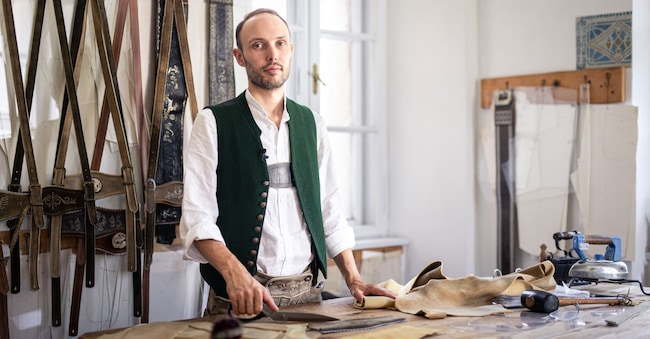
It is said that the castle hides a treasure, but that it is impossible to find because a ghost blocks access to it. Castel Roncolo stands at the entrance to the road leading from Bolzano to the Sarentino Valley, an area which, fortunately, has remained untouched by overtourism – partly because it is deeply attached to its history and culture, so much so that the locals still love to wear traditional dress, often passed down through generations. It is an ideal place to welcome artisan-stewards who, in Sarentino – the largest municipality in the area – are doggedly bringing techniques and materials from centuries past into the 21st century.
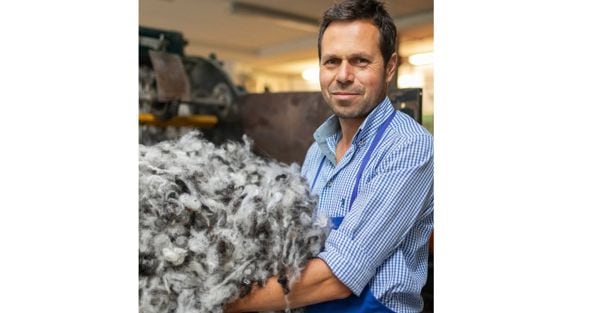
One of them is Albert Unterweger: he collects the wool from the 2,500 sheep that graze in the valley – wool that would otherwise be discarded – from the local shepherds, and transforms it into the ‘Sarner’, the traditional knitted jacket of the area, first recorded as far back as 1590. Thanks to its durability and water-repellent properties – which are also due to the fabric’s special finish – the Sarner has even been adopted by Salewa, a brand belonging to the Oberalp Group, for its latest lifestyle collections: ‘We’re the fifth generation; we process the wool using machinery that’s a century old but still works perfectly,’ says Unterweger in his workshop overlooking a pasture. ‘We carry out many steps by hand, and we’ve even supplied our fabric to Fendi, who used it to make Baguette bags for the Hand in Hand project.’
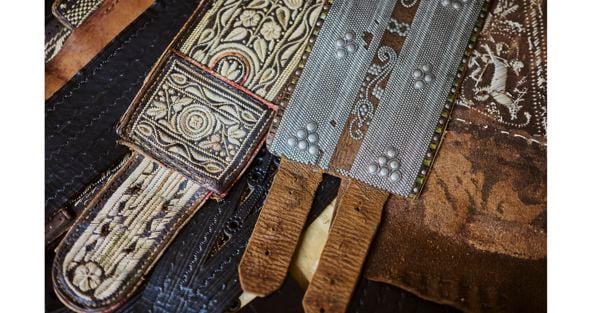
Just head down towards the centre of the village and you’ll come to another workshop where art becomes a form of resistance: the Federkielstickerei run by the Thaler brothers, who inherited the art of peacock-feather embroidery from their grandfather: ‘When the male peacocks shed their tail feathers in summer, we collect them and use the white central part (kiel, ed.) which we cut into very fine strands and sew onto high-quality leather that we buy in Tuscany,’ explains Ulrich Thaler. A young craftswoman standing nearby will still need several dozen hours to finish weaving that ‘thread’ of feather into a belt (facch), using tiny stitches and immense patience. “It’s an art form dating back to the late 18th century, but it’s still in high demand; the belts are often worn on special occasions,” he continues. “We have bookings for the next two years.”
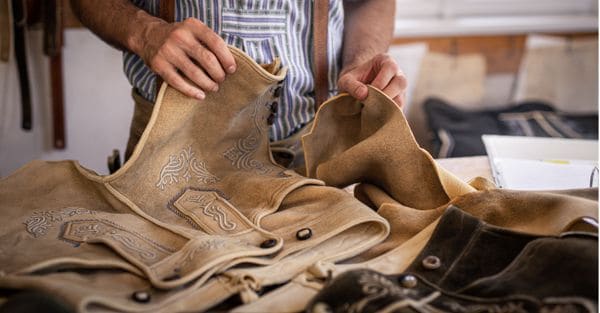
Hand-sewing the lederhosen – the traditional Tyrolean deerskin trousers – with embroidery bearing ancient symbolism (which may vary depending on the customer’s origin, history and trade) are two other brothers, Norman and Thomas Ventura, who in 2014 named their business in Salorno after their grandmother Amalia Pertner, a tenacious late-19th-century clothing merchant, in Salorno. Their workshop is now housed in a 16th-century manor house, where an old grain cupboard has been transformed into a display cabinet for pieces dating back as far as three centuries: ‘My brother and I wanted to save this craft from extinction, and for years we kept pestering the Gebhard brothers from Bressanone – the last artisans who knew how to make them – to teach us,’ says Thomas. ‘In the end, we convinced them, and today we have a workshop with six seamstresses. Lederhosen are very popular with young people, and to raise awareness of this tradition we also organise dinners set up on the workbench.”


