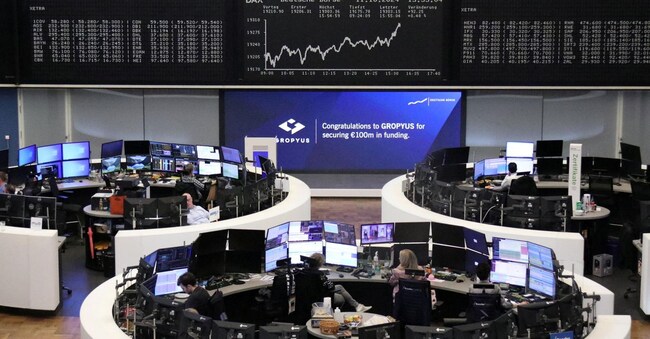
European banks are always the focus of attention. Especially here, given their weight in Piazza Affari in terms of capitalisation and the role they play in the performance of the main index.
They come from a period of excellent health, favoured by interest rates that have allowed them to grind out revenues and thus profits. The situation is the same in many European countries. But now what is the situation and what elements should be considered?
Loading...
The weight of dividends
.
A good indicator to take into account, to assess the health of European banks, may be the amount of dividends.
Major banking institutions will repay more than EUR 50 billion in coupons to shareholders this year, according to Bloomberg calculations. This is a level that has never been reached in the past, which highlights the boost to profits received from rising interest rates. But the season of high rates is coming to an end, with not only the ECB but also the Fed having already started to cut.
If for S&P the performance of European banks in the first half of 2024 is in line with forecasts, the trend on future earnings remains mixed.
Loading...
LE BANCHE EUROPEE SULLE QUALI SCOMMETTERE
Loading...
Declining profits
.
Looking at Italy alone, the six main commercial banks (Intesa, UniCredit, Mediobanca, Mps, Banco Bpm and Bper) posted a net profit of 12.97 billion in the first half of this year, practically the same as the result for the whole of 2022, the year in which the central banks started to raise the cost of money. And Fabi's forecasts, for the whole of 2024, see profits touching 50 billion, up from 40.6 billion in 2023. "After two years of strong earnings growth, thanks to rising interest rates that had significantly improved net interest margin and profitability, we are now at a standstill for European banks," explains Giacomo Saibene, portfolio manager at Quaestio Sgr. "Scandinavian banks are the first to experience this dynamic: the Swedish Risksbank started cutting rates as early as May, taking them from 4% to 3.25% today, and the ECB followed a month late, taking them from 4% to 3.5%. In market prices we see how Scandinavian banks have done worse than their European counterparts by about 15% since the beginning of the year. Today we see analysts reducing their growth estimates for next year especially for the Scandinavian banks, from Swedbank to DNB".
Positioning
.
In this context, it might be useful to position where interest rates will remain higher for longer and where the growth of the economy will be stronger. "In the first case, we are more constructive on British banks," continues Saibene, "from Barclays to NatWest, where the policy rate has remained at 5% after only one cut of 0.25%. As for the second case, 'on banks in peripheral countries, such as Spain or Italy, where the economy seems to be showing better signs than in Germany or France, we opt for names such as UniCredit, Bper or CaixaBank,' concludes Saibene. The monetary easing initiated by the ECB will inevitably have an effect on the banking sector, with the risk that earnings growth will slow down. "Looking at the Euribor curve, more than 600 billion in net interest income is potentially at risk between now and mid-2025," points out Filippo Alloatti, head of financials credit at Federated Hermes. "Hence the increasing focus of various management on fee income. The Danish compromise pushes banks to acquire insurance companies, avoiding double counting and softening the absorption of assets'. This means that the more exposed banks 'such as Intesa San Paolo, or the French or UniCredit, which is buying back CNP and Allianz shares in joint ventures, will see this income component better valued,' Alloatti adds. The discourse can also be extended to asset management. which remains a leading sector.
Acquisitions in pole
.
Bnp Paribas is moving swiftly and the acquisition of Axa's asset management business will set the standard,' Alloatti points out. 'UniCredit's reckless campaign on Commerzbank, with its implications in the event of success, opens up interesting scenarios, while Société Générale has speculative appeal with a stock market capitalisation of just 18 billion but problems of cost and size, especially in retail banking'. Finally, the privatisations of Mps and Abn Ambro in the Netherlands could attract the attention of other European banks, thus expanding the banking risiko.