
In the Dolomites of Bruneck/Brunico, new life for the ultra-millennial Castle Badia
It is the new project of Aldo Melpignano (Egnazia Ospitalià Italiana), which took three years of work and painstaking recovery

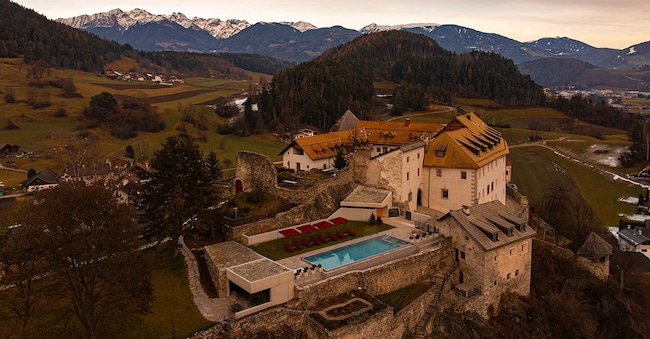
Often, newly opened hotels seem a little sour, cold. The entrance to Castel Badia, which opened in December 2025, catapults us into a warm and welcoming ambience that seems to have been there forever. Loden curtains open onto what will be the stage for a panoramic stay on the hill of San Lorenzo de Sebato, a small village in Val Pusteria, near Brunico and the slopes of Plan de Corones. Castel Badia is a fortress founded in the year 1000, which over the centuries has been a courthouse, the first women's convent in the old Tyrol, a noble residence and, since the 1970s, a hotel. After three years of construction, it is a new project that will leave its mark in the Dolomites. First and foremost for the painstaking renovation, which, by recovering the structure, wooden floors and ceilings, decorated vaults and period furnishings, links the refined present with its ultra-millennial past.
The rebirth of an ancient fortress
Scent of wood, refined yet informal ambience and large windows framing the surrounding Dolomites. Sofas, plants and objects create a relaxing atmosphere, where you feel immediately at home. Merit also goes to the young, spontaneous and close-knit staff. To make the castle a comfortable and contemporary place, the forces of the Niull 17 studio for the structure, the twins Nathalie and Virginie Droulers for the interior, and Marta Ferri for the creative direction joined forces. A team of local artisans, craftsmen and restorers worked painstakingly with them. The result? A contemporary hotel, full of small touches, from history and design books to the choice of religious paintings, from natural materials to landscape-inspired colours, in constant dialogue with its history and past.
Wellbeing for guests in the foreground
Guests' wellbeing is at the heart of this project with almost a thousand square metres of spa, relaxation areas with views and fragments of antique frescoes on the walls, three swimming pools, two of which are outdoors in the park, with the medicinal garden and the crypt of San Lorenzo, always open even for non-guests. And comfort is always spoken of in the kitchen of Alberto Toè, a volcanic young chef. Venetian by origin, he grew up in the kitchens of Caminada and Niederkofler, both three Michelin stars, and now he happily returns to the mountains, where he can ski and cycle before setting to work in the kitchen. In addition to the gourmet restaurant that is only open in the evenings, he does more easy and local cooking in the stube. But his kingdom is a show kitchen with a worktop in the middle on which he brings seasonal ingredients and a grill on which he cooks them. What you will eat is a surprise.
There are 29 warm and bright rooms in the castle (including an independent chalet), with fragrant woods, soft carpets, armchairs and wool blankets. Some suites have panoramic bathtubs, others have private steam baths, but all overlook the Dolomites. On arrival, instead of the usual welcome bubbles, there is a bottle of apple juice, one of the area's excellent products. And for the children there is a club where they organise games, film screenings and small adventures. If you loved Borgo Egnazia in Apulia, this is its 'mountain version' in the Dolomites, where Ian Schrager's Italian pupil - Aldo Melpignano - promises to bring the same energy and cheerfulness, with entertainment and events here in South Tyrol style.

