
In the Dolomites without a smartphone: Val di Fassa hosts the first digital detox retreat in an alpine refuge
The experience at the Contrin Mountain Hut, organised by the Tourist Board and led by Alessio Carciofi, an expert in digital and corporate wellbeing: three days without social media or notifications to rediscover a balanced relationship with technology

Key points
Have you ever felt overwhelmed or stressed by heavy use of your smartphone? If the answer is yes, then you’re probably among that percentage of Italians - 38.1 per cent, according to the latest Censis report – who have, at least once, felt the need to undertake a digital detox, that is, an experience of disconnection, of detoxing from social media, notifications and the hundreds of chats that fill (and sometimes overwhelm) our day.
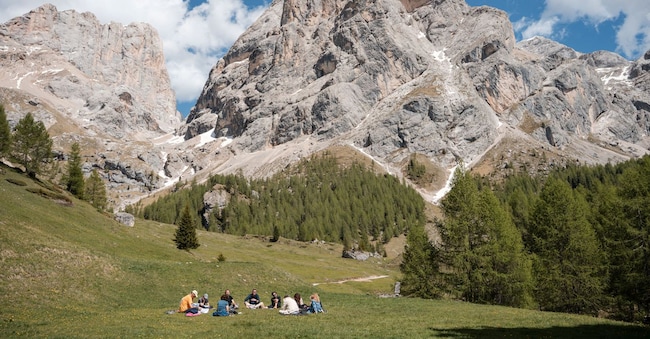
You’ll be interested to know, then, that a few weeks ago in Val di Fassa, in the Trentino Dolomites, the first digital detox retreat took place in an alpine refuge: three days without a mobile phone in hand, immersed in the valley’s magnificent natural surroundings, with walks through the silence of the woods and moments of learning and sharing. I can tell you all about it in detail because I was up there in those mountains a few weeks ago, along with other journalists who were the first in Italia to have the chance to experience what it means to silence your notifications and listen to the energy of the mountains.
Screens off and forest bathing
We were guests at the Rifugio Contrin, run by the young mountain hut warden Francesca Debertol, at an altitude of over 2,000 metres, as part of a special retreat organised by the Val di Fassa Tourist Board and led by Alessio Carciofi, a university professor, author and speaker, one of Italy’s leading experts on digital detox and corporate wellbeing. For three days, we were guided through moments of reflection and sharing, and mindfulness practices, amidst the enchanting scenery of flower-filled meadows at the foot of the Marmolada. We enjoyed a silent dinner, followed by forest bathing, led by the specialist guide Katiuscia Rasom: not just a simple walk, but a slow and gradual immersion amongst firs, larch and Swiss stone pine trees, to meditate in nature and experience just how the mere sight of greenery can almost instantly relieve the tensions we usually accumulate. And so we discovered that the forest is not just a place, but a living presence, capable of communicating with those who know how to listen.
Put an end to mindless habits and hyper-connectivity
But what does it mean to do a digital detox? It means ‘not just giving up your screen for a few days – that’s the most visible step, and almost the easiest,’ explains Alessio Carciofi, ‘but the real work begins afterwards, when you no longer have something to check at every interruption and you find yourself faced with a very simple question: do I still know how to be present where I am?’ The expert in digital wellbeing points out that, according to some research, we check our phones more than two hundred times a day and ‘even without taking that figure literally for everyone,’ he says, ‘the picture is clear: we don’t just check our phones once. We keep going back to it, as if there were always something we might be missing.’ And so ‘we live in a state of constant connection and often mistake it for life, and a retreat serves to break this automatic behaviour. Not to escape from the world,” continues Carciofi, “but to return to living in it with less noise weighing us down.”
So, no demonising of technology here, but simply an experience to ‘put it back in its place’ and get back to listening to ourselves. After all, says the expert, ‘digital wellbeing is also about this: putting boundaries back into our days. Because we’ve removed boundaries from almost everything. Work creeps into our beds, chats intrude on our dinners, the news intrudes on our waking moments, and urgent matters intrude on the time we spend with our loved ones. Everything seeps into everything else. And when everything can intrude at any time, nothing remains truly protected.”


