
In the fake market, electronics undermines clothing
Piedmont is the second region, after Lazio, in terms of number of seizures with 11.9 million pieces

3' min read
3' min read
A product, if passed off as Italian, is worth 20% more. A tricolour cockade on the packaging is enough to send the price soaring. Despite the risk of incurring a criminal offence punishable by imprisonment, the fake market knows no crisis. According to the latest data from the Ministry of Enterprise and Made in Italy's Hyperico report, which analyses the numbers of seizures carried out by the Guardia di Finanza and the Customs and Monopolies Agency, 68.6 million pieces were sealed in Italy in 2023, an increase of 408% compared to 2022, with a total value of 187.9 million euro. Piedmont was the second region, after Lazio, for the number of seizures, with 11.9 million pieces.
It is no coincidence that the economic and financial police unit of the Turin Guardia di Finanza, which also deals with counterfeiting and trade fraud, is one of the largest in Piedmont. "Almost never do our investigations remain confined to the Turin area," explains the commander of the nucleus, Colonel Alessandro Langella. The great wealth of information we have acquired allows us to follow the counterfeit product all the way to its origin, disentangling the entire supply chain: from logistics to distribution, right down to the financing channels of individual productions'.
It is intelligence work that takes investigators to the factories where the products are packaged and then resold in Italy. In December, for example, following a consignment of vegetable seeds passed off as Italian, but produced in China, investigators arrived first in the Cesenate area, then in Piacenza, where they seized almost two million bags of seeds and 29 industrial packaging machines, for a total value of 38 million euro.
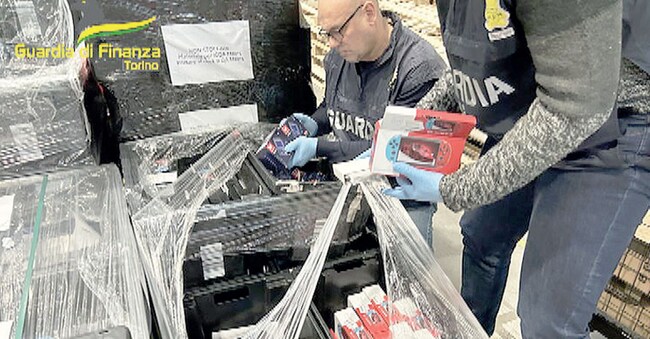
Today, it is not designer handbags that drive the black market in fakes. Sixty-six per cent of the seizures concern electronic material, followed by clothing and accessories, which still account for 43.2 per cent of the products seized, and then toys, with a market of over 22 million euro. But there are many other goods that have caught on in the world of fakes (not only made in Italy). There is practically no product that cannot be 'counterfeited' if the producers of the fake intercept the growing market demand. This is the case with vintage consoles, with 1980s and 1990s video games coming back into fashion thanks to the retrogaming phenomenon. The GdF, coordinated by the Turin public prosecutor's office, discovered and withdrew from the market 12 thousand consoles on which pirated video games worth over 47 million euro had been loaded. Even in the automotive sector, especially in Piedmont, there is no shortage of lucrative counterfeiting attempts, such as that of a company in Volvera, specialising in the production of wheel covers falsely labelled with the trademarks of major European brands. Investigations led to the blocking of 13 production lines.
It is a market that increasingly uses online marketplaces to sell its products and expand its potential customer base. But traditional routes are also still heavily travelled: ports and airports are crucial hubs in the fight against counterfeiting. In the first half of 2024, at the port of Genoa, the Customs and Monopolies Agency seized 190,000 items. An activity that also has major repercussions on Piedmont, because many of the goods arriving in the Ligurian port are then cleared through customs in Rivalta Scrivia, in the Alessandria area, considered by insiders to be the back-port of Genoa's activity.

