
In Tolentino, in the Marche region, it is a tribute to design and its local area
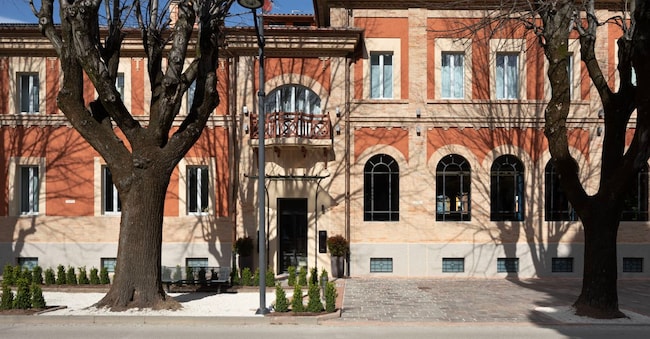
The hotel, designed by Franco Moschini, owner of Poltrona Frau, is situated in the former factory of Nazareno Gabrielli, a historic factory in this town in the Marche region

Key points
Franco Moschini (1934–2025) is to Tolentino what Henry Ford is to Detroit, Crespi to Trezzo sull’Adda, and Olivetti to Ivrea. All things considered and in the context of his time, Moschini was a magnate for his small town in the province of Macerata – the sort who brings prosperity, shares it, and seeks to help his community grow, rather than simply increasing his bank balance. A man of a bygone era, a Cavaliere.
The insight of a passionate entrepreneur
In 1962, needing to recover a debt from Poltrona Frau in Turin – a company that was not in a good financial position – Moschini set off to negotiate its sale. The deal went through and production was transferred to Tolentino, to the factory of Nazareno Gabrielli, the leather goods company founded by his wife’s grandfather. In the Marche region, the company took off once more, bringing prosperity to the town and its inhabitants. Moschini’s insight was to invite the finest designers of the time to create the new collections. First among them was Gio Ponti, who in 1965 designed the Dezza upholstered armchair for a hotel. Since then, Poltrona Frau has collaborated with the stars – Castiglioni, Cappelli, Magistretti, Zanuso, Aulenti, Palomba Serafini – and with anyone who needed armchairs, from theatres to trains, from airlines to luxury cars. It is highly likely that all of us, at least once in our lives, have sat in an armchair from the Marche region.
A manufacturer with a long-standing tradition
In 2014, the company was sold to the American Hawarth family, but the company remains in Tolentino and, to tell its story, has converted a warehouse in the industrial estate into a museum designed by Michele De Lucchi to resemble a theatre, where the stars of the show are Poltrona Frau’s chairs, from the company’s origins right through to its most recent designs. Cavalier Moschini, through his holding company, acquired Gebrüder Thonet, famous for its Viennese wicker chairs, and subsequently focused on a major new project: restoring the former Gabrielli factory in the city centre, which was severely damaged by the 2016 earthquake, and transforming it into a hotel.
Every room is an iconic piece
Interno Marche was conceived as a way of giving back to the local area, and its 25 rooms pay tribute to the designers who have been associated with Poltrona Frau. Each room has been furnished with its own iconic pieces, following extensive research; where items were no longer in production, the manufacturers have produced them specifically for the hotel. The experience is different in every room. Room 201, in glossy black and white, resembles a micro-museum dedicated to Mario Bellini and Cassina, featuring the Cab Night bed, the Cab 412 chair – the world’s first self-supporting leather chair – and the Chiara T lamp. In a former office featuring frescoes by Nazareno Gabrielli, they have created the Piero Lissoni room, featuring the Moov bed, the Eve chair and the Camouflage lamps. Meanwhile, the Vico Magistretti room features iconic pieces such as the Atollo and Eclissi lamps and the 0301 chair with its oriental-inspired lines, now produced by Gebrüder Thonet. A further five rooms, in a building opposite, are dedicated to artistic movements – Modernism, Arts & Crafts, Pop Art, the Vienna Secession and Radical Design – featuring historic pieces from every era.
The tastes and flavours of a gentle land
Finding a common thread amongst so many disparate elements, all of the highest quality, was no easy task. Moschini, with his customary commitment to supporting local talent, placed his trust in the Ora studio, a team of young architects from Tolentino, who have woven a design that is immediately recognisable and have enhanced the factory’s original features. The photographs in the corridors tell the story of Poltrona Frau and its key moments; in the first corridor there is an original armchair by Renzo Frau, dating from 1934, and in the bistro there are several leather and paper artefacts on display from the historic Nazareno Gabrielli company. Speaking of the Bistrot, the cuisine is not about design but about authentic flavours and generous portions – a sign that certain core values remain firmly in place here.

