
In the Humanitas knowledge hangar training the doctors of the future
Architect Taidelli: the Innovation Building is designed to express the sense of frontier research with an eye to the future and hands firmly anchored in the values of the scientific method

3' min read
3' min read
An innovative building in terms of construction process, materials used and final performance, dedicated (not by chance) to engineer Roberto Rocca, a leading figure in the promotion of avant-garde scientific culture, and hosting study and research activities with very high added value.
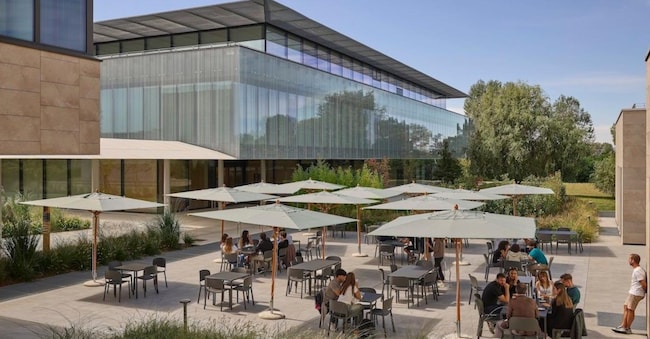
We are talking about the Innovation Building of the Humanitas University Campus in Pieve Emanuele, bordering the South Milan Agricultural Park. A new-concept building, designed by Filippo Taidelli, owner of the studio of the same name and already a signature of the campus, "to encourage dialogue and interdisciplinary exchange between Medicine and Engineering and to welcome students, professors and employees as a single social community, without spatial hierarchies".
The Innovation Building (6,000 square metres on three levels, inaugurated just a few months ago) houses part of the teaching activities of Humanitas University, a university that is closely integrated with the Irccs Istituto Clinico Humanitas in Rozzano and boasts a visiting faculty of Nobel Prize winners in medicine and internationally renowned researchers in the various active courses, including the course in Medicine and Biomedical Engineering (MEDTEC School) run in collaboration with the Milan Polytechnic. This 'knowledge hangar' also houses all the activities of the advanced laboratories for 3D printing of biomedical materials, surgical phantoms and bioprinting, the laboratories for electron microscopy, as well as the AI Centre, the centre for Artificial Intelligence in which doctors, researchers, data scientists and engineers work side by side to identify new diagnostic systems, guarantee increasingly personalised treatment, increase the speed and precision of interventions and help hospitals in better patient care and treatment.
"The Innovation Building is also designed to express through form and material the sense of frontier research, with an eye to the future and hands firmly anchored in the values of the scientific method," explains Taidelli. All the choices go in this direction: from the building's transparent envelope, with its double glass skin, which guarantees maximum natural light, energy performance and visual continuitỳ with the park outside, to the materials chosen, i.e. wood, concrete and steel, in many cases deliberately exposed; from the internal layout of the space with the large central volume starting from the nave that opens into the atrium of great narrative impact, to the versatility of the classrooms and all the spaces. "The building invites us to think and create connections and aims at a dynamic and modifiable use of space," continues the architect, "which must be able to be reconfigured to interpret future needs and functions, which we cannot yet imagine today. The inscrutability of technology requires the design of flexible buildings, capable of adapting to rapid changes of use'.
The building was also awarded in January by the "Wood Architecture Prize", an award promoted by the Klimahouse trade fair in Bolzano, with the Turin Polytechnic, the Iuav University of Venice, and PEFC to valorise contemporary technological wood structures. The high degree of energy efficiency is also reflected in the LEED Gold Certification. "A knowledge factory," Taidelli concludes, "built around the needs of teachers and students, to host the highest of exercises, that is, the transfer of knowledge that is at the basis of all progress and that can only germinate in a place designed to foster relationships between people.

