
In the mine of the tennis scribe
At the Catholic University of Brescia, Gianni Clerici's publishing heritage: a precious journey through tournaments and talents (and more)

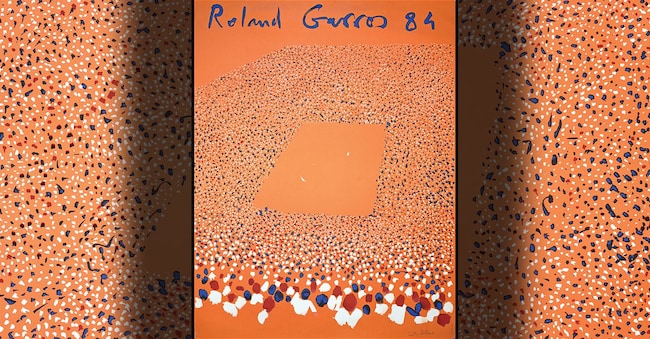
He possessed that British spirit - in the sense of elegant and punctual - even in the archiving of his holdings: the articles published over more than sixty years bound in folders and carefully framed by a red highlighter, to make their presence stand out on the page; the tennis magazines catalogued with expertise and precision; the books - his own and those of others - documenting the constant updating on everything that was published, from biographies to manuals, from volumes of statistics to novels; the tournament posters, graphic specimens of equal aesthetic value (like the one on the page), a journey in the journey of this sport, alongside the writing.
Browsing through the collections of a journalist and writer like Gianni Clerici, who spanned the second half of the 20th century and the first two decades of this century, here and there, one can lose one's head. Donated by his family to the Catholic University of Brescia, where the reorganisation and inventory work is currently underway under the careful guidance of Pierangelo Goffi - head of the university's library, historical collections and archives - they are a veritable treasure trove that includes almost two thousand photographs, drafts of books (later published) with corrections by intellectuals such as Giorgio Bassani and Mario Soldati, and correspondence with friends and protagonists of Italian culture such as Oreste del Buono and Alberto Arbasino.
Those who love tennis could set up a tent and make an arrangement with the university canteen, because staying a few hours just isn't enough. Even just reading some of the chronicles in the 'Gazzetta dello Sport', the 'Giorno' and, of course, the 'Repubblica' is an enjoyment for the use of words (even before the strictly tennis-related assessments). For certain unforgettable portraits, such as that of Baron von Cramm in the aftermath of his death, for some biting headlines (see 'Becker's marble legs') or affectionate ones ('Monsieur Panattà has enchanted Parisians') inspired by his pen. For the disappointment "whose equal the scribe does not remember", the famous 2019 final lost at Church Road by Roger Federer to Novak Djokovic after squandering two match points: wouldn't a draw have been fairer, for once?", he concludes bitterly in an italic.
But this is only a slice of the cake. The collections of magazines - starting with Italy's oldest, 'Il Tennis Italiano', alongside the American 'World Tennis', the English 'Lawn Tennis' and many others - transport us to another era of the sport, as do the neat notebooks with Clerici's results as a player (respectable, by the way, having been to Wimbledon in 1953 and Paris in 1954) and the black-and-white photos with other elegant athletes of those years such as Fausto Gardini and Umberto (Bitti) Bergamo. While gazing at the dedications of Lea Pericoli and Novak Djokovic inscribed on their respective books, one's eyes run over the shelves where various tennis encyclopaedias stand, pausing over his all-time favourite player, the divine Suzanne Lenglen. Then they linger on the colours of the panels along the walls reproducing some posters: the epic '76 Davis Cup final between Chile and Italy on a blue background, the Wimbledon centre court (1997) in a triumph of green, the fiery ground of Roland Garros (1984) that rises up just by looking at it.A trip to the depot yields other surprises, such as the notebooks in which he jotted down the progress of the matches, perhaps already preparing the attack of a piece or fixing comments that would come in handy when remembering a point, such as the quadruple "Fuck!" on the sidelines of a match between Serena Williams and Lindsay Davenport. Large tubes contain posters and playbills waiting to find a suitable location, as well as hundreds of photos that will soon be identified and catalogued, not only tennis-related. They tell of the world travels and curiosity of those who took them. Among papers and memorabilia of various kinds, there is a record-book on the Davis of '76 by journalist Mario Giobbe, with the voice of Paolo Bertolucci conveying the strength and team spirit of that great team, and the Tennis Pocket Book, a little notebook on Roland Garros in 1999 with statistics by Rino Tommasi, companion of memorable commentaries.
Before leaving, one last curiosity: what did the scribe say about a certain Jannik Sinner, when he was starting to make his mark? Here in 'La Repubblica', 8 November 2019, is his assessment on the eve of the semifinal of the Next Gen Atp Finals with Miomir Kekmanovic (later won by the South Tyrolean, who was then eighteen years old): "His strokes seem to have existed since kindergarten, from the day when, like all the sportsmen in his area, he could have been a skier (...) You have never seen a more gifted Italian tennis player, and I can affirm this myself, who met on a court at the old Parioli Nicola Pietrangeli when he was sixteen". It all adds up, you see? Jannik's rise is a story already written, preserved in the pages and glances of Gianni Clerici. All you had to do was know how to read it.


