
In the name of sustainability new services at Villaggio Barona in Milan
The visionary project conceived in 2003 by the Attilio and Teresa Cassoni Foundation has been a model of urban and social regeneration at national level for the past 20 years on an area of approximately 30,000 square metres
4' min read
Key points
4' min read
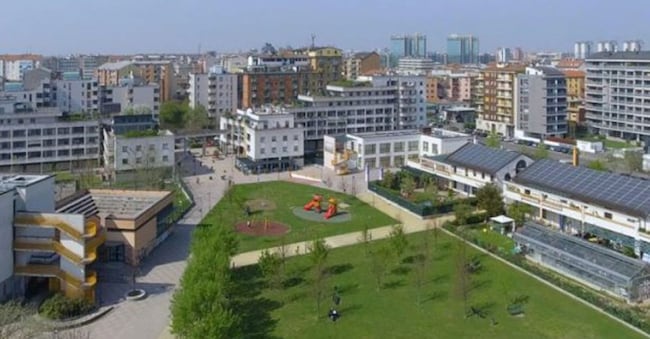
New life for the 'Avv. Giuseppe Sala' park in Villaggio Barona, the visionary project conceived in 2003 by the Attilio and Teresa Cassoni Foundation, which is preparing to write a new chapter in its history and its relationship with the neighbourhood and the city. For more than twenty years, Villaggio Barona has been an outpost of excellence on the Milanese urban welfare scene: born on the initiative of the Cassoni Foundation, the Village has become a recognised model of urban and community regeneration, hosting more than 30 realities including associations, cooperatives, health services and commercial activities, all committed to a common project: to create shared wellbeing and sustainable development in the Barona neighbourhood and the city. Considered the first social housing project promoted by a private individual in Italy, it was born when the term "social housing" was still the prerogative of a few architects in northern Europe, and is conceived not only as a place of residence, but as a model of community life that combines residency, services, culture, sport, ethical commerce and social enterprise. The project extends over several buildings between Via Ettore Ponti, Via Zumbini and Via privata Cassoni, with a total area of about 30,000 square metres, welcoming hundreds of people every day, including residents, students, the elderly, families, people with fragility and workers.
The new services
.The Barona Village expands its offer with a new multifunctional green area that enriches its social and environmental inclination, with a space designed for all generations, under the banner of sharing and collective wellbeing. The new space also includes a new area equipped for dogs; an events area with a large stage, designed for concerts, shows and cultural events under the stars, ready to host the multifaceted summer calendar. A new gate on Via Italo Svevo will connect the park to the Milano Green Way Community Garden, another green space with an educational farm, curated by Opera in Fiore in cooperation with the Milan City Council and managed by the Cassoni Foundation. "This work represents the completion of the original vision of the Baron Village," recalled Gabriele Rabaiotti, President of the Cassoni Foundation, "a place that is not just about living, but also about meeting, growing, caring for, working, building together.
Joint work for environmental sustainability and social inclusion
The expansion of the green areas, in the spirit of the Villaggio Barona, is the result of joint work with the project partners, different realities that have put themselves on the line for the common good. The Forestami Wood was realised thanks to the collaboration with Forestami, which allowed the planting of 116 medium-sized trees to create a tree-lined lawn and adorn the new green areas. The Opera in Fiore cooperative, an actor that has always been active in the Barona Village, also contributed to the work. It sees this intervention as the natural evolution of the virtuous projects implemented in recent years for environmental sustainability and social inclusion, generating new jobs for disadvantaged people thanks to an incredible collaborative network between Forestami, Canon, AfolMet and the Cassoni Foundation. With Canon Italia's contribution, it was possible to create the new irrigation system, fundamental for the growth and maintenance of the Forestami forest in the years to come. Lastly, to guarantee a play/sports activity that is fundamental for keeping the new space alive over time, the BPM Foundation contributed to the creation of a multi-purpose basketball and five-a-side football pitch, destined to become a new reference point for young people (and others) in the neighbourhood.
Residences, accommodation centres, cultural and sports spaces
A network of high-density social services within the Village coexist with experiences of great human and professional value. They range from social residences such as Casa Serena (for people with psychological distress), Casa Alloggio A77 (for AIDS patients), and Casa Grace (designed for self-sufficient or partially self-sufficient elderly people, with an innovative view to social housing for the elderly), as well as 77 dwellings rented at subsidised rents, services for children and parenthood, with the Il Giardino nursery school and the ASP-GiocoMondo family centre, and inclusion and work projects such as Officina dell'Abitare, Opera in Fiore, A&I, Graffiti, which offer employment paths for prisoners, migrants, people with disabilities and young NEETs (i.e. young people neither employed nor in education or training). There are also reception and care centres such as the 'Ponti' Youth Centre of the ASST Santi Paolo e Carlo, Arcobaleno Hub for the disabled and the NAGA HAR centre for refugees and victims of torture. The jewel in the Village's crown are also a number of cultural and leisure spaces: from the Lab Barona - Milan's first 'repair café', a circular economy workshop for students and families - to the Casolo and Aletti multi-purpose halls, as well as entrepreneurial activities with a strong social impact, such as the Milcopy solidarity stationery shop, the Mondadori Bookstore (which organises literary meetings every month, with various recreational and reading activities also designed for children, including bookshop nights) and the Ribalta Barona risto-pub, a craft brewery that is first and foremost a cultural and gastronomic project housed within the Zumbini 6 integrated boarding school, managed by the La Cordata cooperative. Ininfe, there is no shortage of places for sport: the PalaBarona, the Barona Village's multi-purpose gymnasium, hosts numerous activities and sports venues throughout the year, with basketball and artistic gymnastics courses designed for children and young people promoted by associations such as Basket Femminile Milano (BFM) and SGEAM 2003, to the volleyball and basketball teams of IULM University. As part of the expansion of the Village park, a new open-air sports field was created, designed for free activities of the neighbourhood's youth, organised tournaments and seasonal sports events.

Brand connect


Newsletter RealEstate+
La newsletter premium dedicata al mondo del mercato immobiliare con inchieste esclusive, notizie, analisi ed approfondimenti
Abbonati