
On the Neverland in Bergamo, hope for the future and integration
The author, invited to discuss the screening of 'Ali has blue eyes', reflects, together with families from 14 ethnic groups, on the new citizens

4' min read
4' min read
A sense of bewilderment takes hold of you as you find yourself on a warm June evening invited to comment on a film forum in Ponte San Pietro in the middle of the island. An island that doesn't exist except as a spatial metaphor for the area between the Brembo and Adda rivers, teeming with roundabouts and warehouses that swallow the names of what remains of the villages. Disoriented, you reposition yourself between Pontida and Bergamo and the Dalmine tollgate. You are in that island produced by the eruption of the volcano of producing lava from the numbers of companies in the foothills of Lombardy, traced by network capitalism between Malpensa and Orio al Serio. I wonder if my friend Roncoroni of the Cda (Food Distribution Consortium), who invited me, wants to use the cineforum as a place and moment of conscientization for the themes of work and doing business.
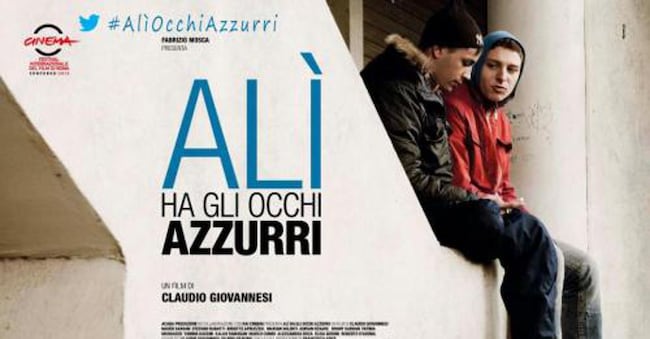
Cinema played a role as a reflective critical consciousness in the years of the economic boom and the assumption of class consciousness and could be used to understand the shed boom and the living, dwelling and working in the triangle of Neverland. Instead, I found myself in a kindergarten. Screening of the film Alì ha gli occhi azzurri by Claudio Giovannesi in a cineforum cycle on the second generations, sisters and brothers of the 50 children in that educating community, where 14 ethnic groups coexist: the melting pot of families in that small village junction between Pontida and Bergamo, and I emphasise Pontida, of 12 thousand inhabitants of which 20% are immigrants. An emblematic place to understand the impact of flows in places that change economically, culturally and anthropologically. In the centre of the town, where there was the legendary Legler textile company, a Swiss family that made business and a hard-working community from the late 19th century throughout the 20th century, today the water of the Brembo river cools the energy-consuming circuits of Aruba's European data centre. Despite having pioneered the Migros supermarket formula with Legler, today it is a commercial desertification town, surrounded by Bergamo's mega shopping centres. It seems to have a destiny to be a meeting place for the multitude put to work in the island district where, in the words of Max Frisch, 'we were looking for arms and people came'. Luckily, the kindergarten has held its own with its hopeful numbers for our demographic winter. From being a non-profit organisation Principessa Margherita 1867 Infant School, Donation of Count Moroni, to becoming in 2023 a third sector organisation run by Piermauro Sala. In its courtyard equipped for projection, two girls, one from Burchina Faso and the other from Morocco like the boy, gather, presented by three second-generation youths, with their wishes on how to get through the present. Many are the children's families, relatives, sisters and brothers of the fourteen ethnic groups who follow the bitter and Pasolinian story of Ali trying to eat a future in Ostia, a metaphor for the sea of the island that laps Bergamo. And then the debate. It goes far beyond wanting to know more about Ali and his peers. It becomes an evening questioning families, the local community and institutions on the theme of confrontation on forms of coexistence and our and their identities. A stinging theme if approached without starting from the assumption that in that kindergarten on the island of the coming community, weak identities in transition between the 'no longer' of the 'how it was' and the 'not yet' of the 50 kindergarten children are confronted. Those of the island periphery of Bergamo and productive district with the cube of Aruba, a little bit Bergamasque, a little bit Lombard, a little bit European in the making and a little bit uncertain and afraid in a shattered globalisation that speaks and shouts of war.... Those of the fourteen ethnic groups with identities, language, religion left behind, who confront each other day after day in the diaspora of migrating in giving themselves syncretic identities, given by what they leave behind and what they meet, barely represented by the crude story of Ali who 'wanted' blue eyes. I thought I was supposed to talk about companies, but instead I found myself discussing families in metamorphosis, local institutions with the councillor and Romanian councillor Adele Zeng from the municipality, and the forms of coexistence of the society to come. Tracing a thread in the weaving and reweaving of despair that becomes hope, as Marco Rossi Doria, animator of the founding project 'With Children', teaches us. Possible, starting not from fundamentalisms on either side, but from the fundamentals of the kindergarten that becomes a school that makes community in becoming society. Sperum to put it in Bergamascan, having understood that the entrepreneur Roncoroni started in that kindergarten. Much will depend on how far kindergartens will get in the way of economics and politics.
bonomi@aaster.it


