Music

In the new season of the Accademia di Santa Cecilia great classics, excellent debuts and innovations

Presented in Rome the programme for the 2025/26 season, which will open on 23 October with Richard Wagner's Die Walküre
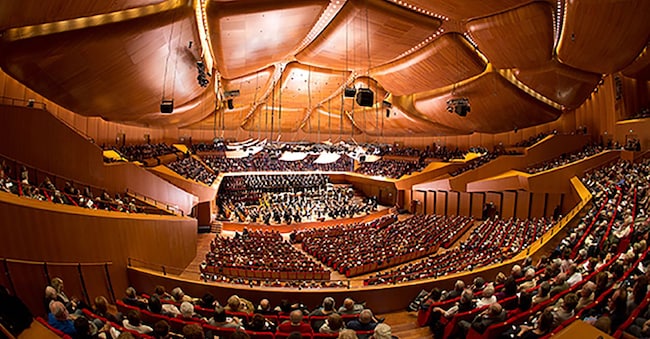
Roma, Auditorium Parco della Musica 28 10 2014. Inaugurazione Stagione di Musica Sinfonica. Orchestra e Coro dell'Accademia Nazionale di Santa Cecilia, Coro di Voci Bianche, Antonio Pappano direttore, Evgenij Kissin pianoforte, Ciro Visco maestro del Coro. (Copyright: Musacchio & Ianniello)

5' min read

5' min read

'Classical, present, eternal': the claim of the next season of the Accademia di Santa Cecilia encapsulates the focus on the classics of the past, the masters of today and the innovations of young talent. Presented today in Rome, the 2025/2026 concert season of the historic institution - which since February has been led by its new president Massimo Biscardi - will open on 23 October with Richard Wagner's Die Walküre (with replicas on 25 and 27 October), conducted by Daniel Harding, in his second season as music director, if it will develop among great returns, excellent debuts and international tours.

In fact, alongside timeless masterpieces such as Händel's Messiah, Mahler's Symphonies or Beethoven's, the programme will also give space to today's music, with the return of John Adams on the podium of Santa Cecilia, and with world premieres such as the new commission to Fabio Vacchi Il tutto in tutti, entrusted to Daniel Harding.

Loading...


Giants of the podium such as Myung-Whun Chung, Tugan Sokhiev, Semyon Bychkov, Sir John Eliot Gardiner and Daniele Gatti will conduct the Orchestra and Choir of the Accademia Nazionale di Santa Cecilia; Sir Antonio Pappano, the institution's conductor emeritus, will greet his 'dear audience' with two concerts, while new batons such as Petr Popelka and Joana Mallwitz will make their debut on the podium. The Academy will once again be an ambassador of symphonic music in the world with three important tours, between Asia and Europe.

The inaugural concert itself will mark the beginning of an unprecedented journey: directed by Vincent Huguet, for the first time in its history the Accademia will tackle the complete cycle of Wagner's The Ring of the Nibelung in stage form, a titanic project that will run through the 2028/2029 season and has not been performed in Rome since 1961. Daniel Harding will be grappling with the Ring for the first time and the Sala Santa Cecilia itself will play a role in the production, as it will be entirely transformed by the stage design of designer Pierre Yovanonich.

Also at the centre of Daniel Harding's Rome tour is the Mahler cycle, with the performance of the Third Symphony (with mezzo-soprano Wiebke Lehmkuhl) and the Fourth, in a programme that also includes the Italian premiere of Alexey Shor's Violin Concerto No. 7, entrusted to Gil Shaham. Harding will also take the orchestra's podium for a concert that will feature music by Verdi, Rachmaninoff and Ravel's Concerto in G with a new promise of international pianism and the youngest ever Van Cliburn laureate: Yunchan Lim. It will be precisely with Lim that the Orchestra, led by its conductor, will set off on a long tour of Asia that will touch the main concert halls in Seoul, Taipei, Beijing and Shanghai.

Other not-to-be-missed appointments with the Cecilian music director are in February with Haydn's The Creation and the concert with pianist Daniil Trifonov, who will perform Brahms' Piano Concerto No. 2; or in April 2026, when he will return to the Orchestra podium to once again conduct Brahms, whose Piano Concerto No. 1 will be performed with Igor Levit at the keyboard.

Sir Antonio Pappano, emeritus conductor of the Accademia, will return to Rome with two special concerts, Anton Bruckner's Grosse Messe - with the Accademia Choir instructed by Andrea Secchi - at the beginning of the season and Šostakovič's Violin Concert with Leonidas Kavakos on bow, in May.

The new concert season will feature, among others, conductors Myung-Whun Chung, Tugan Sokhiev, Semyon Bychkov, Sir John Eliot Gardiner, Daniele Gatti, Jakub Hrusa. And among the protagonists of 2026 there will also be Baroque music, starting with the February concerts with Rinaldo Alessandrini - making his debut on the Cecilian podium - and music by Vivaldi and Bach, and continuing with another Bach opera, the Passione Secondo Matteo, scheduled for April with the baton of Riccardo Minasi. Back after a 19-year absence is a specialist of the French symphonic repertoire, the Swiss conductor Charles Dutoit, who will perform La damnation de Faust by Hector Berlioz.

One of the most eagerly awaited debuts on the podium of the Cecilian Orchestra is that of the Greek conductor Teodor Currentzis, who in March will perform Šostakovič's Symphony No. 13 'Babij Jar' (absent from the Santa Cecilia programme since January 1998). Other debuts include that of the principal conductor of the Wiener Symphoniker, the Czech Petr Popelka, who will lead the orchestra in a programme with music by Stravinsky, Martinů, Tchaikovsky and Gershwin (Concert in F) with Hélène Grimaud at the piano, who returns to Santa Cecilia after ten years; of the German conductor Joana Mallwitz and the Romanian conductor Cristian Mačelaru.

Among the soloists performing for the first time at Santa Cecilia is cellist Sheku Kanneh-Mason, who is engaged in Elgar's Concello Concerto: with him on stage is Lorenzo Viotti, who returns for the second consecutive season to conduct, in addition to Elgar, Tchaikovsky's Symphony No. 5.

Alongside the symphonic programme, the Chamber Music Season at Santa Cecilia - with twenty subscription concerts, two more than in previous seasons - confirms itself as one of the jewels in the crown of Roman musical life, with a very rich proposal: the start on 1 November with an exceptional trio formed by Lisa Batiashvili, Gautier Capuçon and Jean-Yves Thibaudet and a programme already appreciated in several international concert halls dedicated to Rachmaninoff, Debussy and Dvořák, while the return of Les Musiciens du Louvre with Marc Minkowski and the homage to Alessandro Scarlatti - entrusted to the Accademia Ghislieri Choir and ensemble - mark some of the most representative appointments of the autumn. Andrea Lucchesini will dedicate part of his concert to Luciano Berio, whose 100th birthday falls this year.

Baroque again with Antonio Florio and his Ensemble Cappella Neapolitana, who, with soprano Rosa Feola, will dedicate the concert to the Bari composer Niccolò Piccinni, while Christophe Rousset, conducting the English Baroque Soloists ensemble and the Monteverdi Choir, will conduct Händel's Messiah.

A special project dedicated to the complete Beethoven Quartets starts this season and will continue until 2027, the year that marks the bicentenary of the Bonn composer's death, with the Quatuor Ébène, while space will be reserved for vocalism by Asmik Grigorian, with a recital focusing on Tchaikovsky and Rachmaninoff. Among the leading names that will take turns on stage, mention should also be made of Isabelle Faust, Kian Soltani, András Schiff, Beatrice Rana, Grigory Sokolov, Víkingur Ólafsson, Arcadi Volodos and Lang Lang, who will close the season at the end of May.

Also accompanying the programme are formal innovations in the spaces, starting with the transformation of the Sala Santa Cecilia, which will evolve into a true stage space at the opening. The sectors of the hall have also been redesigned, in order to offer a more balanced and convenient layout and to meet the needs of an increasingly diversified and participating audience. As of the upcoming 2025-2026 season, moreover, the symphony concert schedule on Thursdays and Fridays has been standardised to 8 p.m., while Saturday's schedule remains unchanged at 6 p.m.

Copyright reserved ©
Loading...

Brand connect

Loading...

Newsletter

Notizie e approfondimenti sugli avvenimenti politici, economici e finanziari.

Iscriviti