
In Northern Portugal, land of nostalgia, art and legends
In the region of Porto, Guimarães and Braga, along the coils of the Douro river among Art Nouveau bookshops, monasteries, fragrant markets, ancient sweets and chefs who guard family recipes
3' min read
3' min read
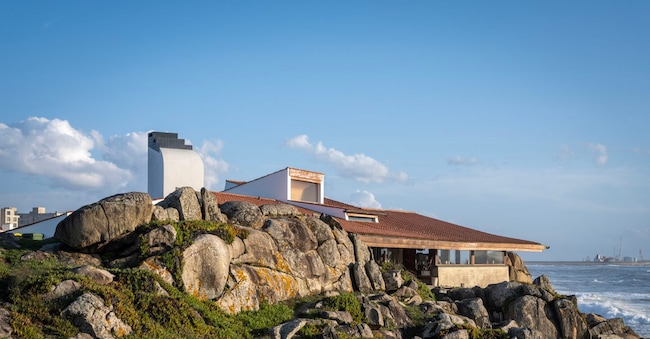
Stormy nights can be wild. Imposing waves crashing against the immense windows, the roar of the sea screaming overbearingly. And to think that this house, the Casa de Chá da Boa Nova, started out as a quiet tea room. Designed by Pritzker Prize winner Álvaro Siza in the late 1950s, it became a national monument in 2011 and is still an iconic place in northern Portugal, the region that has Porto as its centre and wraps itself around the coils of the Douro river. The house sits on a rock at sea level, above the Praia da Boa Nova, isolated and spectacular. It has evolved from a tea room into a two-starred restaurant, where chef Rui Paula presents cuisine inspired by a verse ('Waters hitherto unexplored') by the famous Portuguese poet Luís Vaz de Camões. The sea gazing out of the windows enters the dishes with its most special gifts: red prawns, 'Chanel' squid, St Peter's fish and cannolicchi.
In the neighbourhoods of Porto
.Porto, the region's charming capital, is half an hour's drive away, with its cobbled streets, historic wine bars, and riverfront teeming with tourists. Not to be missed, even at the cost of a long queue, is a visit to the Livraria Lello, which behind its Art Nouveau façade hides neo-Gothic interiors with a ceiling of multi-coloured glass, carved wooden panels and a winding staircase. The real gems, however, are kept in the Gemma Room, on the floor below: rare books, manuscripts, first editions, such as Vladimir Nabokov's Lolita or Lewis Carroll's Alice in Wonderland. The latest acquisition is Amy Winehouse's personal collection, containing more than 200 volumes. Aromas, spices and bacalhau in a thousand versions at the Mercado do Bolhão, impressive azulejos in the atrium of the São Bento station, and a kaleidoscopic diorama of old Porto in the streets of the Ribeira quarter. Those who love Portugal's azulejos have one must-see destination: the Banco de Materiais, a veritable 'bank' of azulejos, created to protect the architectural heritage of this part of the country. Due to years of neglect, many of the original tiles of the city's buildings - all hand-painted - have been lost or damaged. The Banco de Materiais guards tens of thousands of them and makes them available to property owners, who can take them free of charge to restore a façade.
Gastronomic experiences
.Leaving Porto, after the inevitable boat trip on the river, to really immerse oneself in the history and traditions of Northern Portugal one must travel to Guimarães, where the ancient fortress bears witness to the birth of the nation. Stop off at the Confeitaria Clarinha, in business since 1947 with the traditional (and secret) recipe for clarinhas, which originated as convent sweets stuffed with pumpkin and are now even covered by three patents. The city is also famous for textiles and embroideries made using ancient techniques that make each piece unique. From here you can move on to a unique gastronomic experience in Portela. Renato Cunha, a self-taught chef of great talent, is a genuine custodian of the local culinary tradition in the Ferrugem restaurant, located in an old granary. But it is elsewhere that he expresses himself most passionately: in the garden of the family farmhouse during the summer months he organises singular open-air dinners for small groups. It is what in Piedmont would be called a 'merenda sinoira', a long interlude of wine and food that unfolds from sunset to late evening. Everyone in the circle listening to Renato recount the family recipes, while the food simmers in large black pots. Food that unites and bears witness, friendships that are born around the simmering logs, impromptu toasts late into the night. Another unmissable destination is Braga, a city of monasteries and legends. Bon Jesus do Monte is earned by climbing steps (577). A pilgrimage site dating back to the 14th century, it is a complex assemblage of architectural styles, with bizarre and surprising details, criss-crossing Baroque-style staircases dedicated to the five senses and fountains to soften the floors. Fortunately, in 1882 a convenient funicular railway was built for the descent. By then, every sin is already atoned for.


