The stops on the new Grand Tour in hotel restaurants
From Venice to the Aeolian Islands, via Tuscany and Rome, in hotels that reflect the local character through their cuisine

Key points
Chasing the light of Claude Lorrain, measuring Palladio’s proportions, and losing oneself amongst the ruins of Rome whilst jotting down one’s discoveries in one’s *cahiers de voyage* were some of the essential experiences of the 18th-century Grand Tour. Today, we invite you to retrace Italia’s steps with the same thirst for knowledge as back then, but following a different map—one made up of raw ingredients, technique and sensory memory: that of hotel menus.
It is here – in kitchens that, until a few decades ago, were merely a standard stop-off for tourists, serving up familiar but essentially unremarkable dishes – that identity, authenticity and the genius loci are finding their highest and most contemporary expression, thanks in part to a close dialogue with the great artisans of the agri-food sector. Italy’s many gourmet hotels have thus become a destination within a destination, amongst the best in the world. Suffice it to say that several three-Michelin-starred restaurants – from Heinz Beck’s La Pergola at the Rome Cavalieri to Antonino Cannavacciuolo’s Villa Crespi, and La Rei Natura by Michelangelo Mammoliti at the Boscareto Resort – shine within luxury establishments, benefiting from the investment, well-organised kitchen teams and stability that independent restaurants struggle to maintain.
From the Lagoon to the Emilia
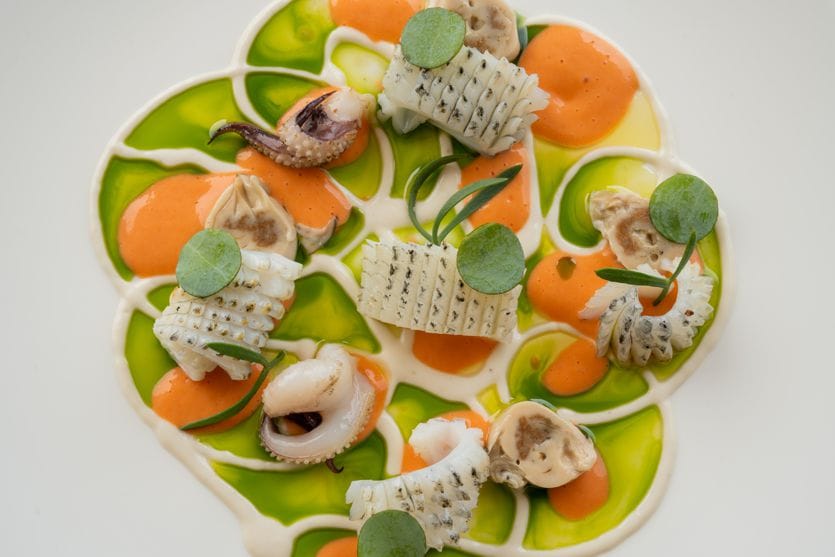
Let’s begin our journey in Venice, where folklore has finally given way to a more refined culinary style. Among his many consultancy roles, Enrico Bartolini has also put his stamp on Glam, the restaurant at Palazzo Venart, a luxury hotel with an enchanting garden overlooking the Grand Canal. Chef Donato Ascani creates an ‘instinctive’ cuisine, inspired by the market, which sensitively reinterprets local traditions. The other unmissable stop in the city is Oro del Cipriani, a Belmond Hotel on the island of Giudecca, where Vania Ghedini, under the creative direction of Massimo Bottura, presents a menu that showcases the lagoon’s produce with real character, as in the roasted cuttlefish with canocia reduction and oysters.
From Venice, we head to the heart of Milan’s middle-class district to meet Antonio Guida, one of Italy’s most talented chefs, at the helm of the Seta at the Mandarin Oriental, a city institution: the mastery of fine French technique blends with Mediterranean sensibility in dishes such as the now-classic risotto with raspberries and herb cream, or sweetbread with carrots, jasmine yoghurt and wild Madagascar pepper. We head down to Emilia, into the Modena countryside, to Casa Maria Luigia, the country house owned by Lara Gilmore and Massimo Bottura, which has redefined the very concept of hospitality: on the one hand, there is the chance to enjoy a complete experience featuring the signature dishes of Osteria Francescana, served in a convivial setting; on the other, there is Al Gatto Verde, the restaurant led by Jessica Rosval, where the stove and the grill take centre stage in a contemporary and daring cuisine.
From Tuscany to the Coast
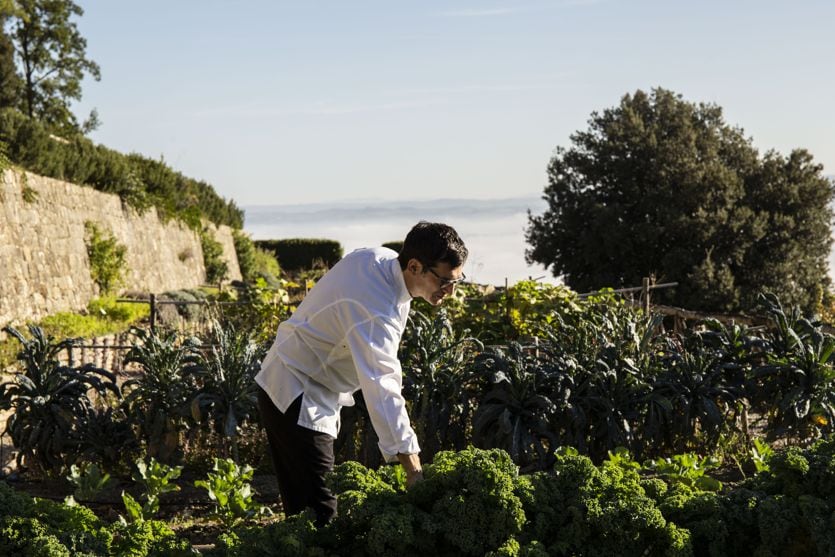
Leaving Emilia behind, the Grand Tour heads for Tuscany, the true ‘sprawling capital’ of Italian culinary hotels, and more specifically to the heart of the Val d’Orcia, to the Campo del Drago restaurant at Rosewood Castiglion del Bosco: here, Matteo Temperini draws liberally from the estate’s vegetable garden to create elegant and unique dishes such as Egyptian onion leaf au gratin with Parmigiano crusts and sfogliatella, and Cinta Senese pork with wheat, lavender and medlars. On the coast, the tone shifts once more at Forte dei Marmi with the Lux Lucis at the Hotel Principe: under the guidance of the ever-inspired Valentino Cassanelli, the cuisine literally takes to the rooftop and is expressed through three distinct tasting menus – ‘Versilia in Movimento’, ‘Litorale’ and ‘Vegetalmente’.