Outdoor

Riding from the Sibillini Mountains to the Adriatic along the Strade di Marca

It is a cycle tourism route that involves 29 municipalities and covers all five provinces of the Marche region, extending from the heights of the Sibillini mountains to the coast

by Pierangelo Soldavini

6' min read

Translated by AI
Versione italiana

6' min read

Translated by AI
Versione italiana

Le Marche is Italy's only 'plural' region, with a name derived from marca, the term that identifies border lands formed throughout history, then reunited for geographical and political reasons. They are territories that maintain different histories, traditions and cultures, well proud of their past, with economies and knowledge that range from fishing to agriculture, from oenology to footwear craftsmanship to the plurality of food and wine specialities that, as always in Italy, represent a synthesis of those cultural and historical declinations.

An all-round plural reality, therefore, that has been able to overcome divisions by choosing the bicycle as a privileged tool for 'slow' knowledge of the different territories, a 'plural' means by nature, because on two wheels it is difficult to pedal alone.

Loading...

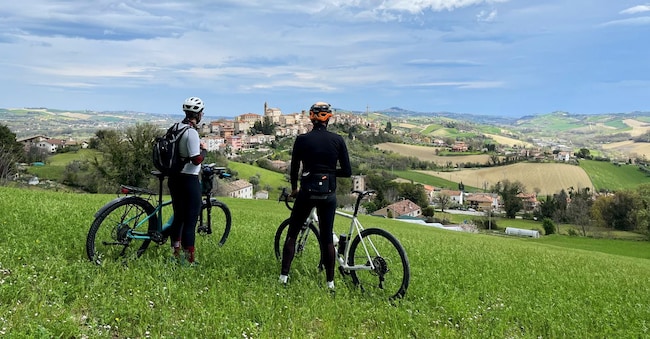
With an initiative that stands out in the Italy of a thousand bell towers, some thirty municipalities in the Marche region, distributed between the coast and the rolling hills of the hinterland, have joined forces to create a bicycle touring proposal that combines 800 kilometres of 'light' infrastructure, made up of secondary roads with low traffic and high safety, with the services that increasingly demanding tourist cyclists require for their two-wheeled holidays, from bike hotels to electric recharging points, from road information to tourist destinations to 'bike friendly' activities.

A permanent path

"Strade di Marca' is the permanent cycle-tourism route that was created within the NoiMarche consortium, with Civitanova Marche as lead partner, networking 29 municipalities, united by a memorandum of understanding for the promotion of tourism. And it is no coincidence that the initiative focuses precisely on two wheels, identified as the ideal tool for slow tourism that connects the individual realities with a common thread made up of roads and dirt tracks that link splendid medieval municipalities. Each municipality in the network has undertaken to identify in turn three evocative themed cycling routes, further multiplying the opportunities for cyclists, and to provide an interactive information point with the possibility of downloading Gpx tracks through the geolocalised web app, in addition to involving local businesses: between hospitality and "bike friendly" activities, more than two hundred local businesses have been activated and are beginning to benefit from a flow that is growing month by month.

The impact on hospitality

Thus the Natural Village Resort in Porto Potenza Picena was able to extend the season beyond September thanks to the arrival of cyclists, also attracted by sporting events in the area, dedicating a bike room to cyclists, for maintenance and washing, with pedal-assist bicycles for hire. But also the Country House La Colombaia, in the hills around Appignano, offers special attention to its two-wheeled clientele, with specific care to recover from the day's exertions and a 'reinforced' breakfast for cyclists. In the meantime, a young man from the Marche region has decided to return to his homeland in the Macerata area with his partner from Veneto to create an exclusive 'glamping' experience - Marche Nascoste, in Galdo -, with a special focus on cyclists. The village of Appignano is worth a visit on the occasion of Leguminaria, when the medieval historic centre is invaded by more than 30,000 people who, over the three days of the third weekend in October, come to consume twenty quintals of the legumes that are one of the riches of local agriculture. The people of Appiano renew the challenge with their rivals from Treia, on the opposite hill, with whom they have been battling for centuries: today the rivalry is played out to the sound of soups and polenta, or the game of ball with the armband, in the historical reenactment held at the beginning of August.

In sella dai Monti Sibillini all’Adriatico lungo le Strade di Marca

Photogallery20 foto

From stone mills to shoes

On the Conero heights, a historic winery such as Moroder, focuses on its wines made from the grapes growing on the Adriatic not only with careful refinement of its wines but also with the hospitality of slow pedal tourism, as does the Tenuta di Tavignano in Cingoli, inland, which is dedicated to the revival of Verdicchio with tastings for a stop along the way. Near Cingoli, it is also possible to visit one of the oldest family-run mills in Italy: the Bravi Mill has continued, for at least five hundred years (but perhaps even longer), to grind wheat and local cereals strictly with water-activated stone millstones, with a capacity of 25-30 quintals per day. In Montefano, you can visit the Ciclo Museo where Sandro Braconi has collected dozens of bicycles from the days when the economy travelled on two wheels: from the barber to the knife-grinder, from the ice-cream vendor to the priest with his confessional, from the fireman to the butcher to the schoolteacher, there are many models recovered or, perhaps, invented from scratch that tell a unique story of the Italy of times gone by. In Montegranaro, the centre of the shoe district, another museum tells the story of how agricultural culture was transformed into craftsmanship that evolved from cloth slippers into luxury footwear known the world over. Souvenirs of the workshops remain in the rooms of the museum where the development of an activity is reconstructed, an actor of which can still be found among the steep alleys of the centre. In what is still to all intents and purposes an artisan's workshop, Doriano Marcucci keeps alive the tradition of craftsmanship by transforming into art the culture and empathy of a master such as Basilio De Stella, whose apprentice he was for only a couple of years, enough to keep alive the art that today produces exclusive models for selected customers and for wealthy Arabs from the Gulf. Doriano even managed to make a model for Pope Benedict XVI and deliver it in person when he was 'Pope Emeritus'. And now he has ready a pair of eccentric shoes with the Moroccan flag for King Mohammed VI, he is just waiting for the opportunity to give them to him personally: he does not trust intermediaries, even trusted ones. A short distance away, Magliano di Tenna has decided to challenge the crisis in the footwear sector by focusing on the integration of mobility and sustainability, betting on cycle tourism and recovering the tradition of the Mediterranean diet, which has one of its research bases here.

A public-private partnership

The 'Strade di Marca' initiative was born from the intuition of Mauro Fumagalli and sisters Loredana and Sonia Miconi who, between their passion for cycling and love for the territory, have involved the municipalities of the Marche region with an initiative that is a model for the promotion on two wheels of the artistic, historical, cultural and gastronomic riches that Italy is full of, with a project that can be replicated in any territory, offering new opportunities for local economies with limited investment and light infrastructure. It is also with cycling that the Marche region aims to relaunch its riches in the face of competition from more accredited regions in terms of tourism such as Emilia Romagna, Tuscany and Umbria: 'Cycle tourism offers a great opportunity to network people and territories: it is not just a question of joining routes, but also of focusing on opening up to tourism and hospitality operators, with what we have conceived as a true public-private partnership for the benefit of all,' Fumagalli summarises.

From the Adriatic Ciclovia to the Via Flaminia

The total 800 kilometres of cycling routes, with a total elevation gain of more than 13,000 metres, are accessible through the 'Strade di Marca' web app, which allows the organisation of the journey in total autonomy, but organisation is also available through the NoiMarcheBikeLife structure. The route covers all five provinces of the Marche region, extending from the heights of the Sibillini mountains to the hills of the hinterland to the coast, where it exploits the structure - to tell the truth, not completely completed - of the Adriatic Cycle Route connecting the maritime centres. Fano, known as the 'city of fortune', is the natural outlet of the Metauro valley and is the junction of the ancient Via Flaminia that connects directly with Rome. In the centre remains the structure of the old port of the Eternal City's outlet to the Adriatic and the East. Next door, Leo Vitali's bar offers the 'Moretta', a typical drink that over the years has become traditional for fishermen before they set out to sea: a mixture of coffee, rum, cognac, aniseed, sugar and lemon peel still prepared according to the historical recipe, strictly with liqueurs. Again by bicycle, we descend towards Senigallia, with its iconic 'Rotonda sul mare', then Ancona, the Conero, Civitanova, down to San Benedetto del Tronto, on the border with Abruzzo, where the fleet of fishing boats that used to reach as far as the Atlantic has dwindled and today offers fishing tourism to take enthusiasts out to the high seas to fish with a rod. Here too, on the local fishing boats affiliated with the route, it is possible to have the stamp to complete the Passport of the Cycle Tourist, the document that holds the tourist experience together, integrating cultural and artistic activities, history, food and wine and hospitality into a single game. Everything within reach of two wheels.

Copyright reserved ©
Loading...

Brand connect

Loading...

Newsletter

Notizie e approfondimenti sugli avvenimenti politici, economici e finanziari.

Iscriviti