
In the streets of Scicli, the spirit of the Baroque takes on a contemporary feel
It has become the fictional town of Vigata in the famous Inspector Montalbano series, inspired by the stories of Andrea Camilleri

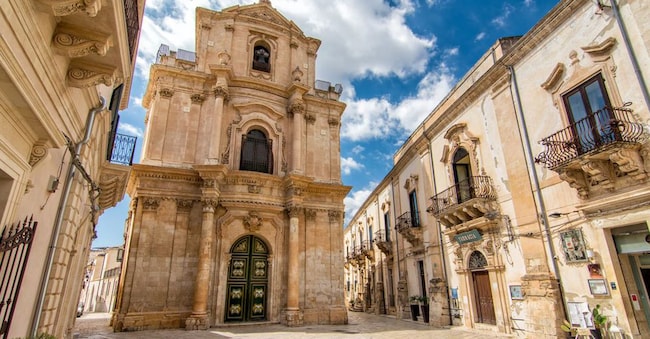
There must be something special about Scicli. In fact, this small town on the south-eastern tip of Sicily has always been special, even before Commissioner Montalbano, in the hit series inspired by Andrea Camilleri’s short stories, transformed it into the fictional town of Vigata in 1999. Before that, it was a quiet spot in the Val di Noto, certainly not the most famous of the eight late-Baroque towns built on the ruins left by the 1693 earthquake, which today boast the title of UNESCO World Heritage Site. Scicli stands on three hills, a limestone nativity scene criss-crossed by caper bushes, in a spectacular fusion of nature and architecture. Elio Vittorini described it as ‘perhaps the most beautiful of all the cities in the world’, whilst Pier Paolo Pasolini was struck by the caves of Chiafura, ‘a sort of mountain of purgatory, with circles one upon the other, pierced by the holes of the doors to the Saracen caves’. Guarding that prehistoric village, inhabited until the 1970s, stands the church of San Bartolomeo, built from the same soft, pale stone as the caves, yet skilfully crafted. There is almost no boundary between the countryside and the built-up area: the town unfolds seamlessly in a harmony that Piero Guccione, Franco Sarnari and the other painters of the Scicli Group never tired of depicting.
Ancient architecture in the heart of the village
Next to the church is Sanbartolomeo Casa e Putia, a small hotel with hand-painted majolica tiles, old sideboards, crocheted bedspreads and the feeling of being embraced by the houses perched all around. And even though the hotels in Scicli can be counted on the fingers of one hand, something is changing. In the countryside, with its scent of Mediterranean scrub, for example, Dimora Camille opened last summer: a restored, derelict farmhouse converted into three rooms, a suite and four flats, where stone and terrazzo floors, ceramics and natural fabrics create a contemporary dialogue with the original structure.
Over the last ten years, Sicily has attracted significant international investment, and Scicli is no exception. Visitors often find themselves falling in love with its Baroque splendour, the scent of freshly baked almond biscuits, and the religious festivals that are still deeply cherished. Take the ‘Gioia’, for instance: the Risen Christ carried in procession by a crowd shouting ‘He’s alive, he’s alive’, which has also become the refrain of Vinicio Capossela’s song ‘L’uomo vivo’. Choosing to live in Scicli is not a matter of course; some might find it a bit cramped. Yet some top executives have found their happy place there, such as Gary Davey, former chief executive of Sky and, for 37 years, a trusted confidant of founder Rupert Murdoch: for his wife Angelica Fontana, accustomed to the pace of London life, it wasn’t easy at first, but in the end Scicli won her over too. Since their arrival, the Daveys have brought a cultural buzz to the town, inviting artists and entrepreneurs and supporting the projects of the Macc, the museum of contemporary art which opened in May 2025 with an exhibition by Emilio Isgrò, a very dear friend of theirs.
Multiple Worlds
In its simplicity, Scicli is a refined little town: thirty churches, sumptuous palaces, cobbled streets as gleaming as if they’d just been washed, sun-drenched afternoons and evenings spent in the square. But its true strength today may lie elsewhere. Rather than relying solely on the beauty of the Baroque or the fame of Montalbano, Scicli has chosen to continue producing culture and to reflect on the present. It does so through artists and events such as the new ‘Mondi Multipli’, the first edition of a wide-ranging festival tackling the ecological crisis, changes to the landscape, migration and memory (until 13 December). It is an intelligent way of being a destination: not merely preserving what has been inherited, but, through art, telling the story of what it is becoming.

