Fibre and telecoms

‘In the telecoms sector, we need to put an end to the conflict; no one can do it alone’

Marco Nespolo, CEO of FiberCop, takes stock of the challenges facing a sector that is crucial to competitiveness

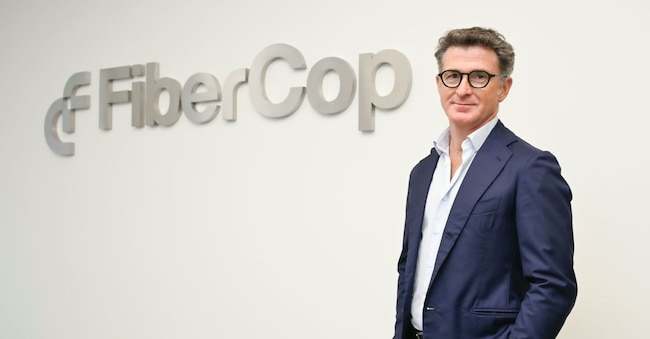
Marco Nespolo, ad di FiberCop

6' min read

Translated by AI
Versione italiana

6' min read

Translated by AI
Versione italiana

A concerted effort is needed because ‘no one can succeed on their own’. This is the message from Marco Nespolo, the new chief executive of FiberCop, particularly with regard to the issue of fibre take-up. Once the country has been equipped with the necessary infrastructure, the key challenge is the adoption of the new technology – that is, its actual use by households and businesses – an area in which Italia lags behind the European average. In his first interview, broadening the perspective within the sector, Nespolo states that it is time to reduce tensions. Finding a different path is not “just possible but necessary”, he explains to DigitEconomy.24 (report in collaboration with Digit’Ed).

Read the December DIGIT ECONOMY report

Loading...

Today, FiberCop – the company into which TIM’s former fixed-line network has been merged and which manages a digital infrastructure comprising 28 million kilometres of fibre-optic cable, 114 million kilometres of copper cable, 10,500 exchanges, is, on the one hand, working to find a solution with TIM regarding a series of disputes, whilst, on the other, it is engaged in discussions with AGCOM regarding the new price lists, which have been contested by alternative operators. With regard to the operational issues between TIM and FiberCop, in particular, CEO Pietro Labriola has already signalled a willingness to engage, suggesting a possible resolution by the end of the year.

Italia’s problem today is not so much ultra-broadband coverage as take-up, which remains low and below the EU average. From your perspective, what would be the most effective measures to encourage this?

In an economy increasingly driven by data, the network is the key enabler of development. With the roll-out of ultra-broadband, Italia is undergoing a massive infrastructure transformation in just a few years. It is like building the country’s digital motorway in one go, to which FiberCop is contributing around 10 billion euros in investment between 2024 and 2027, with the aim of connecting around 20 million properties via Fibre-To-The-Home (FTTH) technology. However, alongside the completion of this coverage, we must accelerate adoption. Part of the gap compared with other countries stems precisely from the speed with which we have carried out the roll-out: it is only natural that some time passes between the arrival of fibre and its adoption, all the more so with such a rapid roll-out. The signs are positive: FTTH connections continue to grow.

There are also some distinctive Italian characteristics. We have very widespread use of mobile connectivity, which in many households replaces the fixed line rather than complementing it: over 30 per cent of Italian households are ‘mobile-only’, a particularly high proportion by European standards. This, too, helps to explain why fibre take-up remains relatively low: the challenge is no longer simply to bring FTTH into homes, but to ensure that people genuinely recognise its value.

And then there is the issue of the ‘last mile’. Bringing fibre to a building does not automatically mean that every flat can be connected without hindrance: the layout of buildings, the internal cabling in blocks of flats and certain regulatory constraints can slow down the transition from coverage to the actual availability of the service. It is also essential to raise awareness amongst citizens and businesses about the benefits of fibre. To this end, FiberCop is working with local authorities to facilitate the preparation of residential properties and to raise awareness of the opportunities offered by the new network. Bringing fibre to an area is the first step; we must then create the conditions for that infrastructure to be effectively utilised. And this is a challenge that no one can overcome alone. It requires a concerted effort from the entire digital ecosystem. Operators can make the most of the new connectivity with services that highlight its benefits; businesses can accelerate the digitalisation of their processes; and the public sector can contribute through increasingly advanced digital services. At the same time, we need skills, applications and use cases that make that network capacity genuinely useful for citizens and businesses.

How far have you got with the contract you were awarded in July to connect a further 477,000 properties across the country? What is the expected timeframe? Are you encountering any problems with obtaining the necessary permits?

We are now in the operational phase. Following the award of the tender organised by the Department for Digital Transformation, we signed agreements with Invitalia in August and commenced work. We are talking about over 477,000 property addresses – equivalent to around 700,000 properties – to be connected by 2030. Site surveys are currently underway, as a preparatory step for the design and subsequent implementation phases. With regard to planning permission, the experience gained through the PNRR shows that local authorities are paying increasing attention to the speed of project delivery.

Let’s start with a key achievement: in June, we completed the PNRR projects under our responsibility on time and within budget. Under the ‘Piano Italia 1 Giga’ scheme, we worked in 1,900 local authorities, covering 1.2 million house numbers and over 1.9 million properties; under the ‘5G Backhauling’ scheme, we connected over 8,500 mobile radio sites via fibre.

Loading...

This process has also shown us just how crucial collaboration with local authorities and simple, standardised authorisation procedures are. Continuing along this path means speeding up investment and prioritising the provision of infrastructure to local areas.

For the most remote areas, where it is uneconomical to install fibre-optic cables, could satellite be a solution? Are you concerned about competition from satellite in the long term?

I do not see fibre and satellite as competing technologies, but as complementary ones. Fibre remains the cornerstone of the infrastructure, whilst satellite can provide valuable support in reaching the most remote areas, where rolling out a fixed network is technically complex or economically unviable.

It is a model that we at FiberCop have been trialling since 2025 in collaboration with StarEdge by Orbius (formerly FMC-Globalsat, ed.). The tests focus on hybrid solutions that combine a state-of-the-art satellite link (LEO constellations) with terrestrial fibre or copper access, thereby also making the most of existing infrastructure. The opportunity lies precisely in the synergy between the two technologies, not least because satellites have certain physical limitations: to receive the signal, adequate sky visibility is required, just as with a satellite dish. By integrating fibre and satellite, it is possible to capitalise on the strengths of both solutions, thereby reaching even the most difficult-to-serve areas.

The telecoms sector has historically been characterised by a certain degree of conflict; is it possible to find an alternative path to confrontation?

Not only is it possible, but it is necessary. The sector is undergoing a transformation that requires very substantial investment and a long-term perspective. Everyone, including us, must shift the focus from defending individual positions to driving market growth.

FiberCop is a wholesale-only operator. Our ecosystem comprises around 500 client operators, ranging from large national groups to local operators, as well as multi-utility companies, public sector organisations and international operators. We do not compete for end customers: we make our infrastructure available to operators, creating the conditions for them to develop services and compete.

Industrial interests may certainly differ and the debate may be heated, but on certain challenges we must work together: increasing take-up, supporting investment and accelerating digitalisation. Infrastructure is only valuable if it generates value for the entire ecosystem that uses it.

Turning to human capital, how important is the ongoing reskilling of staff for a company like yours, and do you currently have the necessary human resources in place?

It is essential. FiberCop has over 17,000 employees and an extraordinary wealth of technical and industrial expertise. Many of our staff have played a part in the history of Italian telecommunications, designing, building and managing one of the country’s most extensive networks. We must build on this heritage and, at the same time, ensure it continues to evolve.

Today, we are working on edge computing and cybersecurity, and experimenting with technologies such as quantum key distribution, fibre sensing and hollow-core fibres. We must therefore complement our traditional skills with new ones in software, data and artificial intelligence.

One example is Expert Hub, the programme run by the FiberCop Academy through which we recognise our Subject Matter Experts: colleagues who have acquired a particularly high level of knowledge and experience in specific fields, with the aim of systematising this know-how and passing it on to the next generation.

However, FiberCop’s responsibility extends beyond the company itself. We must help build an ecosystem of skills, strengthening our links with schools, universities and research organisations, and encouraging young people to pursue careers in telecommunications and female students to engage with STEM subjects. The network is evolving rapidly, and the people who design, build and manage it must evolve alongside it.

Copyright reserved ©
Loading...

Brand connect

Loading...

Newsletter

Notizie e approfondimenti sugli avvenimenti politici, economici e finanziari.

Iscriviti