
In the village where Jews and Palestinians have chosen to live together
A bilingual, bi-national school that teaches children about peace. At the beginning it had 11 pupils, now it has 250
by Lara Ricci
4' min read
4' min read
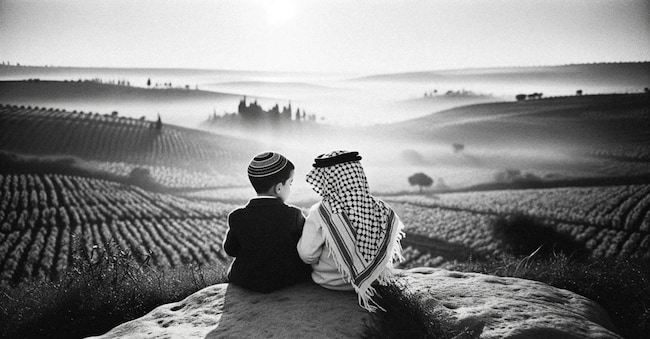
In the village of Neve Shalom Wahat al-Salam ninety families, half Jewish, half Arab, all Israeli citizens, live in peace. Despite what happens. They chose to live together: it is a spontaneous, intentional community, it has existed for half a century. Over the years, the inhabitants have set up a number of institutions, such as a bilingual and bi-national school. A 'school for peace', explained at a meeting at the Turin Book Fair organised by the Gariwo Foundation Giulia Ceccutti, a literary scholar, an expert on the work of Lalla Romano, who has been working for years with the Italian association that supports the village - whose name means 'oasis of peace'. Gariwo in this utopian but also very real place has created one of its Gardens of the Righteous, gardens that "teach hope and trust in humanity through the story of the moral figures of our time, in dialogue against hatred",
The school originally had 11 pupils, now it has 250, many from outside. "Our education system is based on dialogue, on the mutual knowledge of both peoples," explained Nir Sharon, a Jewish villager and director of the bilingual and binational school, a school that teaches and respects the history of both peoples. "We were very happy to see that even at a time like this the children returned to school, happy to meet each other."
Sharon does not hide the difficulties, nor does Samah Salaime, Palestinian journalist and women's rights activist, who is also a villager. "This possibility of meeting and human contact is what I wanted for my three children. The fact that the parents continued to send the children to school, side by side with what some consider 'the enemies' showed us that we are on the right path. Conflicts can only be resolved by standing together. The catastrophe and pain of others we do not erase. To build peace and educate for peace takes time, effort. It is much easier and faster to educate in hatred, to make war takes little".
Of course, after the 7 October attack, "the challenge has become greater and the risk of hatred taking over is great. The atmosphere of hatred against Palestinians living in Israel is terrifying. Often people we know pressure us to take sides, implying that if we don't, it means we don't respect their pain. Instead, we must first be there for each other. In our village, after the attack, we came together to share our suffering and our fear. We enlisted the help of two facilitators, sharing personal stories. Mine, that I have friends in Gaza, people who worked in social work and mental health, those of those who lost relatives in Gaza - one neighbour lost 70, another 27 - and those of Jewish friends who lost relatives and friends in the attack or the war. We know that we must not neglect the values we believe in: peace, democracy, non-violence, and we also know that we cannot have peace if our neighbours do not have it'.
'We need to give as much space as possible to this kind of narrative,' Ceccutti added, 'opposing fans do not help anyone. Peace is very complex, we have a responsibility to embrace and hold together the pain of both peoples'.


