
AI: the challenge for specialists – beyond the generalists, there is room for Italia too
From translations to images, from video to voice: specialised systems focus on accuracy, control and fewer revisions in professional work. It is a market in which Italian companies can also compete, by bringing experts and machines together.

Translating a catalogue into twenty languages, preparing an advertising campaign, editing a video clip, narrating an audiobook: ChatGPT, Gemini and other general-purpose AI systems are taking on an ever-increasing range of tasks. But sometimes they aren’t enough. Sometimes a more specialised tool is needed, especially when the work is professional. A single incorrect term across a thousand product sheets or a change that alters the colour of a package can undo the time saved thanks to AI. It is these benefits – in terms of quality and productivity – that specialists are focusing on.
The great thing is that, thanks to these specialised niches, we Italians – who have been sidelined in the major league of cutting-edge AI models – can get back into the game.
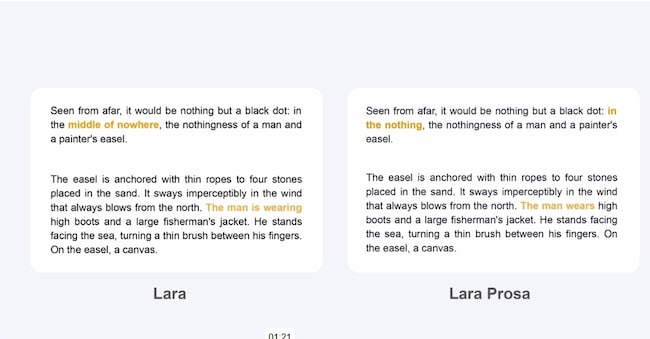
Translated, a Rome-based language services company and a pioneer in AI long before ChatGPT, launched Lara 3 in October – a model developed for professional translation. What sets it apart is its treatment of terminology, context and stylistic consistency as key production requirements, thanks in part to client-approved glossaries and translation memories. The training also includes cycles of trials and evaluations based on the experience of human proofreaders. Translated’s defining feature – its underlying ethos – has always been the collaboration between human translators and AI. Lara, too, does not merely translate but highlights to the user any ambiguous points in the machine translation, thereby encouraging collaboration, from which – it is hoped – the final result will be the best of all possible worlds.
In tests published by Translated, professional translators carried out a blind review of 16,800 translations from English into 21 languages, based on public texts and corporate content. 82 per cent of Lara 3’s translations were deemed usable without modification, compared with 69 per cent for GPT-5.6 Sol, the best generalist in the comparison. Yes, the tests were organised by the company and are limited to that specific content. However, they do highlight a potential advantage: for those localising large volumes of text, fewer revisions mean fewer hours of work. Lara also offers rates based on the number of characters in the source text, rather than on the number of tokens processed.
The need to keep corrections to a minimum also applies to design. For a brand, the success of an image depends on the exact wording on the packaging, the positioning of the logo and the ability to change a single detail without having to redo the whole thing. Ideogram focuses on typography and layout control. Version 4.5, released in October, allows for targeted changes, whilst seeking to preserve the rest of the image through subsequent revisions.

