
On holiday with Artificial Intelligence: the bespoke algorithm
Efficiency, memorability and continuous interaction. This is how AI turns a holiday into a film, shot through dark, smart lenses.

8.00 am, Milan, the Isola district. A notification on my smartphone tells me that the chauffeur who is due to take me to the airport is waiting outside my flat. The chauffeur, however, isn’t there. There’s just the black electric saloon, driverless, which will take me to Linate Airport, where a private jet is waiting to fly me to New York for Fashion Week. Everything has been organised according to my preferences, carefully recorded by Claude (the reference to Claude from Anthropic is purely coincidental – or perhaps not), one of my AI agents, who manages my image, my wellbeing, my business affairs, of course, and all my interactions with the world. The journey and my stay are tailored to what I want and need – because the algorithm knows my biorhythm better than I do – from my favourite music in-flight to detours to a couple of vegan spots in the Big Apple, to the creation of a dynamic itinerary whilst I’m there, based on who in my network is in New York on the same dates. My smart sunglasses will help conceal my dark circles before my in-flight beauty routine, whilst at the same time providing me with real-time information about everything around me. Claude has asked the Bowery Hotel in New York, where I’ll be staying, for a suite with a robot, which will assist me, discreetly and promptly, 24/7 throughout my week in New York, and has arranged for driverless taxis and an electric bike, available on demand, depending on my appointments, dinners and parties. The hotel, which processed my digital history in a matter of seconds, is providing me with a drone that will follow me throughout the week, ensuring my safety and giving me a photo and video report to share on social media and with my network. Back in Milan, I’ll decide with Claude whether to turn it into a film or a series of short clips, for my followers or perhaps just for myself. All for me. Thanks to AI, the future of luxury is even more centred on me.
Here is a summary of what AI can already do today and will soon be doing for the new cosmopolitans. The application of AI to the world of travel – particularly premium travel – does exactly what technology is meant to do by definition: enhance efficiency, opportunities, sophistication and memorability. We live in a world of dynamic hyper-personalisation, served up on a silver platter by software and hardware (glasses, robots, drones, earpieces and the like), which turn our lives into a ‘set’ for fantastic, almost cinematic stories. The destinations favoured by the elite are more or less the same – from the Bahamas to Monte Carlo, from St Moritz to the Costa Smeralda – and I don’t think they’ll change. What is changing is the sublimation and dramatisation of these experiences, which can be made available to luxury brands or travel operators for a fee, or shared on social media to boost social currency and status. After all, luxury has always been a form of self-expression. The best creators are already driving change in the industry. The next film The Devil Wears Prada, version number three, might feature me among the protagonists. Feasible? Let me ask Claude to blend my holiday in New York with footage from the film, to create my very own personal version.
AI-powered travel planners are already available online, and these are often start-ups or apps that promise efficiency and itineraries off the beaten track (without being able to name them all, there are already plenty of them). And AI is already being integrated into the planning and operations of major cruise operators, such as MSC, and on the most popular online travel portals, from Booking to Expedia. MSC, an Italian company and world leader in cargo transport and cruises, has integrated AI into the entire customer journey, from the travel agency to experiences both on land and on board. For example, boarding a ship carrying thousands of people takes minutes rather than hours, whilst staff know each morning exactly which activities to suggest to each cabin, organising restaurant menus and the entertainment team’s schedules down to the minute. There is more to the journey of the future, however, beyond the necessary efficiency and personalisation. And it is not just a matter of exotic destinations.
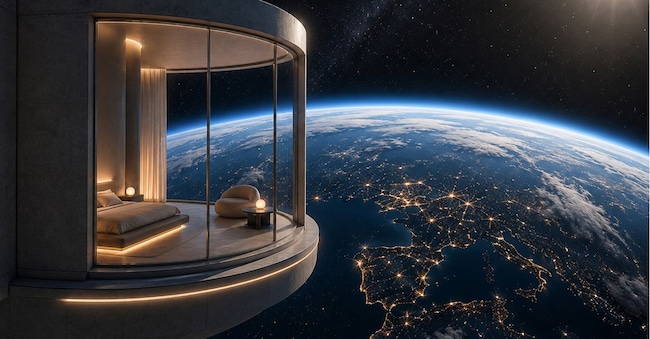
Luxury space travel could take us to places we could never reach before. Blue Origin, the space company founded by Jeff Bezos – the founder of Amazon – or NASA Mars, NASA’s spacecraft bound for Mars (for which you can sign up on the US agency’s website), will take millionaires and the curious into space. Here too, it is not just about the experience itself – which is exceptional not so much for the financial investment as for the time commitment (bear in mind that a return trip to Mars could take up to 18 months). It is about spectacle, which adds excitement and prestige to life.
Luxury has always been a matter of lifestyle, as confirmed by a recent study by The Economist on the sector. AI and technology not only boost travellers’ egos, but also elevate them to the status of film stars. The personalised digital and mental journey created by AI and technology is the key to forging the new Marco Polos. The physical and digital worlds are already one and the same, and the pampering of a first-class journey must cater to both the physical self and its digital twin. Personally, I intend to go with Claude to the usual chic spots around the world, but in a whole new, personal, phygital and somewhat Fellini-esque way. I don’t need to tell you what happened to me in New York and the marvellous experiences I had. I’ve left that to Claude, who’ll do it for me – and better than I ever could. My dream holiday and the story of it have already been created by the AI. All that’s left for me to do is decide whether to make it public.

