
In Venice, national spaces become a battleground
Reignited debate on the relationship between art, institutions and freedom of expression from Australia to the United States. The South African case

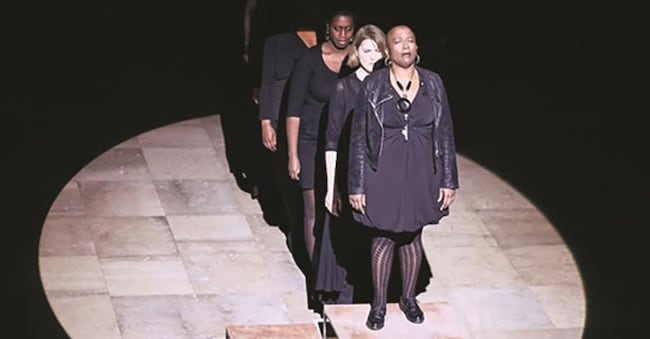
The 61st edition of the Venice Art Biennale reignited the debate on the relationship between art, institutions and freedom of expression. How autonomous are institutions really when it comes to choosing who represents a country on the international stage?
Some events that are geographically distant, but surprisingly close in the dynamics that generated them, show how cultural decisions are today increasingly exposed to political, media and institutional pressures. The cancellation of artist Gabriella Goliath's participation in the South African Pavilion, the case of Khaled Sabsabi - first selected, then excluded and finally readmitted to the Australian Pavilion - and the choice of artist for the US Pavilion tell more than just legal disputes.
In these cases, decisions have taken shape amid pressure, controversy and public second-guessing, transforming processes that should be eminently curatorial into veritable political and institutional battlegrounds. Different episodes, but symptomatic of a structural fragility: that of a system that continues to proclaim the autonomy of art, while - at decisive moments - struggling to defend it. Moreover, the tensions surrounding the pavilions of Russia, Israel and the United States have further shown how geopolitical dynamics are increasingly directly affecting the processes of cultural selection, legitimisation and representation. Between protests, resignations, government pressure and accusations of censorship, the Biennale now seems to be turning into a space where diplomatic conflict ends up redefining even the boundaries of artistic autonomy.
Facts in Australia
In February 2025, the Lebanese-Australian artist Khaled Sabsabi (Milani Gallery), initially chosen by Creative Australia to represent Australia at the Venice Biennale 2026, was excluded five days after his nomination due to the controversy caused by some of his works, including 'You' (2007), which depicts former Hezbollah leader Hassan Nasrallah, and the video 'Thank You Very Much' (2006) about the 9/11 attacks. Creative Australia justified the decision with the desire to avoid a 'divisive debate' that could undermine public support for the arts sector; the matter also reached the Australian Senate in the context of concerns over incidents of anti-Semitism. However, some commentators have pointed out the ambiguous and critical nature of Sabsabi's works, which are strongly linked to themes of Arab identity, the Palestinian issue and criticism of extremism. In July 2025, Australia finally reversed its decision: thus Sabsabi and curator Michael Dagostino represented the country at the Biennale.
South African history
The story of the South African artist Gabrielle Goliath (Raffaella Cortese, Milan, formerly Goodman Gallery, CapeTown), who was initially selected for the South African Pavilion with the video 'Elegy', dedicated to Heba Abunada, a young Palestinian poetess killed in 2024 in an Israeli airstrike in Khan Yunis, Gaza, together with her young son, is different. On 2 January 2026, the Minister of Sport, Arts and Culture Gayton McKenzie cancelled the artist's participation, claiming that: 'it would not be wise or defensible for South Africa to support an art installation against a country currently accused of genocide'. On 22 January 2026, Goliath, together with curator Ingrid Masondo and studio manager James MacDonald, challenged the decision in the North Gauteng High Court, arguing - through his lawyer Adila Hassim, a former member of the country's legal team in the South Africa v. Israel case before the International Court of Justice - that the minister had exercised 'a power that is not his due', also violating freedom of artistic expression. The lawyer Zinzile Matabese for the minister, on the other hand, qualified the dispute as a contractual issue.
The ruling, which rejected Goliath's appeal, was delivered on 17 February, just hours before the deadline for submitting the exhibition project. The Court found that the Minister had acted in the exercise of a contractual power of withdrawal. South Africa is therefore not present at the 2026 Biennale and its pavilion has remained closed. Goliath has announced its intention to appeal.
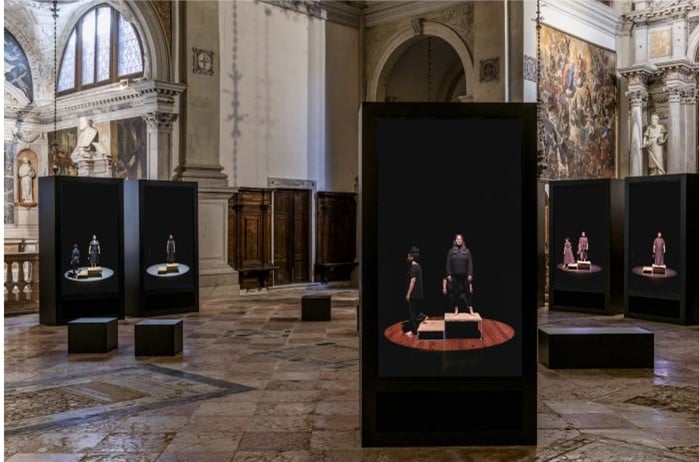
The artist has found a way to make his voice heard in Venice with the exhibition 'Not the South Africa Pavilion' from 5 May to 31 July in the Church of Sant'Antonin, in the Castello district, the building currently owned by the city's patriarchate and closed for worship. It hosts the video installation 'Elegy', excluded from the national pavilion Goliath also presents 'Elegy Reader', a collective publication of 50 poems and texts - including by the Palestinian poet Heba Abunada, by the Iranian poet Forough Farrokhzad, by the Haitian poet Danielle Legros Georges and the South African writer Maneo Mohale, among others - that tell stories of displacement, pain, colonialism and genocide, produced with Ibraaz Publishing.
After the controversy surrounding the cancellation of her participation in the Venice Biennale, we asked Gabriella Goliath how she interprets the accusation of producing a 'divisive' work, made by Minister Gayton McKenzie. The artist strongly rejects this label, pointing out that the judgement was made without her work having actually been seen. For Goliath, this reaction rather reveals the political climate in which works dealing with themes of mourning, violence and memory are quickly dismissed in the name of an institutional rhetoric of 'social cohesion'. Moreover, for Gabrielle Goliath, the issue is not just about her personal case, but the precedent that such a decision could set. The artist recalls how freedom of expression is a central principle in the South African constitution after the censorship of the apartheid regime and warns that the erosion of these rights through political or financial pressure would have consequences for the entire artistic community. "At the same time," notes Goliath, "the willingness of art institutions to support works that address geopolitical conflicts remains deeply uneven and often tied to international balances.

