
In Venice Pavilions between live action and curatorial vision
Performance, works in images, sound and installations challenge collecting

The 61st International Art Exhibition of Venice (9 May - 22 November 2026) revolves around the curatorial vision ofKoyo Kouoh, who passed away in May 2025, whom the Biennale has chosen to honour by entrusting the international exhibition "In Minor Keys" to the team she appointed. Conceived as a musical metaphor, "In Minor Keys" invites attention to the subtler frequencies of the present - silent resistance, vulnerability, listening - privileging artistic practices based on improvisation, relationship and time. In this context, performance emerges as one of the most emblematic languages of this edition.
Performance remains, however, one of the most complex media to place on the market: for many artists immateriality is an indispensable condition, while others accept its translation into derivative forms such as video, photography, sound or object.
The pavilions that adopt performative practices at the 61st edition of the Biennale translate "In Minor Keys" into corporeal and temporal experiences, in which the work manifests itself as process, relationship and situated act. This approach is particularly evident in some of the Northern European pavilions, where the centrality of the body, time and live action emerges as one of the most significant novelties of this edition of the Biennale.
The Performance Countries
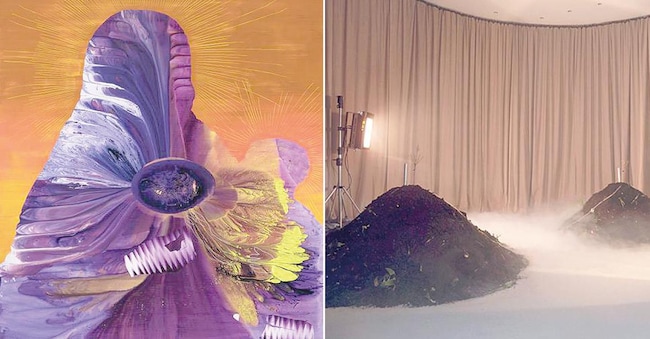
In many cases, the selected artists are not represented by galleries, as they come from the theatre or are in the early stages of their careers. This is the case ofMaja Malou Lyse (1993), the youngest artist to represent Denmark, whose practice investigates forms of presence, voice and corporeity that escape the fixity of the object, situating herself in an intermediate zone between installation, action and environment (the 3-1AP edition photographs are on sale at around EUR 4,700). Intimate and processual is the proposal of the Estonian Pavilion, hosted at the Church of the Patronato Salesiano Don Bosco in the Castello district. Merike Estna (1980) integrates performative elements in the form of an open studio: the artist will create 11 large-scale paintings live throughout the Biennial (represented by Temnikova & Kasela from Tallinn).
For the first time, the Netherlands and Belgium chose to entrust their respective pavilions to artists whose practice is predominantly performative. The Netherlands Pavilion will present 'The Fortress', a project that transforms architectural space into a performative action by artist and theatre author Dries Verhoeven (1976). His practice fuses theatre, installation and audience participation, resulting in interventions that are often site-specific and difficult to relate to traditional object works such as paintings or collectible sculptures.

