
Incentives provide the impetus to modernise factories
Average age reduced by more than three years; boom in connected installations. 72 per cent took action thanks to the incentives. Rosa: ‘Now let’s move forward with stable measures’
by Luca Orlando
 Aggiungi Il Sole 24 Ore
ai preferiti su Google
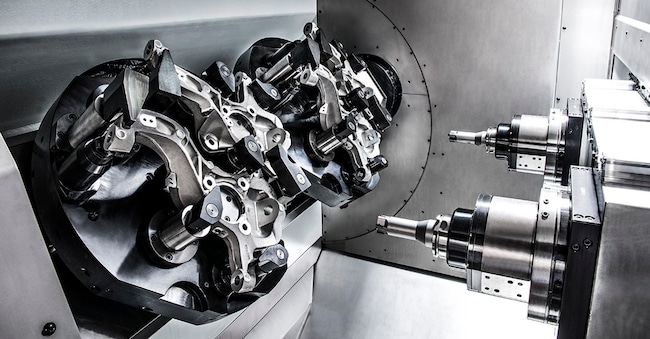
An average age that is falling, with more technologically advanced equipment, acquired largely thanks to government incentives.
These are the main conclusions of the survey carried out by Ucimu within the national manufacturing sector, an analysis conducted amongst more than 2,000 companies to assess the age, quality and quantity of installed machine tools. A key finding in this seventh survey is the drastic reduction in the average age of the more than 350,000 machines surveyed, which has fallen by over three years compared with the previous survey in 2019 and also that of 2014, bringing the average to 11 years and two months. This rejuvenation has been accompanied by a technological upgrade, measured primarily by the proportion of numerically controlled machines, which now accounts for 52 per cent of the total. However, the most significant increase compared with the previous survey concerns interconnectivity, attributable to the Industry 4.0 and 5.0 transformations: the proportion of machinery with digital interconnectivity has reached 24.1 per cent, more than four times the figure from the previous survey. A key factor in the renewal of machinery was the package of incentives introduced by successive governments, including the Industry 4.0 and 5.0 tax credits, hyper- and super-depreciation schemes, the Sabatini Law and the ZES tax credit. Overall, 72 per cent of the companies surveyed stated that they had made use of some form of incentive: the 4.0 tax credit (62 per cent) and the Sabatini Law (46 per cent) proved to be the most popular measures. Whilst the data confirm the established pattern in geographical terms, with Lombardy (27.9 per cent), Triveneto (19.9 per cent) Emilia-Romagna (14.9 per cent) and Piedmont (14.3 per cent) accounting for the lion’s share of machinery, the sectoral analysis, however, reveals a substantial shift, with the transport sector experiencing a sharp decline, particularly in motor vehicle production. Here, the number of machine tools has more than halved, from 67,000 units in 2019 to 30,000 today. In contrast, the star of the period is the aerospace sector, which has seen the number of machines in use rise from 1,500 units in 2019 to 8,500 in this survey. In general, however, a comparison with the 2019 survey highlights significant progress. ‘Metalworking companies,’ explains Ucimu President Riccardo Rosa, ‘have updated their machine tool and robot fleets and have embarked on a decisive digital transformation of their facilities. The results also show that, in the long term, the continued availability of these measures allows for more effective investment planning: incentive policies have brought great benefits to the renewal of the industrial system. In light of this, and given the new challenge posed by Physical AI – which is now affecting all manufacturing sectors – we call on the government to consider extending the measures currently in force to support the forthcoming transformation of the country’s factories. ‘The hyper-depreciation scheme, currently in force until September 2028, is therefore a positive step, but we need to start thinking about the future now because we are facing a new technological leap.’ ‘The data show that sustained growth,’ observes Confindustria Vice-President Antonio Gozzi, ‘stems from the continuity of industrial policies’. Meanwhile, explains Marco Calabrò, head of the Department for Business Policy at the Ministry of Economic Development (Mimit), the current ‘Measure 5.0’ scheme has attracted over 32,000 projects totalling 9.2 billion in investment, ‘exceeding expectations’.
However, what is causing concern amongst machine tool manufacturers is the rapid pace of change in the automotive sector – the industry’s largest customer – which is clearly struggling in the face of the technological transition brought about by the new EU regulations. “With the transformation of the automotive sector,” adds Rosa, “the metalworking industry is losing a significant part of its business. For this reason, once again, we draw the European Union’s attention to the need to uphold the principle of technological neutrality.”

