
India a candidate for the new centre of gravity of the world
From the Gulf to Imec, oil, diaspora and trade corridors shift the axis towards New Delhi. Sapelli reads the Indian rise as one of the great trajectories of the new world order

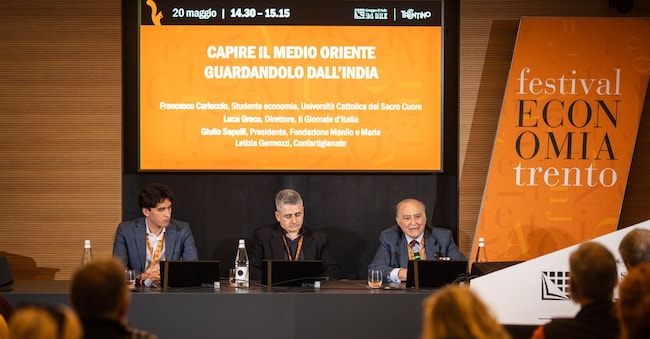
Today it is a seemingly silent giant, but India is destined to become a hegemonic power. Certainly not immediately, but in fifty years time it may be so. At least according to Giulio Sapelli, economic historian, former professor at the University of Milan, president of the Manlio and Maria Letizia Germozzi Foundation of Confartigianato. A scholar accustomed to reading economic facts in the long run of history.
It is from this depth of vision that, in the panel 'Understanding the Middle East by looking at it from India' at the Trento Festival of Economics, Sapelli proposed a clear key: to understand the Middle East, one must also look at it from New Delhi. Because India is no longer a periphery of the world but one of its next centralities. With him were Luca Greco, editor of the Giornale d'Italia, and Francesco Carluccio, an economics student at the Università Cattolica del Sacro Cuore.
Carluccio, who was born in 2005, had already been a speaker at the Trento 2025 Festival in the panel 'The return of the non-aligned, starting with India', after being selected among the winners of 'Le Voci del Domani'. This year he returned to the same thematic axis, shifting his gaze to the Middle East.
Introducing the topic was Greco, starting with numbers. India is the first country in the world by population: around 1.4 billion inhabitants, 17% of humanity. It still has a GDP per capita that is far from that of the West, but it has numbers, industry, a middle class and political ambitions that make it unattainable. Greco called it 'a silent, seemingly silent giant' and 'an important geography to understand'.
Sapelli picked up the theme by rejecting a word that is abused today. 'I will never use the term geopolitics,' he said. He prefers to speak of 'international relations': power, economy, routes, states, ruling classes, domestic politics shaping foreign policy. The world, for him, has entered 'a great transformation of the weight of economic and geostrategic relevance'. Asia returns to the centre after the Western interlude. 'We are back to before the 18th century'.


