
Industrial decarbonisation: a comparison of three Italian cases

The Italian manufacturing and construction sectors account for 12.7 per cent (ISPRA 2024 data) of national greenhouse gas emissions. The path towards climate neutrality involves a range of technological solutions: from on-site solar power generation to thermal storage, from reused batteries to certified energy supplies. Enel has developed an approach that adapts to the production context of each sector: not just energy supply, but the co-development of technological solutions. Three recent case studies demonstrate its practical application.
The pressure of targets: what Europe is asking of industry
According to ISPRA data, emissions from Italy’s manufacturing and construction sectors fell by 49.9% between 1990 and 2024: a significant achievement, but not enough. In 2025, according to ENEA’s annual analysis, Italy’s total emissions remained stable: to meet the targets of the Integrated National Energy and Climate Plan (PNIEC) by 2030, the country would need to reduce them by 6 per cent each year.
The European regulatory framework, from the Fit for 55 package to the European Climate Law, sets a target of climate neutrality by 2050 and increases the pressure on energy-intensive sectors. The government has responded with the Transition 5.0 plan, which allocates €4.3 billion for digitalisation and the decarbonisation of manufacturing.
In this context, industrial decarbonisation cannot be limited to simply switching energy suppliers: it requires structured strategies. Enel offers companies multi-tiered decarbonisation pathways.
The Rummo case: solar power for self-consumption
One project that stands out is the partnership between Enel and Rummo, a long-established agri-food company based in Campania. The agreement provides for the construction of one of the largest photovoltaic systems for industrial self-consumption in Europe: approximately 15,000 modules produced by 3Sun, the Enel Group’s Gigafactory in Catania, using proprietary HJT CORE – H® proprietary technology, for a total capacity of 9 MWp. Estimated annual production, between 15 and 17 GWh, will cover 65–75 per cent of the energy requirements of the Benevento plant, with an estimated reduction in emissions of between 3,500 and 4,000 tonnes of CO₂ per year. Pending full operational capacity, Rummo has already secured a 100% renewable energy supply for the two-year period 2026–2027, with the aim of completely decarbonising the production site within five years.
Sand thermal storage: the first industrial application in Italia
The MGTES system (Magaldi Green Thermal Energy Store), developed by Magaldi in collaboration with Enel, stores renewable energy in the form of heat within a bed of silica sand and releases it as medium-temperature steam (120–400°C), thereby reducing gas consumption in production processes. This is the first instance in Italia of thermal storage applied on an industrial scale. The plant, built for the food company I.GI, a supplier to the Ferrero Group, in the Buccino (SA), has a capacity of 7.5 MWh and, according to Enel data, covers around 15 per cent of the company’s thermal requirements and reduces CO₂ emissions by 500 tonnes per year. The system also contributes to grid stability by offsetting the intermittency of renewable energy sources.
Second-life batteries: the Pioneer project in Fiumicino
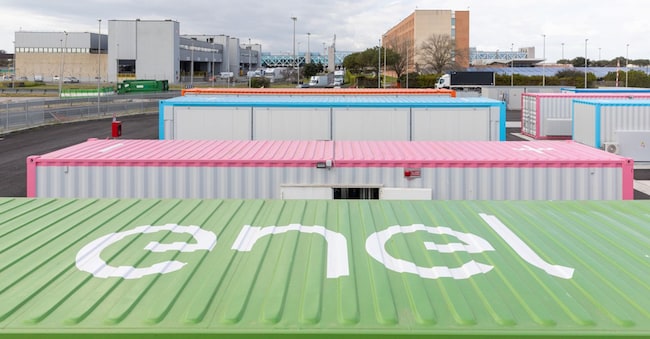
The Pioneer project, launched in May 2025 at Leonardo da Vinci Airport in Fiumicino, is the largest storage facility in Italia powered by second-life batteries: 762 end-of-life batteries from three major car manufacturers, integrated into a single system using advanced optimisation software. Developed by ADR - Aeroporti di Roma and co-funded by the European Commission under the Innovation Fund, Pioneer is connected to the existing solar power plant alongside runway no. 3, forming the largest self-consumption hub of its kind in Europe. According to Enel figures, the estimated savings amount to 16,000 tonnes of CO₂ over ten years.
Projects of this kind, such as energy storage systems like MGTES and Pioneer, also address another key issue in the energy transition: the intermittency of renewables, helping to offset it whilst simultaneously providing flexibility services to the grid, thereby helping to ensure the stability of the electricity system.
Industrial decarbonisation becomes a competitive advantage
Photovoltaics, thermal storage, second-life batteries: different solutions for different contexts, all converging on a common goal: a measurable reduction in emissions and greater control over energy costs. For Italian businesses, access to renewable energy – which can be certified for ESG reports and quantified in carbon footprint assessments – is an increasingly important factor for competitiveness in international markets and access to capital. 2030 is not far off: companies that are building structured solutions today are in a stronger position than those who still do not see the transition as an opportunity.

